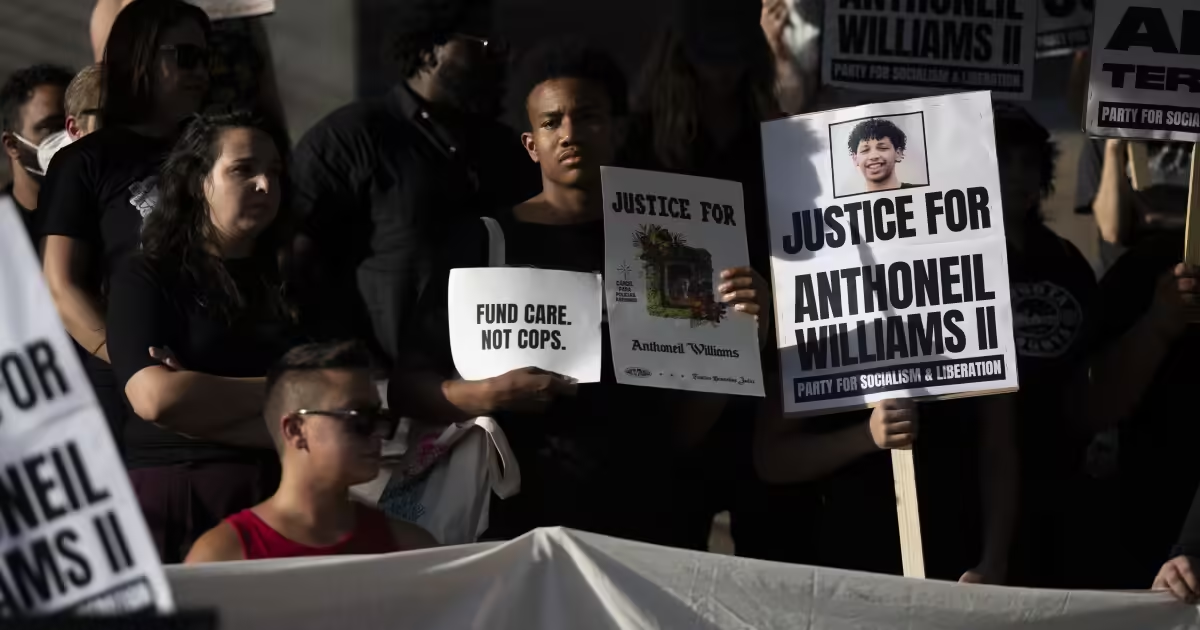

The fatal shooting of 17-year-old Anthoneil Williams II in July was characterized by the Austin Police Chief Lisa Davis as a likely “suicide by police.” But Austinites came out in droves to protest the shooting, questioning the use of force and arguing the department should better handle cases involving mental health crises.
While that shooting is under investigation by APD, the department told KUT that it’s working on bolstering its training and communications to better deal with calls involving potential mental health emergencies — and avoid these types of shootings going forward.
Call and response
The July incident started with a call — a 911 call APD said was placed by Williams — that said a suspect was in a park with a gun.
Chuck Wexler, head of the Police Executive Research Forum (PERF), a national thinktank that provides training for law enforcement, said the 911 call is a crucial part of any incident. It dictates the tone of how officers will respond, and it gives them key information before heading to a call. Wexler helped draft PERF’s industry-standard training for so-called “suicide-by-cop” calls.
“Our whole purpose of our this training … is to try to prevent this tragedy from happening, that if you can somehow get dispatchers to ask the questions, to try to figure out … if they are suicidal,” Wexler said.
Seth Stoughton is a former police officer and a criminologist at the University of South Carolina. He previously testified in the trial of Christopher Taylor, a former Austin police officer who fatally shot Mike Ramos in 2020. Stoughton says the officers responding to Williams’ call got the key information you’d expect. But he points out the dispatcher asked Williams a simple question, one that has far-reaching implications: whether the suspect was “brandishing” a gun.
“A lot of people don’t know what ‘brandishing’ means, or if they do know what ‘brandishing’ means, they’re not going to be necessarily using ‘brandishing’ in the same way as as as the police or a dispatcher,” he said.
Williams’ call was not flagged as a mental health-related, and officers did not know he was unarmed. In videos released after the shooting, three officers are seen responding Williams, who is by a playscape. As officers approach him, Willams reaches for his waistband. They fire. Williams was carrying only a water bottle.
Stoughton didn’t say whether the officers responding to this incident were unreasonable or whether their actions were illegal, but he said the use of “brandishing” may have put them more on-edge.
It’s a phenomenon called “dispatch priming” — when information relayed to officers colors how they may react to a call, Stoughton said. It’s a necessary part of being a cop, and it saves lives. But if the information is wrong or incomplete, it can lead to bad outcomes.
“I would expect a dispatcher to ask a more open-ended question there, not to supply the terminology that someone may not know,” Stoughton said.
Wexler wouldn’t comment on the Williams shooting, but he said there are always variables in these situations. It’s never clear whether an incident like this was planned or spontaneous until after the fact, he said.
“This kind of behavior, this kind of phenomenon, happens, and you frequently don’t realize it until after it happens,” Wexler said.
Looking ahead
APD Assistant Chief Angie Jones said the shooting is “heartbreaking for our community,” and APD is looking to the incident for lessons going forward. The officers involved were placed on administrative leave.
As for solutions going forward, Jones said the upcoming transition of APD’s 911 call center to a civilian-managed model provides an opportunity to improve call takers’ performance. While the department has quality assurance reviews under APD’s management, they’re done on an ad hoc basis. The civilian-run model would have a manager tasked with consistent quality assurance on calls, Jones said.
“That will allow a much deeper dive into our quality assurance of our call takers, of our dispatchers, how things are operating,” she said. “Not only are we answering calls at the right time, but are we routing calls appropriately? So this supervisor position, this manager position … it will have great outcomes.”
As for the officers’ response, Jones said the department has been using PERF’s training on how to avoid “suicide-by-cop” situations since its inception. Cadets at the Austin Police Training Academy simulate situations involving people having mental health crises, and they practice de-escalation. Jones said the department is also expanding training at the academy for both active listening and crisis intervention and requiring that training for all officers.
“That’s going to look at … these situations where we have time,” Jones said. “Can we slow things down, earn trust, gain understanding and build rapport with people before attempting to change their behavior?”
Jones said drones could be another possible solution to avoid officer-involved fatalities in the future.
The department uses drones in specialized units, but since at least last year, APD has been weighing deploying the technology to individual patrol units. An internal memo from obtained by KUT called drones “the future of policing” and said they “could be a worthwhile investment to the police department.”
Jones said a drone’s-eye view in any situation would be helpful to avoid officer-involved critical incidents.
“Those drones will … have an operator that will be able to see what’s happening and then tell the officers that are on standby close by … what they see,” she said. “So it gives us a different perspective, and we’re really looking into those types of technologies and advancements.”
Using “drones as first responders,” Jones added, could also help alleviate pressure on the understaffed department.
Source: www.kut.org