



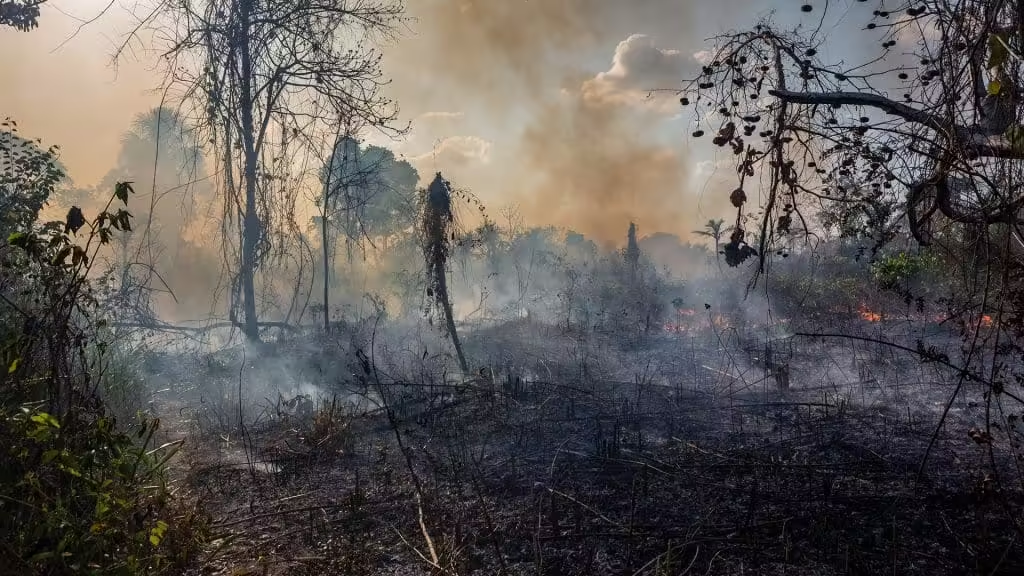

The European Space Agency is committed to harnessing the power of space to protect life on Earth from environmental crime
Environmental crime is a global and growing threat, encompassing illegal activities that damage ecosystems, exploit natural resources, and undermine environmental laws and regulations. From illegal deforestation, mining and fishing to wildlife trafficking, pollution and waste crime, these activities can cause lasting harm to biodiversity, communities, public health, and economies.
Detecting and tackling environmental crime is particularly challenging because illegal activity often takes place across vast, remote, or difficult-to-access areas and can span multiple countries and supply chains. Space-based technologies offer a powerful way to overcome these challenges. Satellites can provide wide-area, repeatable, and independent observations of the Earth, helping organisations identify changes in land and sea, monitor environmental impacts, track assets and supply chains, and generate evidence that can support investigations and enforcement.
By combining Earth observation, satellite communications and global navigation satellite systems with advanced data analysis, space-enabled solutions can give governments, law enforcement agencies, and businesses a clearer picture of environmental activity, helping them move from reactive detection towards earlier identification, monitoring, and prevention. The European Space Agency (ESA) is supporting innovation in this area by helping European businesses turn space technologies into practical services that address real-world environmental crime challenges.
To learn more about ESA’s work in this area, as well as its upcoming funding call, The Innovation Platform spoke with Liz Barrow, Business Applications and Partnerships Officer at the European Space Agency, and Emma Howell, Content Editor in the Directorate of Commercialisation and Industry Partnership, ATG Europe for the European Space Agency.
Why is environmental crime a key priority for ESA?
Environmental crime is the world’s fourth-largest criminal enterprise and a critical global challenge that severely impacts ecosystems, public health, and the economy.
It accelerates biodiversity loss and ecosystem collapse through deforestation, illegal mining, poaching, trafficking and unlawful fishing, pushing species and ecosystems to the brink of extinction. As a result of this threat, regulations have tightened. Under the EU’s Environmental Crime Directive, companies failing to comply will face severe fines that reach up to 10% of their total global revenue.
Tackling environmental crime poses significant challenges as this multi-billion-dollar trade involves organised crime, global trafficking routes, and international finance. In addition, the use of digital platforms and social media channels gives crime syndicates unprecedented access to markets: buyers can now simply click and pay for ivory, tiger cubs, orchids, and pangolin scales.
This global problem requires a collaborative global solution, and using space-based technologies to fight environmental crime opens doors to advanced technological responses.
The European Space Agency is committed to using the power of space to protect life on Earth and supports European businesses to design, develop, and demonstrate innovative solutions which benefit society and support the UN Sustainable Development Goals.
Between 2020-2025, over 66% of ESA Business Applications and Space Solutions activities directly impacted the green transition, and ESA contributed 60% (around €128m) of funding, with 40% (around €86m) from industry.
How does ESA use space-enabled tracking to monitor illegal environmental activity?
Space-enabled technologies are already widely used in the fight against environmental crime as they offer unique capabilities for identifying, monitoring, and tracking illegal activity.
Satellite Earth observation data can be used to analyse land cover, soil, and vegetation parameters, identifying anomalies, hotspots, or landscape scars across broad regions. It can provide observations of atmospheric instability, tracking greenhouse gas footprints, smoke plumes, and trace gases, as well as mapping forest canopy structures to build unalterable environmental baselines.
Satellite communication ensures reliable communication in remote or otherwise under-connected regions. It facilitates continuous monitoring and reporting via data transmission, even when terrestrial communication networks are unreliable or do not exist.
Global navigation satellite systems enable the secure tracking and tracing of goods to increase supply chain transparency and regulatory compliance.
Using space-based technologies provides organisations with repeatable, reliable data at scale, making them invaluable in advancing current methods of tracing, tracking, and preventing environmental crime.
How do ESA’s programmes in this field support law enforcement or policymakers?
ESA bridges the gap between commercial innovation and public sector needs by funding the development and real-world deployment of services that use satellite data.
ESA provides zero-equity co-funding to help businesses develop and scale their solutions. Law enforcement teams, public sector clients, and commercial entities can test, trial, and pilot these services completely risk-free during the project. If the solutions successfully resolve their operational challenges, they can eventually choose to become long-term customers.
Space assets provide independent and unalterable data at scale in a way that traditional ground-based monitoring simply cannot match. ESA requires bidding teams to access and process satellite data self-sufficiently. This means that policymakers and other users gain access to reliable auditing tools to verify compliance and see the real impact that environmental policies are having on the ground.
What funding initiatives does ESA offer to support innovation to help prevent environmental crime?
On 19 October 2026, ESA is launching the environmental crimes funding call for proof-of-concept and pilot projects to proactively detect, monitor, and verify environmental crime risks, and encourages European businesses to apply. ESA offers zero-equity co-funding, technical and commercial guidance, access to our network, partners and taskforce members, and ESA brand credibility.
The environmental crimes funding call is for space-based applications and services focused on the following areas: integrity and corporate fraud; poaching and wildlife; illegal fishing and marine activities; illegal mining and quarrying; and waste and pollution.
How does ESA collaborate with other organisations and institutions across the globe on the issue of environmental crime?
ESA works closely with organisations to ensure that funding is used to address real-world challenges where satellite-based solutions have potential to make a significant impact.
The environmental crimes call has been designed in collaboration with leading environmental organisations, including IFAW (the International Fund for Animal Welfare), WWF (World Wide Fund for Nature), TRAFFIC (Trade Records Analysis of Flora and Fauna in Commerce), and INTERPOL (International Criminal Police Organization). Working with ESA, the most critical use cases were identified where reliable and verifiable data is essential.
Please note, this article will also appear in the 28th edition of our quarterly publication.
Source: www.innovationnewsnetwork.com