




Three people crossed a two-lane street between a hotel and a gas station in Southgate around 1 a.m. on a Tuesday in June. Officer Alexander Zielinski waited for them to cross back to the hotel parking lot, where he stopped them for jaywalking.
The officer asks all three for identification. Two young, Spanish-speaking men provided some form of identification. The middle-aged white woman told Officer Zielinski her ID was in her wallet in her hotel room.
She was issued a citation and returned to the hotel.
The two men faced a very different fate.
Body-worn camera footage obtained by Michigan Public shows Zielinski and three other Southgate officers surrounding the men for about half an hour until Border Patrol agents arrest them.
It is generally not considered legal for police to stop people based on their race or language.
“Instead, they look for some technical violation, often of traffic code, to give them that legal justification to make that stop,” said Stephen Rushin, a law professor at Loyola University Chicago. So-called “pretextual stops” are a generally legal tactic for police.
This is one of several hundred incidents uncovered by Michigan Public and Outlier Media in which local police turned people over to immigration enforcement after minor stops for things like broken tail lights, tinted windows, jumpstarting a truck or sleeping under a tree.
Experts who reviewed some of these cases say they carry “hallmarks” of pretextual stops.
For Thaddeus Johnson, a senior fellow at the Council on Criminal Justice and former Memphis police captain, the Southgate jaywalking stop was particularly “disturbing.”
“Jaywalking has been one of those things that officers [have] used as pretextual grounds,” he said.
Pretextual stops provide what Johnson called an “opportunity” to perform a “visual frisk,” ask questions, and investigate further. “It was never about the jaywalk,” he said.
“Two of them don’t speak English”
The woman, who is not identified by name in police reports, told police the men had bought tequila at the gas station. She’s holding a clear plastic cup full of a dark-tinged liquid that sloshes around as she talks.
“Two of them don’t speak English,” Zielinski tells dispatch when he calls. The audio of his conversation with dispatch is redacted. “Dispatch was advised and subsequently contacted CBP,” Zielinski wrote in his written report.
Police have a hard time communicating with the men, who only speak Spanish. In the bodycam footage, they deny drinking.
“No huele, no estamos” one said, motioning for the officer to smell his breath.
“I’m far from concerned about their drinking,” Officer Zielinski said to a fellow officer.
It appears the main concern is the immigration status of the two men.
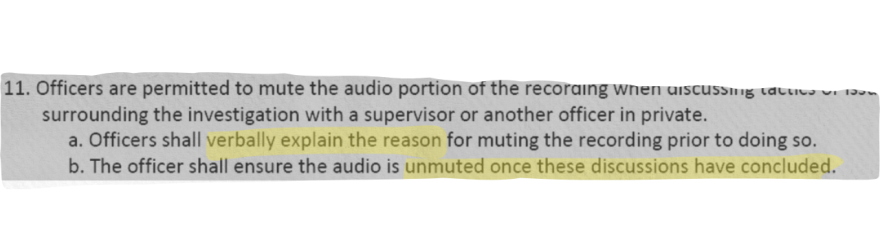
One of the officers uses a translation app to communicate with them. The body-worn camera footage does not shed a lot of light on what was discussed since it was either redacted by records staff, or manually muted by officers during the stop. One of the officers’ cameras was muted for almost the entire stop.
This appears to be a violation of Southgate Police Department’s policy, which only allows officers to mute their body-worn cameras when discussing tactical or investigative matters and then unmute as soon as that portion of the conversation has ended.
While the woman is let go with a citation, the men are surrounded by officers while they wait for CBP agents to arrive on the scene.
“You can only imagine the look on my face when I saw all three of them cross the street the first time,” Officer Zielinski said. “I was like, that don’t make sense.”
“Like a kid on Christmas morning right there,” another suggests.
Southgate Chief of Police Mark Mydlarz did not return numerous calls and emails requesting a response to this incident. Michigan Public also reached out to the mayor of Southgate, city administrator, and members of city council but did not receive responses.
Experts say proving a stop was pretextual is nearly impossible unless an officer admits it.
“I caution against broad-brushing all these cases,” said Ron Wiles, executive director of the Michigan Association of Chiefs of Police.
Wiles declined to review any cases, but said he assumes “that [officers] didn’t have some ulterior motive behind stopping those people.”
If officers are making pretextual stops to catch immigrants, Council on Criminal Justice fellow Thaddeus Johnson said that could be a drain on local resources and community trust.
“It’s the cost of time… and how officers could be spending their time more productively and proactively reducing crime and servicing citizens,” he said.
Southgate police called Border Patrol at least two other times this year, after apparently having no such calls during the five years prior.
![A screenshot of a redacted police narrative document with three text excerpts enlarged and overlaid for emphasis. " The first enlarged excerpt reads: "I ran the vehicle's license plate [redacted] through LEIN which showed [redacted] also observed an air freshener tree hanging from the rear view mirror." The second enlarged excerpt reads: "[Redacted] used a translator app to inform me he did not have a drivers license nor insurance on the vehicle. I also observed a front right passenger who was identified as [redacted] and the rear left [redacted] by their Guatemala ID's." A third highlighted box at the bottom, labeled "BORDER PATROL," reads: "I contacted DCD to notify Border Patrol of our traffic stop."](https://npr.brightspotcdn.com/dims4/default/1223ca3/2147483647/strip/true/crop/1024x576+0+0/resize/840x472!/format/webp/quality/90/?url=http%3A%2F%2Fnpr-brightspot.s3.amazonaws.com%2F92%2F48%2Fe9d7d92b4714aed1000976353b28%2Fcopy-of-white-grey-black-minimalist-modern-simple-trendy-a-productive-day-in-my-life-youtube-thumbnail-1.gif)
Southgate Police report obtained via Freedom of Information Act request. GIF by Adam Yahya Rayes/Michigan Public
In one, officers ran a car’s plate through their system but “also observed an air freshener tree hanging from their rearview mirror.” After the driver and passenger provided only Guatemalan IDs, police advised dispatch about the stop, and CBP showed up to arrest two people.
In another, an officer stopped a vehicle for a license plate violation and directly asked if the driver or passenger were in the U.S. illegally.
During the jaywalking stop in June, CBP agents handcuffed and searched the men before taking them into custody.
As agents walked the two men towards a Border Patrol vehicle, the agent thanked local officers for the call.
“Honestly, this went way better than the last time I called,” Officer Zielinski replied.
Michigan Public was unable to find out what happened to the men after they were taken into Border Patrol custody.
Outlier Media’s Koby Levin contributed to this story.
Source: www.michiganpublic.org