



Unlock the Editor’s Digest for free
Roula Khalaf, Editor of the FT, selects her favourite stories in this weekly newsletter.
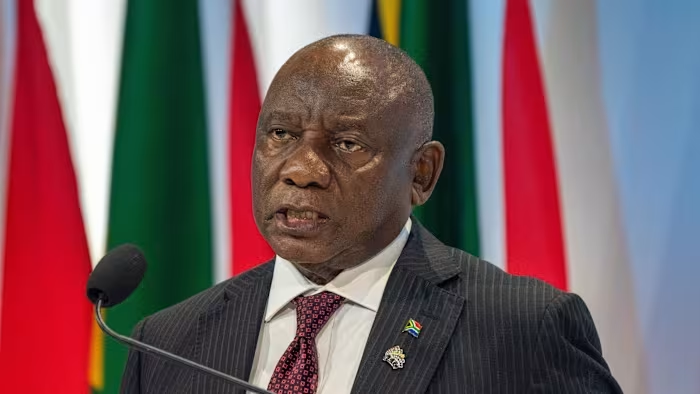
South Africa’s President Cyril Ramaphosa has said the country will seek to expand its trade with nations including China and India to protect against deteriorating relations with the US.
South Africa is the largest beneficiary of the US’s African Growth and Opportunity Act (Agoa), which provides eligible sub-Saharan African countries with preferential access to the US market.
While Washington has renewed the agreement until 2028, Ramaphosa told journalists on Monday that he was searching for alternative markets over concerns that South Africa could lose its benefits under the deal.
Ramaphosa and his deputy had “been going on trips around the world to see where we can open up markets, and soon we’ll be going to other parts of the world”, he said at a briefing.
“We have had with China, not only as South Africa but as a continent, the opportunity to be able to export our goods on a tariff-free basis,” he said, referring to Beijing’s decision in May to extend zero-tariff treatment to qualifying imports from African countries.
South African apples and wine were among the first products to enter China under the new scheme.
Relations between Pretoria and Washington have deteriorated dramatically under President Donald Trump, with the US administration attacking South Africa over its Black economic empowerment policies, its case accusing Israel of genocide at the International Court of Justice and its ties with Iran.
Pretoria’s land reform laws — which the US president falsely claims are part of a “genocide” against white Afrikaners — have drawn particular ire.
Ramaphosa also pointed to India as another potential export market, as the two countries this year revived talks over a preferential trade agreement after a decade of stalled negotiations.
He added that his government was in trade negotiations with the US but was preparing for the possibility that it could ultimately be excluded from Agoa.
“We are not the first and only country to be taken out of Agoa, and I believe we will not be the last,” he said, while acknowledging that it could nevertheless be “devastating” for jobs.
South Africa exports billions of dollars’ worth of duty-free agricultural goods and vehicles to the US under Agoa, directly supporting tens of thousands of jobs in a country where one in three is unemployed.
Legislation introduced in Congress last year has called for a formal review of the US-South Africa relationship, raising fears that Pretoria could be excluded from the trade pact before its scheduled renewal in December 2028.
Shifting exports to alternative markets will not be straightforward, particularly for South African businesses that have built supply chains around exporting wine, vehicles and other goods under preferential access to the US.
Ramaphosa’s comments nonetheless reflect how Trump’s trade policies are accelerating a shift by African countries towards China, which is already the continent’s largest trading partner, as governments seek more predictable markets for their exports.
Last year, garment exporter Lesotho was threatened with a 50 per cent US tariff — the highest imposed on any country in the world at the time — while South Africa faced a 30 per cent levy. Although Washington subsequently reduced some rates, uncertainty over the future of Agoa has prompted exporters to explore alternatives.
China is also deepening bilateral trade ties with other nations, signing an agreement with Kenya in March to grant duty-free access while Nairobi agreed to further open its market to Chinese goods.
For the past decade, South Africa’s economy, long sub-Saharan Africa’s most industrialised, has on average expanded by about one per cent a year — barely above population growth.
Ramaphosa defended the pace of his government’s economic reform programme, arguing that turnarounds in key sectors — including stabilising electricity and improving logistical blockages — had revived business confidence but would take time to translate into faster growth.
“Many businesses lost confidence, and we are now regaining that confidence,” he said.
The government was also looking at building a deepwater port near the Namibian border at Boegoebaai — in the impoverished but mineral-rich Northern Cape — which Ramaphosa cited as an example of infrastructure projects that would be “the flywheel of our economic growth process”.
Source: www.ft.com