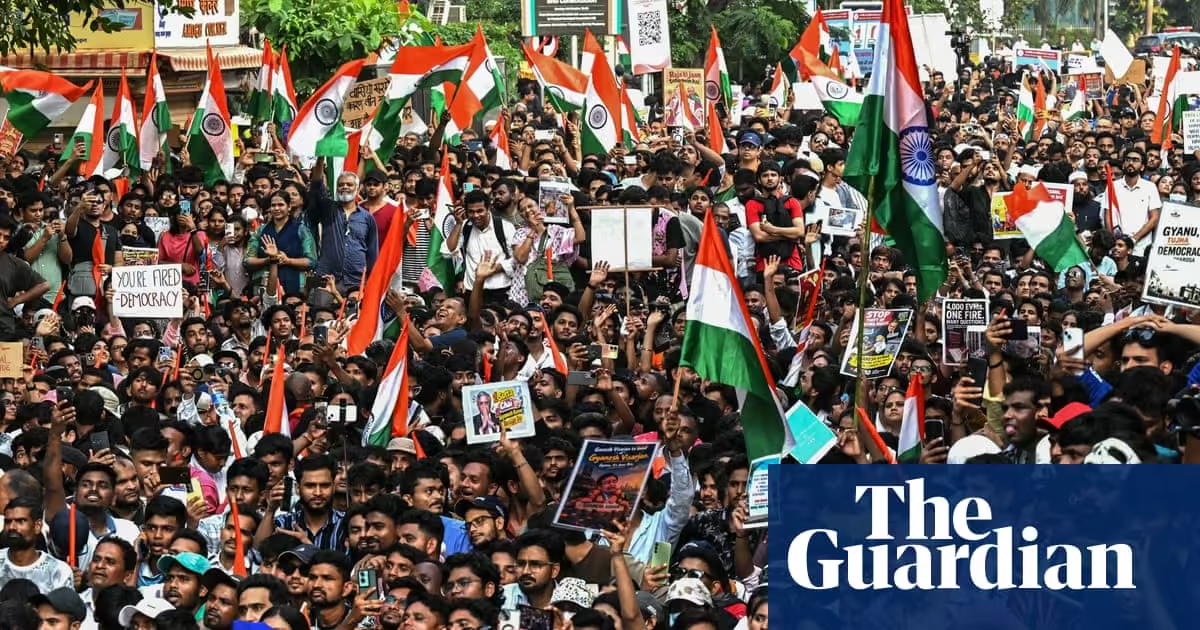

Months of simmering public anger have given rise to a season of discontent in India. In its latest iteration, the demand is for the removal of chief election commissioner Gyanesh Kumar and the scrapping of a controversial electoral rolls revision that has struck 130 million people off the register. Protests have erupted every day over the past week, prompting a violent crackdown on dissenters in the capital.
Over the weekend, Delhi was effectively under lockdowntransformed into a militarised landscape of barricades, road closures and paramilitary forces marching through the streets. Ahead of a protest led by the Cockroach Janta party on Saturday, authorities deployed a massive dragnet: 245 trains to Delhi were cancelled, 45 metro stations were shut, liquor shops were closed, internet services were cut off in the heart of the city and activists were put under house arrest.
The founders of the Cockroach party were removed from an Air India flight shortly after it landed at Delhi airport on Saturday. Opposition leaders were held for more than eight hours in various police stations. Video footage showed students and activists being manhandled, beaten and dragged off the streets while some journalists were also swept up in the detentions. A supreme court lawyer assisting those detained was carried away by police, his shirt torn in the process. The crackdown extended to Mumbai, where Tushar Gandhi, the great-grandson of Mahatma Gandhi, was whisked away by the police to prevent him from participating in a local demonstration. On Monday, the Delhi police denotified Jantar Mantar as a designated protest site, instead recommending three alternative locations.
“I have been in public life and have watched politics for four decades now, and I have never witnessed this kind of preparation for a demonstration. It was extraordinary by any stretch of the imagination,” political activist Yogendra Yadav, who was also detainedsaid of Saturday’s crackdown. Despite what he described as “terror unleashed by the state”, he said, small groups staged flash protests in several areas of Delhi defying the heavy security presence.
The crackdown was preceded by similarly aggressive police action against Congress party’s protests, led by Rahul Gandhi. Dramatic images of police personnel detaining Gandhi and his sister, Priyanka, amid scenes of chaos flashed across screens nationwide.
The ruling Bharatiya Janata party has defended its position, with spokesperson Ravi Shankar Prasad accusing the opposition of weaponising protests after electoral defeats. “One, Indian democracy has thwarted attempts to incite anarchy. Two, the country will be governed by parliament, not by the streets,” he said at a news briefing.
While suppression of protests is not new, what stands out this time is the scale of the crackdown in the capital. Government clampdowns in Indian-administered Kashmir have been far more severe, particularly in 2019, when sweeping restrictions were imposed after the revocation of Article 370.
The ferocity of the state response reflects the high political stakes for Prime Minister Narendra Modi’s government, which faces mounting resistance over the Special Intensive Revision (SIR) and questions about the credibility of the electoral process.
The latest protests began with a demand for Kumar’s resignation after an Indian Express investigation reported that the ECI’s two other commissioners, Sukhbir Singh Sandhu and Vivek Joshi, had raised concerns about changes to electoral rolls, registration procedures, and digital systems. While Kumar has not responded to the investigation, the ECI said in a statement that “differing views” were part of the “decision-making process”. But the anger runs deeper. The SIR exercise has faced criticism for putting citizens through a trial by fire and leaving the most marginalised in a Kafkaesque limbo. Critics and opposition leaders have gone further, charging that the exercise was designed to benefit the ruling regime.
Former election commissioner Ashok Lavasa told me that the SIR process is unprecedented and unfair, marking a departure from the Commission’s traditional emphasis on inclusion. “For more than seven decades the ECI took it upon itself, as a duty, to enrol everyone who was eligible to vote. And that was one of the basic differences between how Indian democracy works and how other democracies function, where you need to apply to get enrolled,” he said. Voters accustomed to a “friendly procedure” now face a hostile system, which he said “is not good for democracy” in the long run.
Yadav argued that the SIR controversy has exposed what he describes as a deeper process of democratic capture by the ruling party. “Elections are the only mechanism now left for the regime to stamp its legitimacy and election capture is critical to their survival. And therefore, Gyanesh Kumar is critical,” he said. He pointed to a 2023 law giving election commissioners legal immunity for actions performed in their official capacity, which he said is broader than even the protection afforded to judges.
As to what comes next, he envisions potential for three strands to find common ground: the opposition parties, organised civil society groups, and ordinary citizens. For a government that has shown no sign of budging yet, he said, the calculus will get harder. “The longer they delay, the higher the stakes.”
On Monday, the Keralam assembly passed a resolution seeking Kumar’s removal, as opposition parties marched toward the supreme court demanding action against him. And the Cockroach movement and leftist student groups have vowed to continue protesting. “People have refused to be fearful any longer. They will come again and again,” said left-wing student leader, Danish Ali. “We are living in a democratic country, and protest is a fundamental right that no one can snatch away from us.”
What else we’re reading about
Human rights | South African jurist and former international criminal court judge, Navi Pillaywho is of Indian Tamil heritage, has won the 2026 Nobel Peace Prize. In a first-person account published in 2023she wrote about her grandparents, who came from India and worked on a sugarcane farm in South Africa for five years before being allowed to buy land.
Technology | The United States has suspended labour-certification processing for several major technology companies, including top Indian IT firmsas part of a crackdown on what it alleges is a misuse of its flagship green card program, fraud and the displacement of American workers. The impacted companies include Cognizant, Infosys, Tata, Wipro, HCL, Capgemini, Microsoft and Adobe. “We will not accept any new or process any pending permanent labour certification applications involving these companies,” the US labour secretary Keith Sonderling announced last week.
Climate| Citing a significant rainfall deficit linked to the El Niño weather phenomenon, the Maharashtra government last week announced water cuts of at least 10% across urban areas starting 16 October. The state government had previously declared drought conditions in 74% of the sub-districts.
Guest shelf
A recommendation from someone with great taste
after newsletter promotion
With Delhi in the news for all the wrong reasons, I turned to Mayank Austen Sufiwho writes a daily Delhi column for Hindustan Times, to share a spot he returns to for a moment of reprieve. “Whenever I can, I spend a solitary afternoon at the tiny Sufi shrine of Hazrat Sarmad Shaheed, beside the Jama Masjid mosque. The bazaar outside the shrine is the Walled City’s noisiest quarter, yet inside one can sit in silence beneath the neem tree growing beside Sarmad’s grave. An Armenian Jew from Iran, Sarmad fell in love with a Hindu boy in Sindh, eventually became a naked fakir and settled in Mughal Delhi. Executed by Emperor Aurangzeb, his grave lies beneath a red cloth that recalls his blood-soaked beheading. These days, I linger a little longer at the resting place of a man who would just not submit to power.”
Count it
A number worth knowing
32
At least 32 children from the Indigenous community in Balaghat, Madhya Pradesh, have died since June, the Indian Express reported. An inquiry found evidence of measles and malaria. The children, aged between one and 13, experienced symptoms including high fever, skin rashes and abdominal pain.
Vibe check
For Mumbai-based cinematographer, Arbab Kamal Khanthe fleeting, unguarded moments of everyday life offer the most honest form of documentation. His Instagram account is an extension of this cinematic vision, capturing the languor of slow days, the beauty of the mundane and the quiet air of romance.
“When someone passes away, we don’t remember the curated moments,” he told me. “We always go back to the little things, the moments that are small or intricate.”
For me, the images and videos featuring his parents – their feet across each other besides teacups resting atop an Urdu newspaper, or his dad resting under his wife’s dupatta as she brushes her hair – are particularly striking because older people are rarely afforded such tenderness in visual culture. In his frames, his parents are not only elderly figures but also lovers who continue to find intimacy in each other’s presence.
Get in touch
Do you have any thoughts or responses to this week’s newsletter? Is there anything you’d like us to cover in the future? Share your feedback by replying to this, or emailing us at [email protected] and we may include your response in a future issue.
Source: www.theguardian.com