





In a mountain village in the heart of Sardinia, Italy, something very special appears to be happening.
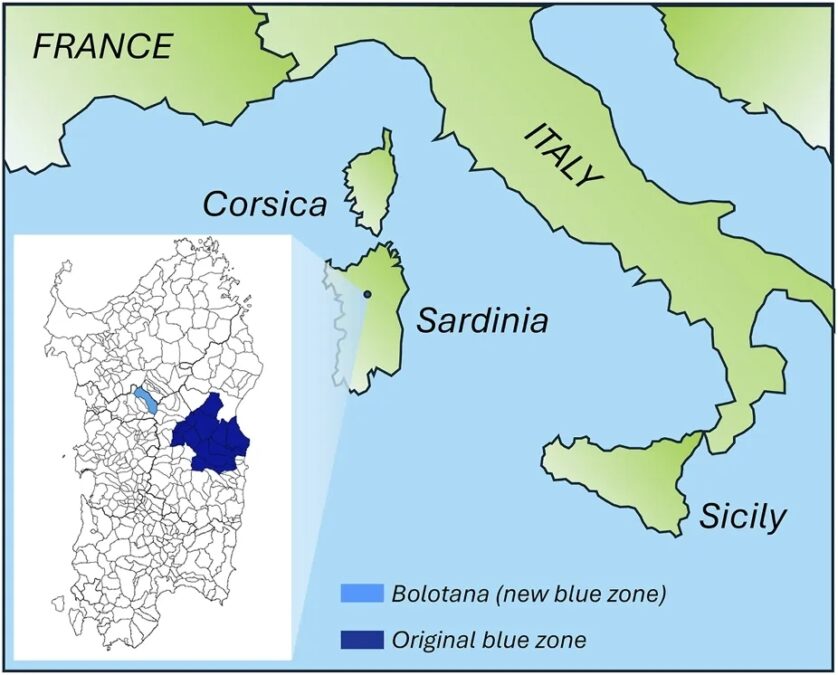
On the same island, roughly 20 years ago, scientists identified the world’s first so-called ‘Blue Zone’ – a geographical cluster in Sardinia where people demonstrated “extreme longevity”.
Now, in the small town of Bolotana, approximately 110 kilometers to the west of the original Blue Zone, researchers may have found another such site of exceptional longevity.
In a new study published in Frontiers in Agingscientists found evidence that women in particular in Bolotana tend to live extremely long lives.
Based on their analysis, which used demographic data from 2021–2025, an average 70-year-old woman in Bolotana has a remaining life expectancy of 20.85 years, compared with 18.61 years for Nuoro Province (in which Bolotana is located), 18.4 years for Sardinia overall, and 18.06 years across Italy.
Even more strikingly, though, the estimated probability of a 70-year-old woman in Bolotana living to 100 years of age is 13.83 percent, versus much lower chances elsewhere: 4.33 percent in Nuoro Province, 4.43 percent in Sardinia, and 3.54 percent for Italy as a whole.
“We think this is the longest-lived female population in the world, or close to it.” – epidemiologist S. Jay Olshansky
To put that into an international context, the researchers say the probability of a 70-year-old Bolotana woman surviving to 100 is more than three times the corresponding value seen in US women.
The overall life-expectancy-at–70 and survival-to–100 patterns for Bolotana women rank their longevity prospects as exceptionally high worldwide, second only to Hong Kong.
“We think this is the longest-lived female population in the world, or close to it,” says epidemiologist and study co-author S. Jay Olshansky from the University of Illinois Chicago.
“If we can identify the characteristics behind this longevity and help people adopt them, the rest of the world can benefit from understanding the values practiced by these communities.”
By contrast, men in Bolotana, while still long-lived, don’t demonstrate such an extreme pattern of longevity.
A 70-year-old man in Bolotana has “modestly higher” life expectancy (16.02 years), compared to the national Italian average (15.48 years), the researchers say.
Still, their chances of surviving from 70 to 100 are markedly better than those of their countrymen, with an estimated probability of 4.92 percent, more than three times higher than the national average of 1.41 percent.
An important caveat worth mentioning with the research is that, due to the small size of Bolotana’s population, the results of the analysis are highly sensitive to the years studied.
When the team shifted their focus to the years 2015–2019, the survival-to–100 estimate was just 1.46 percent for women, which is much lower than the 13.83 percent for the years 2021–2025. Life expectancy at 70, at 18.3 years, remained higher than the national average.
What initially drew the researchers’ attention to Bolotana (population: 2,266 during the study period) was the unusually high number of centenarians living in the small community – a group honored by a local website – but it’s not just the townsfolk’s longevity that is remarkable.
“What makes Bolotana extraordinary is that it has an incredible historical record that allows us to definitively evaluate ages at birth and death,” says Olshansky.
“The municipal and baptismal records date back centuries and allowed us to independently verify ages. Every single person that has made it past 100, we can validate. There is no ambiguity.”

As for what gives the women of Bolotana such long lives, it remains unknown, and the researchers acknowledge it was beyond the scope of their demographic analysis, but they suggest further individual-level studies could explore the potential biological, behavioral, and social contributors.
“Several mechanisms could plausibly contribute to the pronounced female survival advantage,” the researchers write in their paper“including genetic background, dietary patterns, physical activity, family support, social cohesion, continuity of residence, and access to care.”
The town’s environment could also play a role. Olshansky notes that residents live in a steep, hilly landscape, where most food is grown locally, and social isolation is rare.
“You’ve got this close-knit community where people take care of each other,” Olshansky says. “Movement is largely done by walking, not by driving.”
How much any of these factors contribute will have to be verified by future research, but now that Bolotana has been identified, there’s a good chance scientists will pay attention, especially since the study’s findings nominate Bolotana for consideration as a “candidate longevity Blue Zone”.
“We now know something extraordinary is happening in Bolotana,” says co-author and longevity researcher Dan Buettner, the founder of Blue Zones, Inc., a company that promotes and commercializes the Blue Zones longevity concept.
“The next step is to understand why and whether the lessons can help people elsewhere live longer, healthier lives.”
The findings are reported in Frontiers in Aging.
This article was fact-checked by Rachel Garner and edited by Rebecca Dyer. While we pride ourselves on our process, we are only human. If you spot a mistake, please let us know.
Source: www.sciencealert.com