



Welcome to Foreign Policy’s South Asia Brief.
The highlights this week: U.S. Secretary of State Marco Rubio takes a three-day trip to India that skips New Delhi; the full text of the Mecca pact between Pakistan, Turkey, and Saudi Arabia is revealed; and an investigation sounds the alarm on Bangladesh’s measles crisis.
In India, Rubio Is All Business
U.S. Secretary of State Marco Rubio arrived in Mumbai on Tuesday for a three-day trip to India with an unusual itineraryvisiting Mumbai and Jamnagar but not New Delhi. Rubio visited India’s capital in May, meeting Prime Minister Narendra Modi. Though it’s unclear why he isn’t going to New Delhi this time, he could actually do a favor for sputtering U.S.-India ties.
New Delhi is where India’s trust gap with the United States is the largest. Indian officials are deeply displeased about some of President Donald Trump’s actions—from the administration’s tariff regime to its deep embrace of Pakistan. New Delhi perceives that Washington is taking a transactional approach toward their strategic partnerships.
Had Rubio gone to New Delhi, there would have been uncomfortable conversations. Instead, he is visiting the Indian financial capital and then the city that is home to the world’s largest oil refinery.
Much of the focus of Rubio’s trip will be on business and investment. The Indian private sector, much like the government, worries about recent U.S. policies—especially those related to tariffs and visas—but remains keen to partner with Washington, in large part because of the massive market opportunities in the United States.
Something else about Rubio’s visit to Mumbai could help the bilateral relationship. Soon after he arrived, Rubio laid a wreath in honor of the 166 people, including six Americans, killed in the 2008 Mumbai terrorist attacks. That tragedy recalls a time when counterterrorism was a critical area of cooperation for India and the United States.
In the initial years after the Mumbai tragedy, U.S. covert operatives carried out missions in Pakistan focused on tracking down the group that perpetrated the attacks, Lashkar-e-Taiba—a highly potent anti-India outfit.
In Jamnagar on Wednesday, Rubio met with Mukesh Ambani, the head of India’s Reliance Industries, which manages the oil refinery. The meeting should boost U.S.-India ties through a textbook tactic of Trump’s foreign policy: commercial diplomacy that leverages personal relationships and advances U.S. economic interests.
Rubio was keen to talk to Ambani about his company’s efforts to refine Venezuelan crude oil. He likely also wanted to ensure that Reliance Industry’s plans to back an envisioned oil refinery in Texas were on track. The company said on Wednesday that Rubio and Ambani discussed the “global energy landscape” and opportunities for commercial collaboration.
Though energy is a bilateral tension point—since India imports significant amounts of Russian oil—it is also an area of cooperation. India has increased its imports of U.S. oil in recent years, which Rubio appeared to acknowledge early in his trip, when he noted that the country has diversified its energy import mix.
Here, the Trump administration’s recent decision to hold off on implementing a new sanctions bill that threatens to target India and other states that purchase Russian oil is key. That leaves diplomatic space for India and the United States to negotiate energy matters, and it could also provide a confidence-building measure that helps the two sides close on a new trade deal.
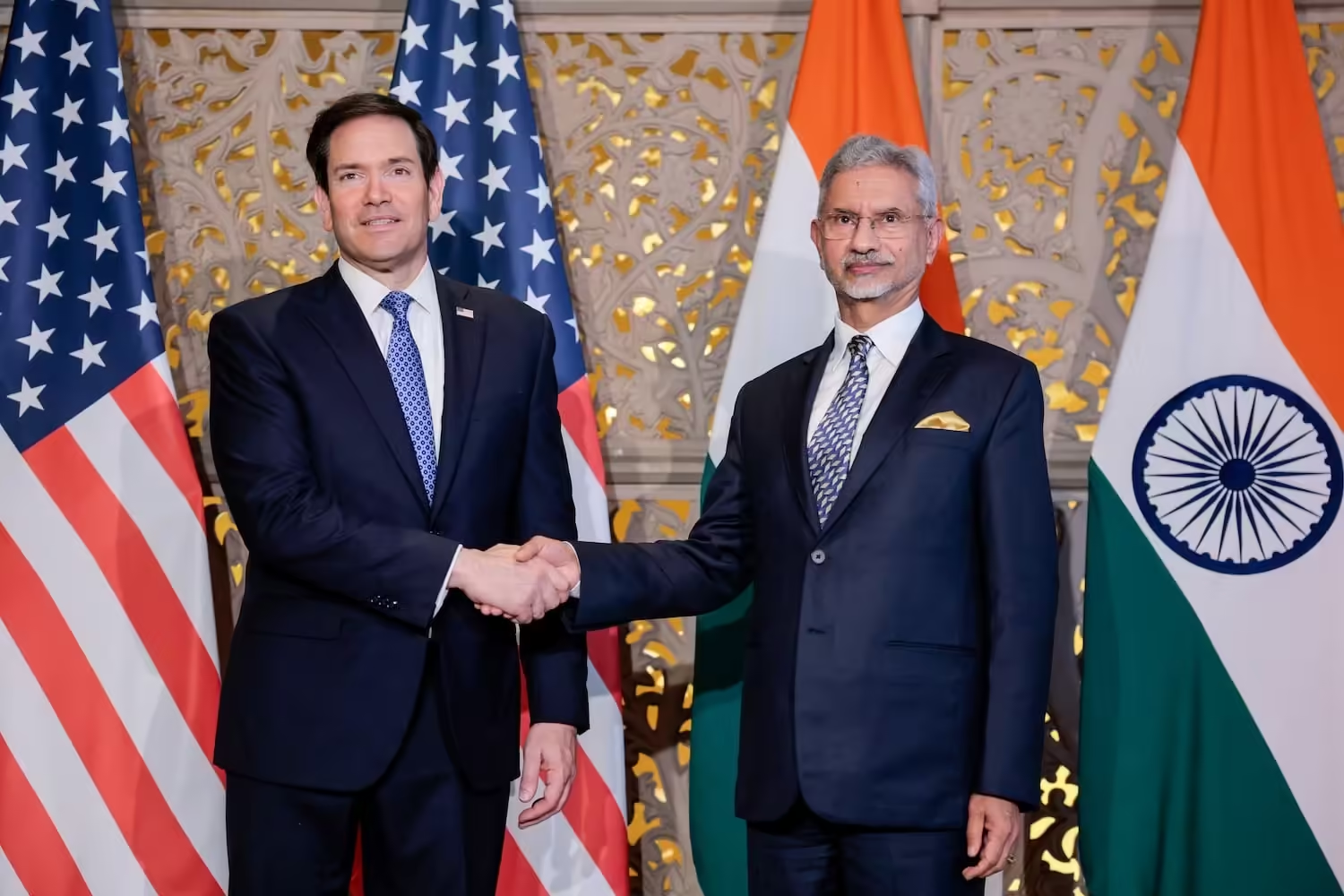
In the end, New Delhi came to Rubio. He met with Indian External Affairs Minister S. Jaishankar on Tuesday in Mumbai. In making the trip, Jaishankar took a bit of a political risk. Indian opposition leaders had said that going to Mumbai would amount to allowing a foreign official—in this case, U.S. Ambassador to India Sergio Gor—to dictate to India on its own soil.
That Jaishankar went to Mumbai highlights the importance that New Delhi accords to its relationship with Washington, despite tensions and trust gaps. It shows that the two sides can get high-level things done in India, even if Rubio doesn’t travel to the capital.
What We’re Following
Mecca pact text revealed. On Tuesday, the London-based Middle East Eye obtained and published the full text of the mutual defense pact involving Pakistan, Saudi Arabia, and Turkey known as the Mecca pact. The revelation came on the day that the deal was submitted to Turkey’s parliament for ratification.
Saudi Arabia recently invoked the pact to call on Pakistan and Turkey’s support to counter attacks by Yemen’s Houthi rebels. The text wasn’t publicly released after the three countries signed the deal in August, and previously known information came from a joint statement and subsequent official comments.
The text confirms that the deal contains NATO-like language, with each signatory viewing an attack on one as an attack on all. It also does not single out any one adversary. The ambiguity is likely intentional, in part so that Pakistan—which borders Iran and has mediated in the Iran war—doesn’t worry that Tehran will read the deal as anti-Iran.
Perhaps the most notable aspect of the Mecca pact is its longevity: The signatories pledged to remain parties to the accord for a minimum of 10 years.
Saudi Arabia executes two Bangladeshis. Two Bangladeshis executed in Saudi Arabia last week for what Riyadh described as an indecent act in a Mecca mosque had been detained in the country on separate charges since August 2023, according to the Daily Star. The newspaper obtained a confidential memo from Bangladesh’s consul general in Jeddah dated Oct. 18.
According to the memo, Nazrul Islam Abdul Basir was detained on cybercrime charges, while Suety Akhter was detained on adultery charges. They both worked for the same cleaning company. The memo also indicates that the Bangladeshi Embassy in Riyadh did not receive prior warnings about the death sentences or eventual executions of Basir and Akhter.
Dhaka will face pressure from the families of the deceased to explain what happened, but it will need to be careful in its approach. Saudi Arabia is a critical economic partner; one-third to more than half of crude oil imports to Bangladesh come from the country. It is also a key donor and home to around 3.5 million Bangladeshis who send remittances home.
The importance of the partnership is magnified by Bangladesh’s worsening economic stress and energy shortages due to the Iran war. Dhaka will need to tread carefully with Riyadh as it seeks answers and considers how to respond to the executions, if at all.
Pakistan’s Munir in Iran. Pakistani Army chief Asim Munir and Interior Minister Mohsin Naqvi arrived in Tehran on Tuesday for talks amid speculation that conflict in Iran could escalate again, possibly soon after the U.S. midterm elections on Nov. 3. The trip appears to be a fresh push for peace.
Pakistan’s job as mediator in the Iran war has become more difficult as Tehran and Washington each double down on hard-line positions. The diplomatic environment for mediation is changing, however, in ways that could advantage Islamabad.
Earlier in the conflict, Pakistan was the prime public mediator, with China, Egypt, and Turkey taking on less robust roles. In recent weeks, other countries—arguably with as much influence over Iran—have stepped up. Qatar is increasingly involved, and Russian Foreign Minister Sergey Lavrov was in Tehran on Monday, marking his first trip there since the war began.
This multinational effort should take some of the heat off Pakistan, which doesn’t want to become the fall guy if mediation efforts collapse. Islamabad could also benefit from some relief on the mediation front as it finds itself in a precarious spot. After agreeing to dispatch troops to Saudi Arabia, it must convince Iran that it remains a credible mediator.
FP’s Most Read This Week
Under the Radar
A Reuters investigationbased in part on new data from the World Health Organization (WHO), has sounded the alarm on Bangladesh’s measles crisis. The country registered 202,000 suspected cases from mid-March through Oct. 9—the highest number in the world. The outbreak has caused 1,147 deaths, 94 percent of those reported among children under 5, according to the WHO.
The investigation finds that a range of factors that have triggered the crisis. The political turmoil caused by the ouster of Prime Minister Sheikh Hasina in 2024 led to disruptions in vaccination efforts. Data-gathering related to vaccination needs has also been problematic, with millions of children left out of inoculation strategies.
Finally, the new government’s haste to move quickly on vaccination efforts this year meant that there were insufficient readiness checks in advance of inoculation campaigns, which led to more problems.
Regional Voices
In the PrintBharatiya Janata Party politician Meenakashi Lekhi argues that efforts to clean up India’s Yamuna River haven’t gone far enough. “The Yamuna riverfront can take valuable lessons from Ahmedabad’s Sabarmati Riverfront Development Project to transform Delhi’s neglected riverbanks into vibrant public spaces while prioritising ecological restoration,” she writes.
In Prothom Hellojournalist Shahiduzzaman warns that not enough attention is being given to climate-related economic damage in Bangladesh: “The question is no longer whether climate change is costing Bangladesh,” he writes. “The real question is how much we are losing, who is paying the price and whether the country is doing enough to prevent these losses.”
A Daily Mirror editorial laments the poor treatment of elephants in Sri Lanka, which calls itself the “land of elephants.” There is a “shameful reality” at play, it argues: “[E]lephants are dying year after year, often because of human actions, while the country struggles to protect them. Respect must be measured by whether they are safe.”
Source: foreignpolicy.com