



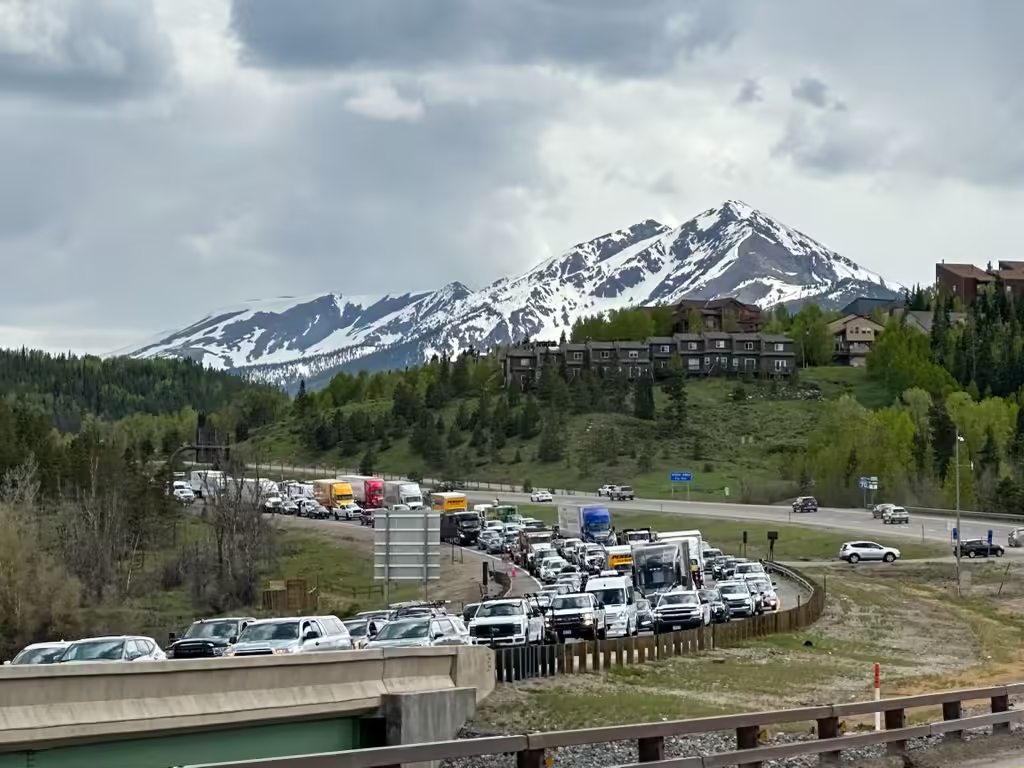

Any Coloradan who has attempted to drive between Denver and the High Country on a busy ski weekend or over a summer holiday knows how busy the Interstate 70 mountain corridor can get.
Whether it’s horror stories of being stuck for hours in bumper-to-bumper traffic at the Eisenhower-Johnson Memorial Tunnels during a snowstorm or the day-to-day snarl of traffic at work zones in the summercongestion is more than just unpleasant — it affects the state’s bottom line.
A new report from the Metro Denver Economic Development Corporation estimates that I-70 mountain corridor congestion costs Colorado about $2.25 billion annually.
“What is really interesting about a report like this is that it reveals that this corridor is what economists think of as a complex system,” said Shaun Brog, a senior economist who helped compile the report. “It’s not as simple as ‘Oh, people spend more time in congestion, and they lose a little bit of their time.’ There are business impacts. There are workforce impacts. There are a lot of different things that congestion affects and that affect congestion.”
I-70 is “Colorado’s most critical east-west transportation corridor,” with the stretch from Denver through Grand Junction functioning “simultaneously as a commuter route, a freight artery, and the backbone of the state’s tourism and outdoor recreation economy,” according to the 65-page report.
Groups including the Colorado Department of Transportation, the I-70 coalition, Colorado Ski Country U.S.A., the Northwest Council of Governments, the Denver Regional Council of Governments, Vail Resorts and the Vail Valley Partnership helped support the analysis with data, technical input and financial support.
Brog said the report uses the same methodology as a 2007 analysis on I-70 congestion to create comparable data. In the past 20 years, he said the cost of I-70 congestion has increased by $777 million, adjusted for inflation.
“The overall dollar figures may or may not resonate with people, but this is a 55% real increase in our figures over the last 20 years,” he said. “That’s a pretty significant increase in what it costs in terms of congestion along the corridor.”
I-70 congestion impacts business, tourism and residents
The report keys in on how I-70 congestion could impact three main sectors: businesses, tourism and residents.
The cost of congestion on I-70 has gone up in part because traffic on the corridor has increased by about 20% as Colorado’s population has grown, Brog said. But he added it’s also because the state’s gross domestic product, or GDP, has grown significantly — as have average wages, which are used to help estimate the cost of the time residents spend stuck in traffic.
He said there is good evidence to suggest that congestion on I-70 impacts worker productivity and business efficiency in the state. Assuming that congestion-related factors had just a 0.5% impact on the state’s GDP, he said that equates to $1.9 billion a year.
“When you’re late to work, when you are tired or angry when you get to work, when there’s a closure and you can’t get to work — these are things that can definitely affect people’s productivity,” he said.
I-70 congestion also has direct impacts on the state’s outdoor recreation industry since the corridor provides access to the mountains and more than a dozen major ski resorts, according to the report.
Congestion has somewhat “ambiguous” effects on retail spending along the corridor since someone stuck in traffic might pull off along their route and spend money in another community, Brog said. But he added that congestion can impact decision-making around when and where people travel.
If I-70 congestion had just a 1% impact on tourism spending in the mountain resort region, the report estimates that would result in a loss of approximately $47 million in annual tourism-related economic activity.
For Colorado residents, the report found that increased congestion on I-70 results in longer commutes, decreased personal time and higher vehicle and travel costs. Valuing only personal time lost, the cost of congestion to Coloradans is about $319 million, according to the report.
But the report also details how Coloradans’ vehicles experience more wear and tear when stuck in traffic compared to when cruising at highway speeds — and how drivers experience lost time and sunk costs, such as fewer hours of skiing, due to congestion.
I-70 congestion expected to continue to increase
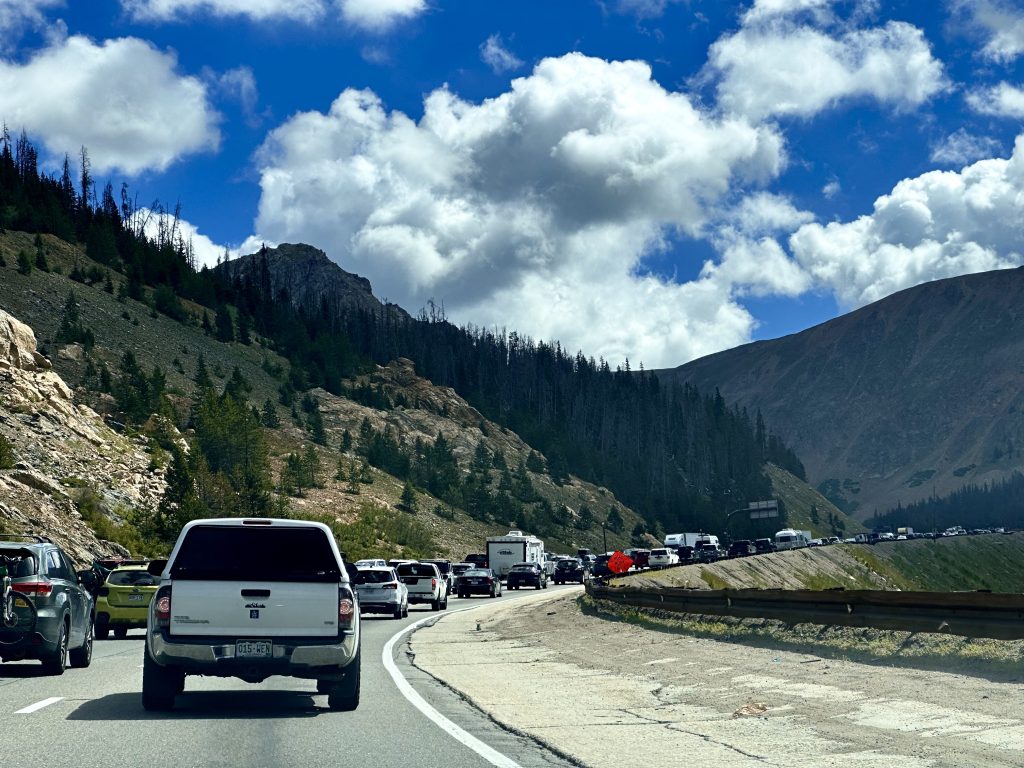
Looking forward, traffic on the I-70 corridor is only expected to increase.
Current estimates predict a 10% increase in traffic on I-70 over the next five years, Brog said. By 2025, he said experts predict increases of about 25% at the Eisenhower-Johnson Memorial Tunnels and 35% near Glenwood Springs, although those numbers could change as Colorado population growth shows signs of slowing.
“If we do see this 25-35% increase over the next 25 years, that’s probably going to create a pretty significant strain on the corridor,” he said. “So we did want to highlight to people that the projections are for vehicle-miles traveled and for total vehicles transiting the corridor to go up quite substantially.”
While the report does not make any specific suggestions for how to improve congestion on the I-70 corridor, he said it aims to provide important information for policymakers and businesses to consider.
For the Western Slope, he said the report helps show the impact that the I-70 corridor can have on mountain communities, which should raise questions about how governments allocate their resources.
“What does it mean for mountain communities for emergency services, when they have more accidents, when they have more congestion? They are not necessarily getting more tax dollars if more people transit past their communities, so they can support those emergency services,” Brog said. “So, basically, you’re asking them to spend more money to cover these things, and they don’t necessarily have the tax dollars to do that.”
Source: www.aspentimes.com