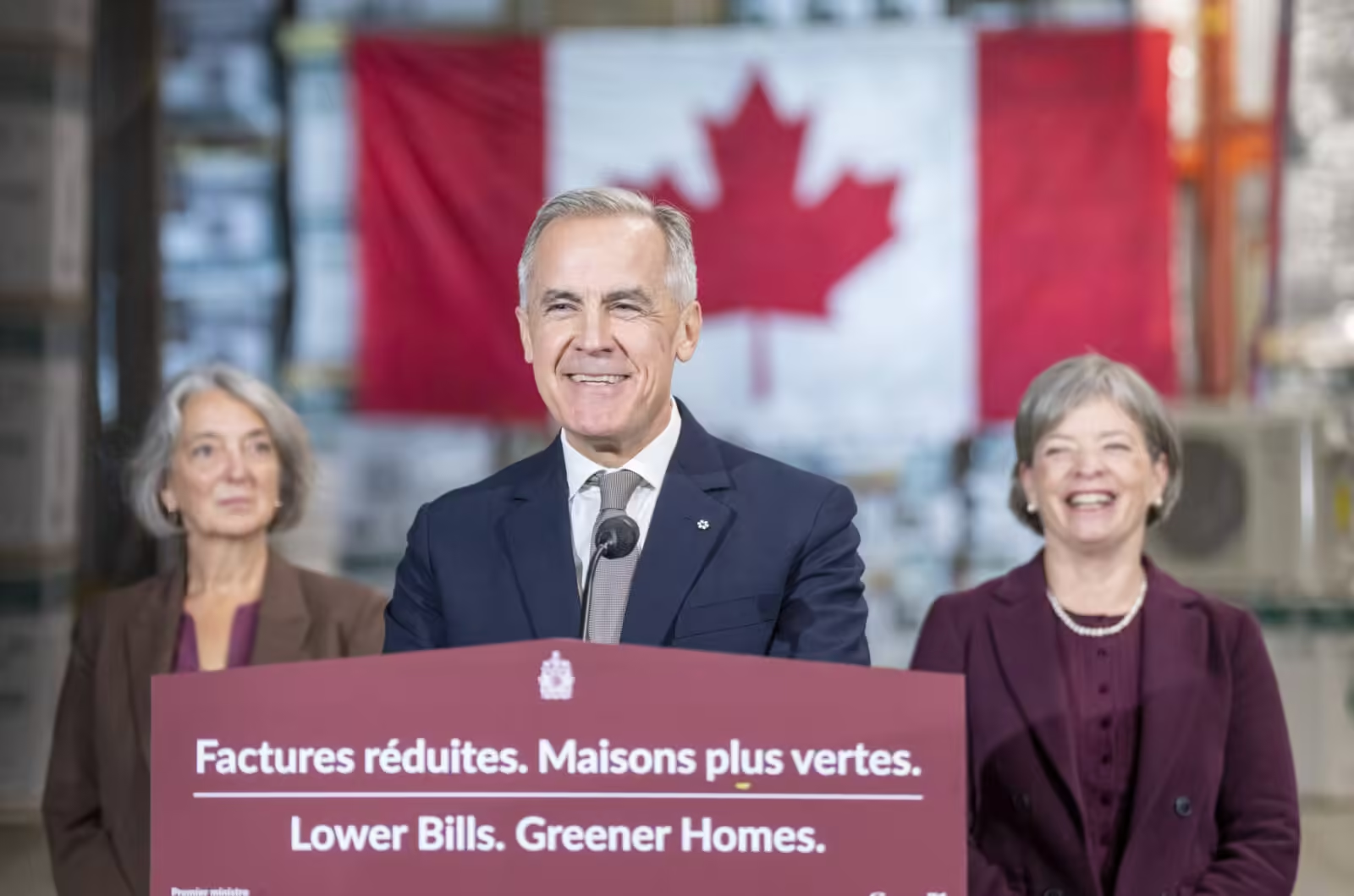

Federal immigration policy, and its effects on the ongoing housing and affordability crisis, is front and centre in Canadian politics once again.
First off, Prime Minister Mark Carney, while speaking outside of Canada to journalists at the New York Times on Sept. 23, suggested his Liberal government is looking to increase immigration following efforts to reduce numbers since forming government in 2025.
“So we’ve taken measures to get that under control, and we have it under control,” Carney told a group of Times reporters in Manhattan, explaining how foreign students and temporary foreign workers are down by 60 and 50 percent, respectively. “Now the question starts to become: When do we resume some controlled increase in the population, which is the nature of Canada. So that will happen, and we just want to make sure that we’ve got it under control.”
On the exact same day, Statistics Canada revised the country’s population estimates for the past few quarters and found the country actually gained an estimated 300,000 people. This was contrary to its previous estimates, which found the country’s population slightly contracted over the past three quarters. The updated numbers tempered previous reports on Canada’s healthy per capita GDP growth, with year-over-year per capita growth dropping from 1.7 percent to an anemic 0.7 percent.
The new numbers reveal Ottawa’s much-publicized efforts to reduce the temporary immigrant population to 5 percent of the overall population have been largely futile: The last quarter’s estimate showed there were an estimated 2.78 million temporary immigrants, 6.7 percent of the overall population, living in Canada.
The Quebec election, held on Oct. 5, was the third event bringing immigration policy back into the public conversation. On the campaign trail, now-premier-designate for Quebec and Parti Québécois leader Paul St-Pierre Plamondon sharply criticized the prime minister’s comments to the Times, saying in French, “We will determine the immigration levels ourselves.” St-Pierre Plamondon also said that over the past decade Ottawa “orchestrated” a large rise in immigration in an “antidemocratic” fashion that failed to account for the effects on housing, public services, and French.
Quebec and Alberta rarely agree on much. On this, they are making the same demand: that Ottawa stop setting immigration levels without the provinces’ approval.
Could Canada be returning to annual population growth of 1% from immigration?
Prime Minister Carney has repeatedly cited reducing population growth from capped immigration numbers as to why Canada’s economy has been sluggish.
The prime minister noted in his Times interview that Canada has “consistently” added “around 1 percent” of its annual population via immigration.
During the latter Trudeau years, the population grew through expanded immigration by 2.4 percent in 2022, 3 percent in 2023 (growing by 1.2 million people that year alone), and 1.9 percent in 2024. By early 2025, as Carney took over, the Trudeau government had already begun tapering immigration. Overall, by the end of the year it had dropped to 0.7 percent growth. The population is projected to grow about 0.8 percent this year if current trends continue.
However, if Carney decides to return to the average 1 percent annual population growth from immigration for Canada in 2027—with a population of about 42 million projected for the end of this year—that would mean about 420,000 more people added to Canada’s population next year.

What increased immigration rates could mean for Canada now
The prime minister would be making that pivot against the clear wishes of most Canadians. A Nanos Research poll commissioned by Bloomberg News in March found that 52 percent of Canadians want the country to accept fewer people in 2027 than this year, 35 percent want the same number, and fewer than one in 10 want more. An exclusive Hub survey of 1,500 Canadians, conducted by Public Square Research and Sago between May 7–13, found the sentiment runs deeper still, with 67 percent of respondents strongly or somewhat agreeing that the country has too much immigration.
That sentiment is being tested most directly in Alberta, where voters go to the polls on Oct. 19 to answer 10 referendum questions, five of them on immigration. Albertans will be asked whether the province should take more control over immigration to bring it down to “more sustainable levels.”
They will also be asked whether only citizens, permanent residents, and people with an “Alberta-approved immigration status” should be eligible for provincially funded programs, and whether people with non-permanent legal immigration status should have to live in Alberta for at least 12 months before qualifying for provincially funded social support programs, which cover benefits such as student aid, the Alberta Child and Family Benefit, and the Alberta Child Care Subsidy.
The immigration questions are non-binding, and because immigration is shared federal-provincial jurisdiction, Alberta can’t make changes unilaterally, whatever the outcome. Still, a strong “yes” vote would send an unmistakable message to Ottawa just as the prime minister floats another increase.
That message would land on a housing market that hasn’t caught up with the last wave of growth, let alone the next one. Carney campaigned on doubling the rate of residential construction over the next decade to 500,000 homes a year. However, Canada Mortgage and Housing Corporation’s summer outlook projects that housing starts will fall 6.8 percent this year to 241,400 units, down from 259,028 in 2025, and that starts will keep falling through 2027 and 2028 because of weak demand, high costs, and elevated inventories.

Rather than close that gap, Housing Minister Gregor Robertson’s department has quietly dropped its longstanding 500,000-start target and says it is no longer focused on “housing unit counts,” Blacklock’s Reporter reported this week.
Canadians have noticed. Habitat for Humanity’s “Home at What Cost?” survey found that 56 percent of Canadians who don’t own a home don’t expect they ever will, the highest rate among the 22 countries surveyed and more than double the global average of 23 percent. The numbers are starker for the youth: 64 percent of young Canadians say housing costs make it difficult to consider starting a family.
Conservatives have seized on those numbers in the House of Commons. During question period on Oct. 8, York—Durham MP Jacob Mantle said, “Habitat for Humanity said this week that Canada is an outlier for all the wrong reasons.” He dismissed the prime minister’s claim a day earlier that housing affordability had improved as “all talk and no action.”
Speaking in the House the same day, Conservative Red Deer MP Burton Bailey tied the cost of living directly to immigration: “As more and more young Canadians are struggling to start a family, our social fabric unravels. Canada is then stuck in a feedback loop of endless waves of unaffordability, unemployment, and immigration.”
The message appears to be landing. An Abacus Data survey conducted Oct. 2–13 found that among Canadians who rank immigration as one of their three most important issues, 61 percent say the Conservatives are best able to handle it, compared with 11 percent for the Liberals.
That political gap on the issue is itself a fault line, but the deeper risk is societal.
Population growth that outpaces housing, jobs, and services inevitably wear down the trust that holds a diverse country together. If Ottawa raises the numbers again before rebuilding that promise, it risks widening the very cracks it is promising to mend.
Fault Lines examines the pressures pulling Canadian society apart and the principles that can hold it together. We look beyond headlines to understand how institutions, communities, and democratic norms are fraying. Our mission is to show how better choices can repair what is broken.

Graeme Gordon is The Hub’s Senior Editor and Podcast Producer. He has worked as a journalist contributing to a variety of publications, including CBC,…
Prime Minister Mark Carney’s proposal to increase immigration in Canada is stirring controversy amid ongoing housing and affordability crises. While Carney argues for a controlled increase in population to stimulate economic growth, recent Statistics Canada data reveals a population gain contrary to earlier estimates. The Quebec election highlighted provincial demands for more control over immigration levels, reflecting a broader sentiment among Canadians who are concerned about the impact of immigration on housing and public services. As Alberta prepares for a referendum on immigration, the political landscape is shifting, with growing calls for sustainable immigration policies.
Source: thehub.ca