


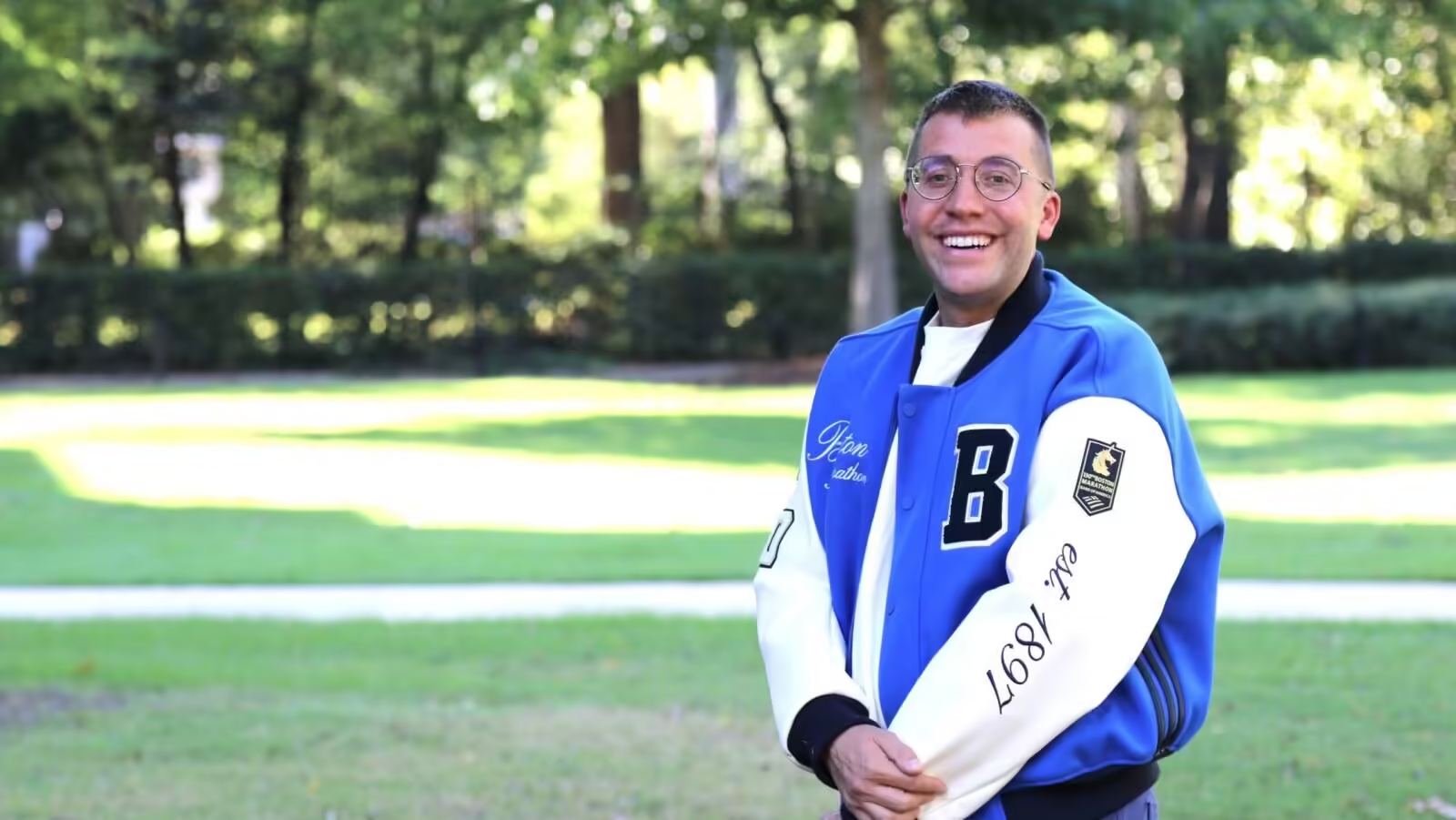

Dr. Benjamin Boudreaux tells his students to imagine a semester as a marathon. Each proceeds through distinct stages of enthusiasm, discomfort, doubt, adjustment and wiliness to try again with lessons learned.
It’s an apt metaphor for Boudreaux, a clinical assistant professor of exercise science in the department of kinesiology at The University of Alabama. He teaches and studies the role of movement in physical health and mental well-being, and he is also a runner.
This November, Boudreaux will run his fourth marathon in New York.
Perhaps marathon running did not start out as a teaching prop, but Boudreaux said his students were surprisingly interested last spring as he trained for the Boston marathon. Many of them followed his progress online or even shouted encouragement if they saw him training on campus.
In addition to a personal habit, his running became a real-life illustration of his classroom material.
Running the Lesson
Running has been a complement to Boudreaux’s academic career from his undergraduate days.
“I’d never exercised before,” he said. “I was never on team sports and was never a fast runner.” But during a difficult period in college, his mother encouraged him to begin exercising as a counterpoint to his discouragement.
“She laid the framework, and I held onto that as my guidance,” Boudreaux said. He noticed a curious pattern during his master’s degree — the more stress he took on, the longer his exercise sessions went.
Even as running became more embedded in his life, Boudreaux advanced his career with a Ph.D. and then a postdoctoral research position in the field of exercise science. In the latter, he was introduced to the discipline of physical activity epidemiology, focusing on all aspects of movement and their long-term relationship to health.
Boudreaux currently teaches four courses per semester in the department of kinesiology. His first semester included some discomfort and even doubt. He took his own metaphor to heart and adjusted: he studied student feedback, sought advice from colleagues and used departmental resources to redesign his course. The result was a “Most Improved” recognition from the UA Teaching Academy.
Running is as much a part of his process as ever.
“For the first few miles, I’m thinking — what can I change in teaching? What can I change in research and service?” As the miles accumulate, his thoughts begin to settle. “My brain goes quiet,” he said. “The thrill of being quiet minded is almost like flying.”
No One-Size-Fits-All Finish Line
“Exercise is medicine for everybody,” Boudreaux said. “But for example, step counts would not be helpful for many adaptive athletes. The recommendation would need to be different.”
This is another place where Boudreaux’s lived experience informs his work in exercise science.
“I use myself as an example in the classroom and in professional talks,” Boudreaux said. “I have autism spectrum disorder and type 1 diabetes, two existing conditions you have to manage side-by-side.” A plan that takes only one of these into account would be a plan that didn’t work for his needs.
Boudreaux’s postdoctoral research was in the field of exercise epidemiology, taking a holistic look at patterns around movement and health. They found that three factors — exercise, sleep, and long periods of sitting — all affect a person’s overall health outcomes. However, telling someone with a disability simply to “sit less and move more” is inadequate.
“My goal is to bridge that gap between disability and overall health and well-being,” he said. “No two are alike, so you have to tailor an exercise prescription for the individual.”
Making exercise science more accessible

Boudreaux uses his personal experiences to inform his professional work. He has stepped into the role of disability advocate within his academic field by helping to oversee accessibility efforts at the American College of Sports Medicine annual conference.
For conference accessibility, his perspective has shifted to a wider lens. “It’s not only about disability,” he said. “It’s about making an impact for everybody. How can I make it easier for anyone to move from session to session or get coffee?”
He also checks in with conference attendees, making sure people with specific needs feel comfortable and welcomed.
This year, Boudreaux was named a Fellow of the American College of Sports Medicine, typically an honor earned during tenure. “This credential means my colleagues believe I represent the highest standards of service and leadership,” he said. “I love working with the staff of the ACSM and am proud of my service to the organization.”

Boudreaux’s first marathon slot was earned as a runner with a diabetes charity, one example of how closely running is tied to his service and advocacy work.
Ultimately, he hopes to use his platform to lift other voices as well.
T-town marathon training
Training for the next New York Marathon isn’t easy in football season. Boudreaux has to find new routes around tailgaters during home games, and he avoids alcohol — even on game days.
Occasionally, a student will yell encouragement as they drive past, and he enjoys knowing they see him living his classroom principles.
A marathon involves a 16-week training plan, leading up to the big moment he and thousands of other runners crowd in at the starting line. And many of Boudreaux’s students will be cheering him on from UA.
Source: news.ua.edu