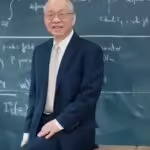





Former Jamaican Prime Minister P.J. Patterson has challenged Africa, the Caribbean and the worldwide African diaspora to move beyond goodwill and organise their collective power, warning that others will continue to capture the value of African resources, labour and talent in a world where, in his words, “right is replaced by might”.
Addressing the Third Africa in Transition Conference in Accra last Thursday, Patterson, statesman-in-residence at The PJ Patterson Institute for Africa-Caribbean Advocacy at The University of the West Indies, called for a Global Africa Coalition to unite governments, regional organisations, financial institutions, universities, businesses, civil society, cultural institutions, young people and diaspora communities behind a common programme of action.
UN vote as proof of concept
Patterson pointed to March 2026, when the United Nations General Assembly, in a resolution spearheaded by Ghana, declared the trafficking and chattel enslavement of Africans the gravest crime against humanity. The measure passed with 123 votes in favour, 52 abstentions and three votes against – from the United States, Israel and Argentina.
“We have not failed to notice those who abstained and those who opposed the Resolution backed by 123 Member States,” he told delegates, describing the outcome as “the fruit of our own brilliant scholarship, and united diplomatic resolve.”
“The world is bound to respond when there is co-ordinated action by Africa, the Caribbean, the diaspora and our allies,” he said, insisting that the campaign be “vigorously pursued” at next month’s Commonwealth Heads of Government Meeting in Antigua and Barbuda and in the capitals of Europe.
A world order breaking apart
The former prime minister warned that the multilateral system on which developing countries relied, “however imperfect, is fracturing”, leaving small and developing states exposed.
“The unequal postwar order is being demolished by a turbulent, hegemonic environment where power increasingly displaces law and right is replaced by might,” he said, arguing that collective action by Global Africa was no longer aspirational but urgent.
No longer the world’s quarry
Patterson outlined the combined strengths Africa and the Caribbean could bring to bear: Africa’s critical minerals, agricultural potential and the world’s youngest, fastest-growing population, alongside the Caribbean’s strategic geography, marine resources, sophisticated services and world-renowned cultural industries.
“Our greatest wealth, by far, is our people,” he said, arguing that the future belongs not to nations with physical resources alone, but to societies that educate their people, create knowledge, master new technologies and build competitive enterprises.
He was emphatic that the old bargain must end.
“As artificial intelligence and the knowledge economy reshape power, Africa and the Caribbean cannot remain suppliers of raw materials, labour, data and markets while value is captured elsewhere,” he said. “We must build the capacity to produce and innovate.”
He framed reparatory justice in similarly transformative terms, saying it “must encompass education, health, economic empowerment, technology, cultural restoration and full control by African and African-descendants over our own development.”
Culture, he said, was not an ornament but an economic asset. African and Caribbean music, literature, film, fashion, sport and cuisine were “a source of jobs and intellectual property, and an instrument of influence.”
From goodwill to machinery
Patterson credited Afreximbank’s Caribbean expansion and the AfriCaribbean Trade and Investment Forums with helping to build “practical infrastructure for a relationship long sustained mainly by goodwill”. He urged delegates to design “constitutional machinery that is dynamic, inclusive and results-driven”.
He called for the African Union’s recognition of the diaspora as Africa’s Sixth Region to be “catalysed to become organised power and sustained co-operation”, adding that the proposed coalition must link “reparatory justice with development; education with innovation; culture with commerce”.
He also pressed for history to be at the centre of the initiative.
“Economic emancipation without historical consciousness is unfinished business,” he said.
Closing his address, Patterson invoked the slave forts along Ghana’s coast.
“As we gather again in Accra, there must be no turning back,” he declared. “Let us instead embark this time from the gates of no return to recast the African identity from dispossession and displacement towards purpose and power through an inseparable partnership within a formidable Global African Coalition.”
The Third Africa in Transition (AIT) Conference, which was held from October 8 to 10 at the ISSER Conference Facility at the University of Ghana, Legon, in Accra, was organised by the Africa Caribbean Centre for Development, a body registered in Jamaica and Ghana and chaired by Professor Ian Boxill, professor of comparative sociology and development at The University of the West Indies, Mona.
Under the theme, ‘Fostering Transformation of Global Africa through Education, Investment, Innovation, and Partnerships’, the conference brings together scholars, policymakers, entrepreneurs and civil society practitioners from Africa, the Caribbean and the wider diaspora.
The conference took place amid growing institutional engagement between Africa and the Caribbean. The Second Africa-CARICOM Summit, held in Addis Ababa in September 2025, was the first in-person meeting of African and Caribbean heads of government. Discussions covered trade, reparatory justice, health, education and climate resilience.
In 2026, Kenya opened a High Commission in Kingston, while Ghana’s President John Dramani Mahama visited Jamaica for its 64th Independence celebrations. The year also saw a landmark UN General Assembly resolution declaring the transatlantic slave trade the gravest crime against humanity.
Against this backdrop, the AIT Conference positioned itself as a platform seeking to translate growing political momentum between the two regions into structural partnerships in education, investment and innovation that its organisers say are long overdue.
Source: jamaica-gleaner.com