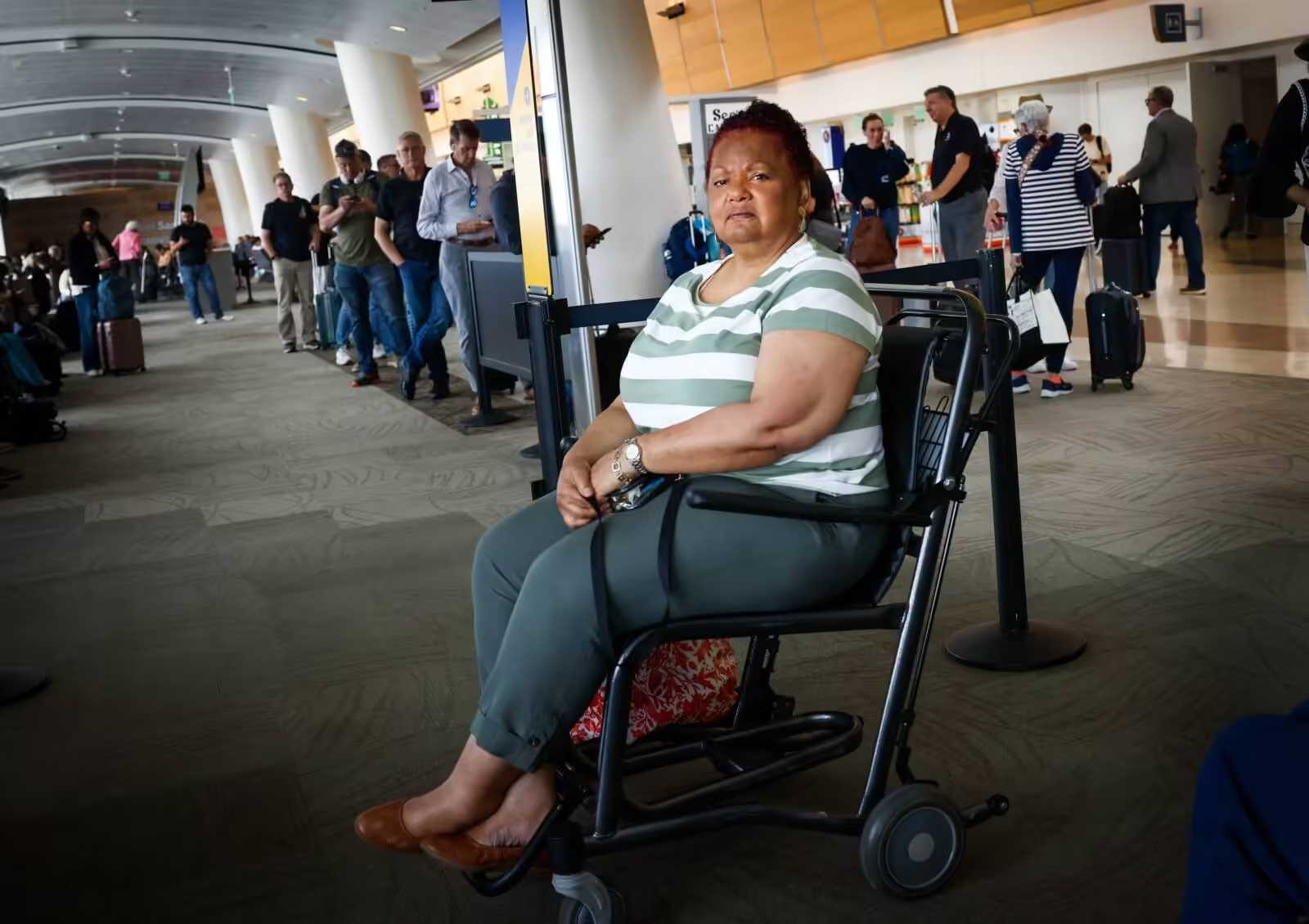

Sitting in a wheelchair near her gate at San Jose Mineta International Airport, 72-year-old Kurtetha Leatores had given herself plenty of time before her flight home to Southern California.
For Leatores, who has had three strokes and was preparing for heart surgery, getting on the plane isn’t necessarily the hardest part of traveling alone. It’s getting to and from it.
Earlier that day, Leatores said she asked another traveler to go inside the airport and find an employee who could help her get from her car to the terminal. During another trip while at Los Angeles International Airport, getting from the terminal to the designated Lyft and Uber pickup area was particularly difficult because of the distance, she said.
“It’s always a major concern for me,” Leatores said.
Leatores’ experience reflects a tension facing many older travelers: They want to keep exploring, visiting family and taking vacations as they age, even as navigating sprawling airports, long lines and heavy luggage are more physically demanding.
A recent national survey commissioned by Luggage Forward, which as a luggage-shipping company has a commercial interest in reducing a common travel burden, found that 78% of Americans 55 and older surveyed viewed travel as beneficial to healthy aging. Nearly 90% reported taking at least one or two trips a year, while a third traveled three to five times annually.
Still, she isn’t giving up travel. Leatores takes at least two trips a year, most of them vacations. But since becoming disabled, she said she travels less and has learned to plan around her physical limitations.
“I try not to overtax myself,” she said.
But 21% said airport and luggage logistics had caused them to travel less often or not as far. Long walks between gates challenge 37% of respondents, while 31% pointed to lengthy lines and 24% cited dealing with heavy luggage.
The survey, conducted by Propeller Insights for the company in May, included more than 1,000 U.S. adults age 55 and older and had a margin of error of plus or minus 3 percentage points.
Audrey Kohout, co-CEO of Luggage Forward, said what stood out to her was that older adults’ desire to travel remained strong despite those obstacles.
“They really want to travel,” Kohout said. “There’s a lot of data that shows interest in older adults traveling and airports being a barrier to that.”
Airports are working to make terminals easier to navigate for travelers with different mobility needs, according to Airports Council International-North America, an industry group representing airports in the United States and Canada. Airports have invested in accessible terminals, elevators, seating, signage and ways to move passengers across large facilities, the group said.
But responsibility for assisting travelers is divided between airports and other organizations. For example, airlines are responsible for providing wheelchair assistance between terminal entrances and aircraft, while TSA Cares handles assistance during security screening.
“There is no single solution for every older traveler,” ACI-NA communications manager Ryan Madsen said in a statement. “Some need mobility assistance while others may simply benefit from a place to rest, more time, clear directions or a person who can answer a question.”
San Jose Mineta International Airport officials said the airport is committed to making its terminals accessible to travelers of all ages and abilities. Officials encourage travelers to contact their airline in advance, as they provide or arrange wheelchair assistance.
The airport also offers complimentary courtesy carts in Terminal B during peak travel periods and autonomous mobility chairs in Terminal A. Passengers can check with airport staff for availability.
“We recognize that navigating an airport can be challenging, particularly for older travelers or anyone with limited mobility,” SJC Public Information Manager Julie Jarratt said. “Our goal is to provide multiple options throughout the journey so travelers can access the support that best meets their individual needs.”
Gina Fox, 61, of Milpitas, was being wheeled through San Jose’s airport after returning from a vacation in Mexico. Since retiring, Fox said she travels every two or three months, including trips to visit her mother in Las Vegas and her daughter in San Diego.
Fox can walk, but a knee problem makes long distances difficult.
She said airport workers who provide wheelchair assistance have been kind and helpful, but she sometimes worries there aren’t enough of them.
“I really do appreciate the assistance we do get, and I wish there would be more staff,” Fox said.
Fox said moving walkways could also reduce the need for wheelchair assistance for travelers like her who can walk but struggle with long distances. She avoids San Francisco International Airport in part because of the amount of walking involved, she said.
Kohout acknowledged that airports already provide services such as wheelchairs and transportation through terminals for travelers with mobility limitations. But not every older traveler needs or wants that level of assistance.
That leaves a broader question, she said, about how large airports can be designed or adapted to make them easier for travelers with varying levels of mobility to navigate.
For Leatores, wheelchair assistance is essential. She said airlines allow travelers to request accommodations in advance, but the experience can vary at the airport.
Her biggest concern when flying home was getting through the next transition: from the plane to the curb in Long Beach. The smaller airport made her hopeful someone would be able to wheel her all the way outside.
She also travels with medication, which means she prefers keeping her bag close rather than separating from it.
Despite challenges like those, most respondents to the Luggage Forward survey said their health wasn’t keeping them home. Fifty-four percent said health rarely or never factored into their travel decisions, while 27% said they had canceled or skipped a trip because of health or physical limitations.
Seventy percent said they were traveling as much or more than they had five years earlier. Having more time was the most commonly cited reason, followed by having more money and wanting to spend time with family.
And many associated traveling with feeling better: 49% said travel made them feel healthier, 39% said it made them feel younger and 29% said it helped them maintain an active and connected lifestyle.
Kohout said travel can give older adults something to anticipate and plan while creating opportunities to see family, experience different cultures and stay physically active.
“Older Americans still see travel as a gift and celebration of life,” she said.

Carey Kyler, senior director of research and insights at AARP Services Inc., said travel has consistently ranked among the things older adults most look forward to in retirement.
“It’s not necessarily just something they want to do,” Kyler said. “Travel can provide opportunities for social connection, satisfy curiosity and allow older adults to spend time with family, which is key for longevity.”
An AARP study found 95% of travelers age 50 and older perceived travel as good for their mental health and 85% said the same of their physical health.
For Fox, retirement has meant more opportunities to reap the benefits of travel. Her knee may change how she gets from one end of an airport to the other, but it hasn’t stopped her from regularly boarding a plane.
And for Leatores, traveling now requires more time, assistance and planning than it once did. She arrives early in case getting help takes longer than expected and thinks carefully about how much physical exertion she can handle.
But she’s already thinking about her next trip.

Source: www.mercurynews.com