






Occasionally, when she is in court, Kaleda Battle crosses paths with people she’s helped navigate the criminal legal system.
“They’ve completed treatment and they’re doing well and they’re like, ‘I really appreciate you helping me get into that program,'” Battle said.
Battle is one of four state-employed resource navigators for indigent defendants — people accused of a crime who do not have the money to pay for a defense lawyer. She works with public defenders to connect indigent people to resources and diversion programs.
Diversion programs are initiatives that help people move away from the criminal legal system and avoid reentering it. That goal exists in many forms, from redirecting defendants to mental health court and mentorship programs to reentry coordination after being discharged from jail.
“Maybe they don’t have stable housing, they need access to food, help with applying for food stamps, or they need some mental health resources,” Battle said. “We’ll help the client reach out to different programs, kind of do a phone screening with them, see which one works best for them and try to get admitted into their program.”
Battle is based in El Reno, but because of the limited number of resource navigators, she works with clients across northwestern Oklahoma. Many of those rural communities are in legal service deserts, where accessibility issues can create barriers.
A lack of public transportation is one such barrier for Battle’s clients. For indigent defendants being released from jail, a lack of transportation makes difficult situations even more complicated.
“If they don’t have any family or friends or anything, they just have to walk or hitchhike,” Battle said. “I know sometimes Diversion Hub has been able to transport people, like if they need to go back to Oklahoma City […] but if it’s short notice, they can’t really plan that quickly.”
Headquartered in Oklahoma City, the non-profit organization Diversion Hub aims to identify and address circumstances that contribute to people touching the legal system over and over again. The organization recently opened a satellite office in El Reno.
“They’ve been very helpful. But still, there are a lot of issues,” Battle said. “The access to resources is kind of limited.”
‘Make those investments there:’ Oklahoma County diversion programs lower recidivism
In central Oklahoma City, Diversion Hub served 8,168 clients in 2025. And it’s not a one-time service — those clients interact with the program frequently.
“We see almost 3,000 check-ins a week,” said CEO Meagan Taylor. “We have reduced recidivism by about half of the county level.”
The organization’s recent annual report stated the Oklahoma County recidivism rate is 27.45%, while Diversion Hub clients showed a lower recidivism rate at 15.97%.
“Public safety starts with helping people access the resources,” Taylor said. “There is a strong return on investment when we meet people where they’re at and we help build a pathway for them out of the system, out of chronic homelessness, out of addiction.”
The non-profit started as a pilot program in 2018 with a team of about five people working to identify gaps in the criminal justice system. Diversion Hub has grown significantly since then, and in June, staff celebrated moving into a new building.
The new OKC location co-locates 16 partners, including the Homeless Alliance, Oklahoma County Treatment Courts, Legal Aid Services of Oklahoma and Lifeline cell service provider Assist Wireless.
“All of the partners and all of the staff of Diversion Hub work closely to collaborate and coordinate services (…) Diversion Hub was born out of community effort,” Taylor said. “We work with the district attorney’s office, the public defender’s office, and the judiciary. We work with the Oklahoma Indigent Defense System, especially in our rural sites.”
Diversion Hub has satellite offices in Norman and El Reno, and the organization plans to open an Ada location in a few months. Taylor said collaborating with existing agencies is a priority, but when moving into smaller or rural communities, staff quickly recognized service gaps.
“[We are] having to work with stakeholders to bring those investments to those communities to fill those gaps, especially if these are gaps in resources and services that we can’t necessarily fill,” Taylor said. “How can we ensure that we’re building solutions to these gaps, and we’re helping ensure that people are getting their needs met so that they don’t have to touch the system again?”
Taylor said people need to look at rural communities and work collectively to provide those missing services.
“We also need there to be investments in this space,” Taylor said. “Rather than pulling all of those folks and continuing to build up resources in Oklahoma City, how do we slowly start building those resources up in rural communities, and make those investments there?”
Public defenders say uniform diversion services haven’t seen ‘buy-in’
The Oklahoma Indigent Defense System is a state organization that provides legal defense through a limited system of satellite offices and private contractors. Oklahoma and Tulsa counties have separate systems, as they have their own county public defender offices.
OIDS officials say the state needs a uniform system for implementing diversion programs. Resource navigators, like Battle, connect clients to specialized services, and directors hope to bolster the program in coming years.
“We currently have four. They each serve one quarter of the state, which is an extreme amount,” said OIDS Executive Director Debbie Maddox. “As a result of rural counties in Oklahoma, we have several legal service deserts. Western Oklahoma was our biggest issue (…) they lack a lot of services, a lot of social services, a lot of legal services.”
According to an OK Policy articlesome public defenders see caseloads of up to 250 cases at a time. Battle said expanding the resource navigator program could help in those situations.
“Sometimes, the attorneys get into the habit of just having to do everything themselves, but if we could come in and we could hire more resource navigators to alleviate some of the in-between work, we could handle that and they could focus more on the legal aspects of the case,” Battle said.
State funding challenges have complicated program expansion. According to Oklahoma’s transparent budget portalOIDS requested $1.5 million from the legislature last year to expand their resource navigators program. The request was not granted.
“We asked for that increase because we were worried about services being able to be provided by the Department of Mental Health after they had gone through a very significant organizational restructuring,” Maddox said. “We wanted to increase that staff so that each [of the 12 OIDS] satellite offices had their own resource navigator to identify local resources so that we could tap into them more easily.”
The Oklahoma Department of Mental Health and Substance Abuse Services works with other state agencies to provide some wraparound legal and social services. ODMHSAS uses “early diversion programs” to give participants individualized case management plans and treatment services, contingent on judicial oversight. However, only 25 of Oklahoma’s 77 counties are currently operating these programs.
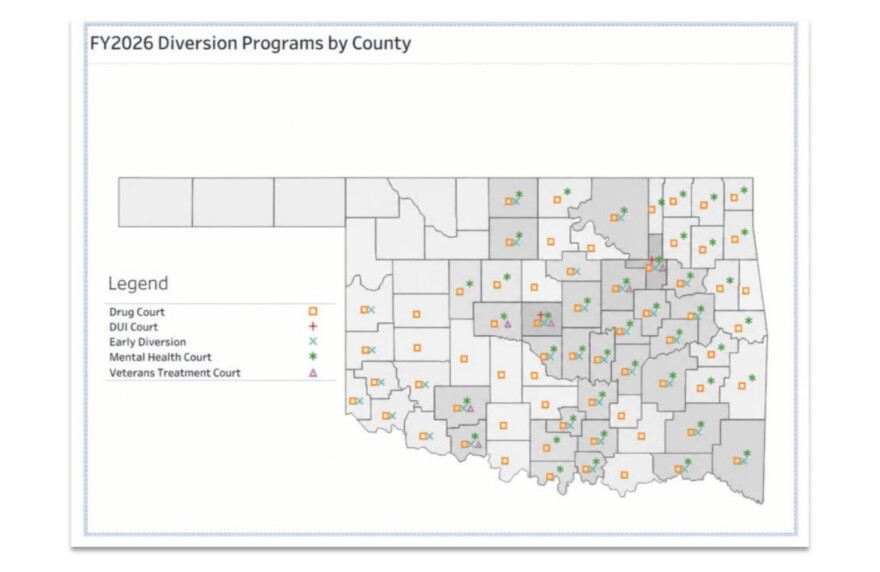
Oklahoma Department of Mental Health and Substance Abuse Services /
“We have a lot of private organizations, and the Department of Mental Health is actually a really good provider of drug court service and mental health court services and veterans court services, but we don’t have much buy-in from the district attorneys. So we’ve got these parallel lines of service that are available that do not interact very often,” Maddox said.
Multiple Oklahoma statutes — such as the Oklahoma Drug Court Act — authorize district attorneys to administer state-funded diversion programs in their prosecutorial districts, but they aren’t mandated to do so. Even if a defendant is eligible for consideration, the court is not not required to recommend the defendant for a diversion program.
“There’s always an instance where, maybe myself and the [public defense] attorney are pushing for treatment, and maybe the DA doesn’t agree to it. But we know deep down that that client could really benefit,” Battle said.
The state does fund diversion in other ways too. In 2025, approximately 30% of the Diversion Hub’s funding came from various government entities. Additionally, the District Attorneys Council provides federal grant money to operate a crisis intervention program at Diversion Hub’s OKC location. However, most of those services are concentrated in more urban areas.
In 2025, the Healthy Minds Policy Initiative published a study that found Oklahoma could save $87 million annually by diverting about 19,000 people to alternative court programs for treatment rather than traditional prosecution.
Maddox said diverting first-time offenders lowers recidivism, saves money and increases public safety.
“If you look at other states that use diversion, the sooner you divert a client, the better off the outcome is for the client and for the system,” Maddox said. “My request to legislators is you need to either help us have a cooperative relationship with the district attorneys council, or you’re going to have to mandate some diversionary programs that we then measure through data and get some evidence-based results on so that we can do better planning.”
Maddox said that of the 75 counties OIDS serves, about 70 are legal service deserts. Often, she said, people in those areas don’t have access to addiction treatment, mental health services or other support services until they are accused of a crime.
“They have to get in trouble and enter the criminal justice system before that help is offered to them,” Maddox said. “An offer of help short of criminal activity should always exist in all of our counties.”
This report was produced by the Oklahoma Public Media Exchangea collaboration of public media organizations. Help support collaborative journalism by donating at the link at the top of this webpage.
Source: www.kgou.org

