




Warning: This article contains references to death by suicide that some readers may find disturbing.
As October 7’s third anniversary approaches, Ronen Shalev’s body tells him something’s coming.
“You start shivering,” he tells DW. “It’s not just one day and you move on. We have many graves to visit, many families to meet. It’s a difficult time and you feel it in your body.”
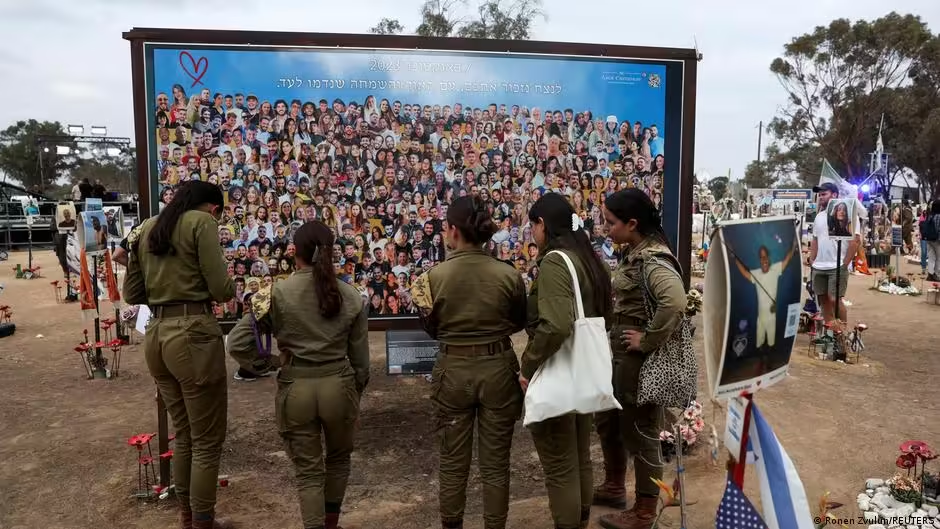
Both of his children attended the Nova Party in Israel‘s south, where almost 400 people were killed in a terrorist attack carried out by Palestinian militant group Hamas and its affiliates in Gaza. In total, roughly 1,200 people were killed in the attack and around 250 were taken hostage.
The attack triggered the war in Gazaduring which Israel has killed tens of thousands of Palestinians and displaced much of the territory’s population.
Shalev’s son, Roee, was shot and hospitalized, but he survived. Roee’s partner, Mapal Adam, was killed in front of his eyes. Shalev’s daughter, Lior, also made it out.
Shortly after that day, Shalev’s wife Gavriela went missing, before her body was found in a burned car with a goodbye letter. “She couldn’t handle the sorrow from that day,” Shalev says.
At the same time, his son Roee’s post-traumatic symptoms started emerging, mostly in the form of extreme mood swings. “He went to treatment to please me, but he didn’t really believe in it. He thought he was OK, that he was strong,” Shalev remembers.
Two years after Gavriela’s death, Roee couldn’t take it anymore, either.
“I’m alive, but I’m dead within,” Roee wrote in his goodbye message, which he posted on his Instagram account. “I’m sorry.”
A country in post-traumatic state
Since October 2023, Israel has been grappling with a mental health crisis of unprecedented scale.
According to a report by Israel’s State Comptroller from February 2025, some 39% of the Israeli public reported suffering from post-traumatic symptoms, depression, anxiety or a combination of the three, on a medium or severe level.
This amounts to some 3 million people, 600,000 of whom could suffer severely. However, the report also found that the number of people receiving mental health treatment had only risen by 1% since October 7, 2023, a difference of around 60,000 people.
Among the affected groups are survivors of the attack, as well as people evacuated from their homes in Israel’s south and north due to the war.
Noga Dagan-Buzaglo is a researcher with the Adva Center, a think tank focusing on inequality in Israeli society. She wrote an extensive paper about Israel’s mental health system and its challenges post-October 7.
She tells DW that while the country’s mental health budget did increase due to the war, it was too little, too late, as the health system faced an ongoing crisis that was not handled properly.
“The biggest challenge is convincing people to work in Israel’s public mental health system, both due to lower wages in comparison to the private sector and due to an overload of work,” she says.
Sedatives often the go-to solution
The current situation affects mental health professionals, too. Research by the University of Haifa found that 84% of the therapists who treated people affected by the October 7 attack showed traumatic symptoms themselves, and some 45% of them said they feel mentally exhausted.
Israel’s Health Ministry has repeatedly said it has increased funding and job openings for the country’s public mental health system, but staffing shortages remain, especially in peripheral regions in the far north and south.
Because of these issues, the report said waiting times for treatment through Israel’s public healthcare system were longer than six months. In some cases, Dagan-Buzaglo says, patients had to wait more than a year before receiving help.
Mental health NGOs and volunteers try to fill the gaps, often struggling themselves under the workload. This also leads to an increased use of prescription medications. Some people turn to substances like alcohol and drugs.
The Israeli Ministry of Health said earlier this year that it had registered a rise of between 13% and 17% in the prescription of sedatives, sleep aids and antidepressants.
Those who suffer from the situation the most are the ones who cannot afford to pay a private therapist. Dagan-Buzaglo labels the Israeli public health system’s response to the situation as “simply bad.”
Soldiers at risk
Combat soldiers have received a special focus when it comes to Israel’s mental health crisis.
Statistics published by the Israeli parliament and the IDF suggest a sharp rise of suicide cases among reservists: from a maximum of one annual case in the six years preceding the war to 11 cases in 2024, as well as nine cases investigated as suspected suicides in 2025. This does not include ex-soldiers who committed suicide due to trauma after the end of their service.
Dagan-Buzaglo, a researcher at the Adva Center, says that while professionals receive better pay and conditions working for the army, the lack of personnel is still apparent. “In the army, too, the length and quality of treatment are by far not at an adequate level.”
To start solving the problem for both civilians and soldiers, she believes the system needs more support. “We have to acknowledge the fact that trauma is not over after a year. This means investing money.”
Breaking the taboo
Ronen Shalev holds regular lectures and talks about the importance of mental health, often to groups of soldiers. He believes this is the best way to continue his son’s legacy of fighting to live on.
Shalev, who himself was diagnosed with post-traumatic stress disorder (PTSD), says he made a choice to live his life to its fullest.
His message: The taboo regarding suicidality — which still exists across Israeli society — needs to be broken. “This is especially true regarding those who say they are strong. They’re the scary ones as they’re less likely to receive treatment.”
For Shalev, speaking publicly about his family’s experience has become part of his own recovery — and a way to encourage others to seek help before they reach a crisis point.
“Life, with all its pain, is still worth deciding in favor of,” he said.
If you are suffering from serious emotional strain or suicidal thoughts, do not hesitate to seek professional help. You can find information on where to find such help, no matter where you live in the world, at this website: https://befrienders.org/
Edited by: Andreas Illmer
Source: www.dw.com