



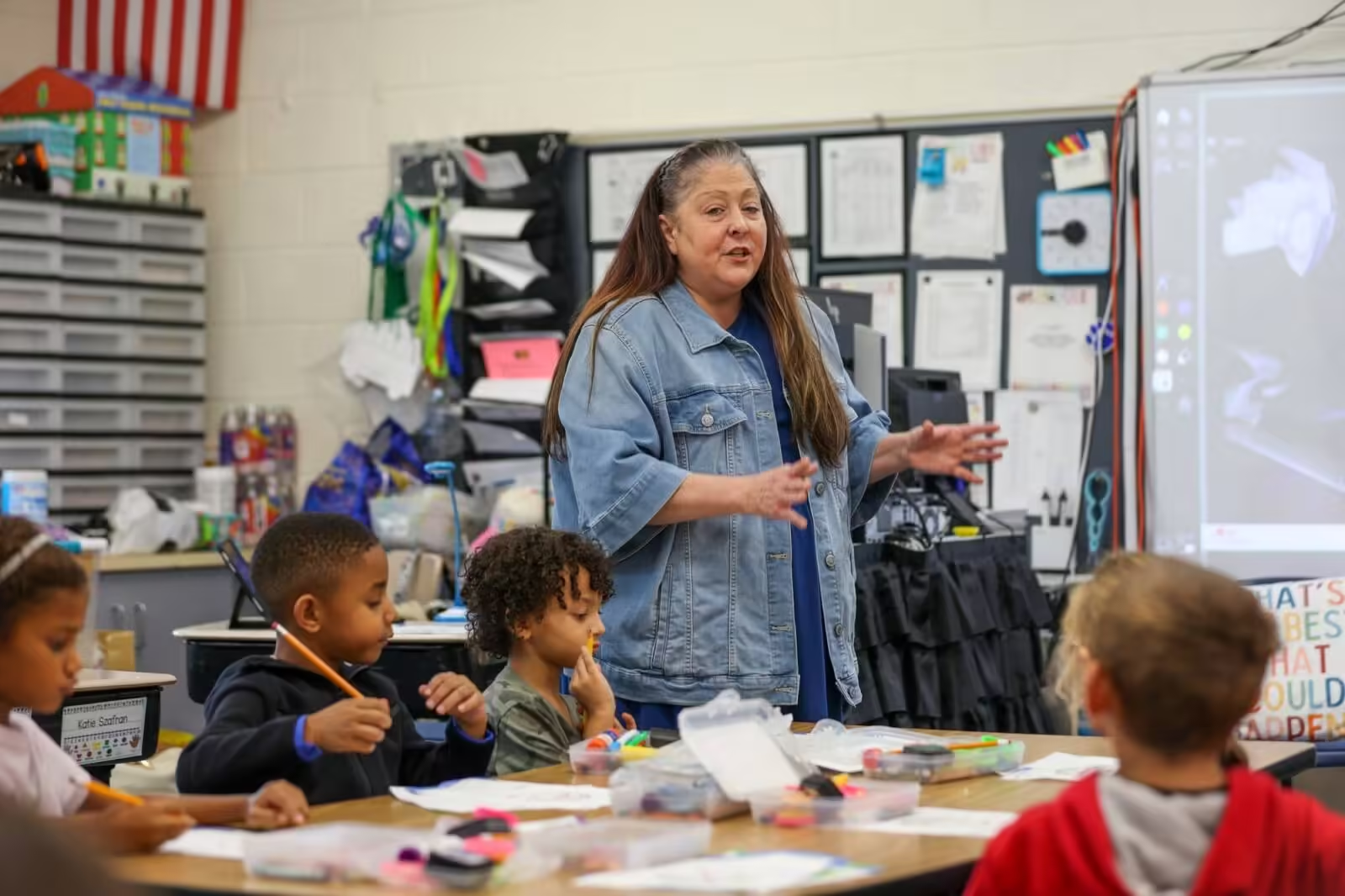

Amid a nationwide decline in literacy, teachers across Pennsylvania — including educators in Northeastern Pennsylvania — are rewriting the rules on reading.
The General Assembly adopted an annual state school code last year creating new mandates for a statewide “structured literacy” initiative. Formally known as Act 47 of 2025, the new school code requires all school districts, vocational schools, charter schools and intermediate units to adopt an “evidenced-based” reading curriculum by the start of the 2027-28 school year.
This evidence-based curriculum embraces a paradigm known as “science of reading,” which state law defines as a “vast interdisciplinary body of scientifically based research” on literacy acquisition. It focuses on phonemic awareness and phonics, with students using their knowledge of different syllables to decode words; as well as key-word vocabulary lessons and reading-comprehension skills.
Kimberly Tesluk, a reading specialist at John F. Kennedy Elementary School in the Scranton School District, said the science of reading has a robust empirical basis.
Scranton currently uses a number of curricula across grade levels with an emphasis in structured literacy. These include Fundations, which Tesluk described as a “really explicit, systematic phonics program” from kindergarten to second grade, and uses programs from Heggerty and Savvas elsewhere.
“It’s an interdisciplinary body of knowledge of research from a lot of different fields, like neuroscience and education, linguistics,” Tesluk said. “We really want to make sure (our curriculum) is evidence based and that it’s going to be effective with our students.”

Dallas School District, in consultation with the literacy group called the Reading League, implemented Amplify CKLA in kindergarten through second grade over the last two years.
Dallas Intermediate School Principal Tom Traver, who is also Dallas’ elementary curriculum director, said the district expanded it to third and fourth grades this school year, and aims to expand it to fifth grade next year.
“Act 47 really covers K to 3, but we’re taking a K to 5 approach with it,” Traver said. “We believe literacy is really important, it’s the key to an education and we have to make sure that our kids come out of fifth grade and they’re really good readers.”
Wilkes-Barre Area has a literacy core curriculum for kindergarten through second grade provided by Superkids, which focuses on science-of-learning techniques. A structured-literacy approach is also being implemented in third through fifth grades, through McGraw Hill’s Open Court Reading.
“We have to get right to it immediately, so that our kids are, by third grade, reading fluently,” Sean Flynn, the Wilkes-Barre Area third to fifth grade district director, said. “And I think this district has definitely stepped up first to try to lead us in the right direction.
“If you can’t read, you can’t do a math problem, you can’t do your science or social studies,” Sandy Atherton, the coordinator of the Title I program at Wilkes-Barre Area, added . “It’s where it all begins.”
Screening & intervention
A crucial component of the new mandated structured-literacy program is screening. Under Act 47 of 2025, all school districts must administer universal reading screeners — examinations to detect reading deficiencies — to all students in kindergarten through third grade three times a year, beginning in the 2027-28 school year. Any student with reading deficiencies flagged in the screen must have their parents or guardians notified and must be referred to an intervention program.
Traver said that Dallas has been using screens for almost 20 years. Currently, the district screens its students for reading deficiencies, using the screener DIBELS 8th Edition, which he called “the gold standard.” Students in kindergarten through fifth grade whose deficiencies are flagged are then referred to an intervention tier based on their grade level and the severity of their challenges, and what challenges they face.
“This is nothing new to us,” Traver said.

Atherton said Wilkes-Barre Area has had a universal literacy screener for students in kindergarten through second grade for around 25 years and administers them a screener provided by the program Acadience, also known as DIBELS Next. All Wilkes-Barre students in third grade, moreover, now take the Acadience screener, while students in fourth and fifth grades take the screener as needed.
“We’re fortunate that we’re already way ahead of the game,” Tom Zelinka, the Wilkes-Barre Area supervisor of curriculum and instruction, said. “It’s just common sense…you test them all, see where they’re at, and if a student is below level, you do an intervention.”
Scranton, for the last several years, has also been administering a reading screener developed by Acadience Learning Online to all its students from kindergarten through fourth grade three times a year. Teachers and reading specialists review the screen’s results to develop instruction tailored to students’ particular needs.

Teacher training
Accompanying the state mandate is the requirement that staff and faculty undergo structured-literacy training.
In 2022, the General Assembly adopted a law requiring the Department of Education to establish professional-development training for structured literacy. The law also required teacher preparation programs for a wide range of elementary, middle school and special education certifications to include lessons on structured literacy before the start of the 2024-25 school year. Act 47 of 2025 further requires all incumbent teachers to complete training in structured literacy by the start of the 2028-29 school year.
The Educational Research & Dissemination program, which is a professional development curriculum provided by the American Federation of Teachers, has included Reading 101 structured-literacy training for all Scranton teachers in kindergarten through fourth grade. Scranton also had those teachers respond to a survey of teachers to tailor the district’s professional-development sessions.
Last year, moreover, Scranton gave literacy training to its middle school and high school teachers, as well as its administrators, focusing on more advanced vocabulary; prefixes, suffixes and root words; and content-specific reading techniques.
“(Reading) and literacy is something that is the responsibility of everyone,” Tesluk said “So, being able to have that professional development and have everyone participate was very important.”
Atherton said she and Wilkes-Barre Area’s other Title I reading specialists and coaches completed a structured-literacy training provided by the Luzerne Intermediate Unit in May 2024. She said kindergarten through second grade teachers underwent two rounds of structured-literacy training the last two years and would undergo a third round of training in January.
Traver said Dallas teachers completed a structured-training course from the Reading League a few years ago. Next year, they will renew that training with the Standards Aligned System program, which the Department of Education provides.
“So, that’s the first piece,” Traver said. “It’s to train everybody, to make sure that we’re all speaking the same language and following the same pedagogy.”
There are still questions whether all the screens and trainings that school districts in Northeastern Pennsylvania now use will obtain the requisite state approval. Tesluk said Scranton would readily participate in another program to renew their development credentials if Harrisburg did not approve Scranton’s ER&D program.

The reading wars
Structured literacy in Pennsylvania has emerged in place of “balanced literacy.” This past approach emphasized “whole-language” learning, removing emphasis on phonics and putting more focus on students’ independent exploration of texts in autonomous reading centers.
Traver said the competition between balanced and structured literacy was part of a broader, nationwide controversy called “the reading wars.”
Dallas has toggled between the two philosophies. Traver said the district converted to a balanced literacy approach in the 2000s and 2010s, which led to suboptimal results, creating “deficits” Dallas had to work to bridge over the last year. The return to a structured literacy approach in recent years, Traver said, has proved beneficial.
“I feel like I’m going back to 1996 in what we’re doing,” Traver said. “But guess what? In 1996, we had more kids who were better readers.”
While maintaining the switch to structured literacy would work to improve outcomes, Traver said he understands that it may be a process for educators accustomed to balanced literacy to adjust.
Science of reading roadblocks
While many Northeastern Pennsylvania school districts are well prepared for much of Act 47, some officials are wary of challenges they may face in implementing all the state’s new requirements.
Zelinka said that the implementation of structured literacy across the commonwealth may be complicated by an impending statewide teacher shortage. While Wilkes-Barre Area has not yet been much affected, Zelinka said teacher candidates who have completed the training programs required under Act 55 of 2022 may be in short supply.
“So, I see down the road, unless things change, there’s going to be a shortage of people with that knowledge of the science of reading,” Zelinka said.
Traver said he was also concerned that the new mandates would not be met with a commensurate increase in state funding. He warned this could have an especially punishing effect on school districts like Dallas, which receives a relatively small share of their funding from Harrisburg.
Restoring literacy
The new reading requirements in Pennsylvania come amidst a statewide collapse in student literacy. In the five-year period from 2015 to 2019, an average of 60.8% of Pennsylvanian students scored proficient or advanced on their Pennsylvania System of School Assessment exams on English Language Arts each year. From 2021 to 2025, those average annual scores had fallen to 53.1%.
This regression is not confined to Pennsylvania. A 2025 research article from Brown Center on Education Policy at Brookings found language arts standardized testing scores across the country declined precipitously at the start of the COVID-19 pandemic and have continued to do so even as mathematics scores have begun to recover.
“The state identified a problem and it’s not just a Pennsylvania problem, ” Traver said. “Reading…and comprehension is a national problem.”
There are signs the shift toward structured literacy results have borne fruit. In May, the Pennsylvania Literacy Coalition recognized Scranton as a “Proof Point bright spot” district for it deemed to be the district’s success in reading instruction.
“It is a process, implementation takes time,” Tesluk said. “I feel like teachers are more aware of the data to drive their instruction…so, I definitely think it is having an impact on the students, which is our whole goal.”
Traver, while saying that he did think structured-literacy approach challenged students more, said he has also found the curriculum more rewarding. He said students have approached him excited to talk about books they are reading, something he said had been rare in the past.
“This will be a deliberate and sustained effort,” Traver said. “And if students and teachers follow this program, follow the science of reading, follow this structured literacy approach…our students are going to be better readers and writers.”
Source: www.citizensvoice.com