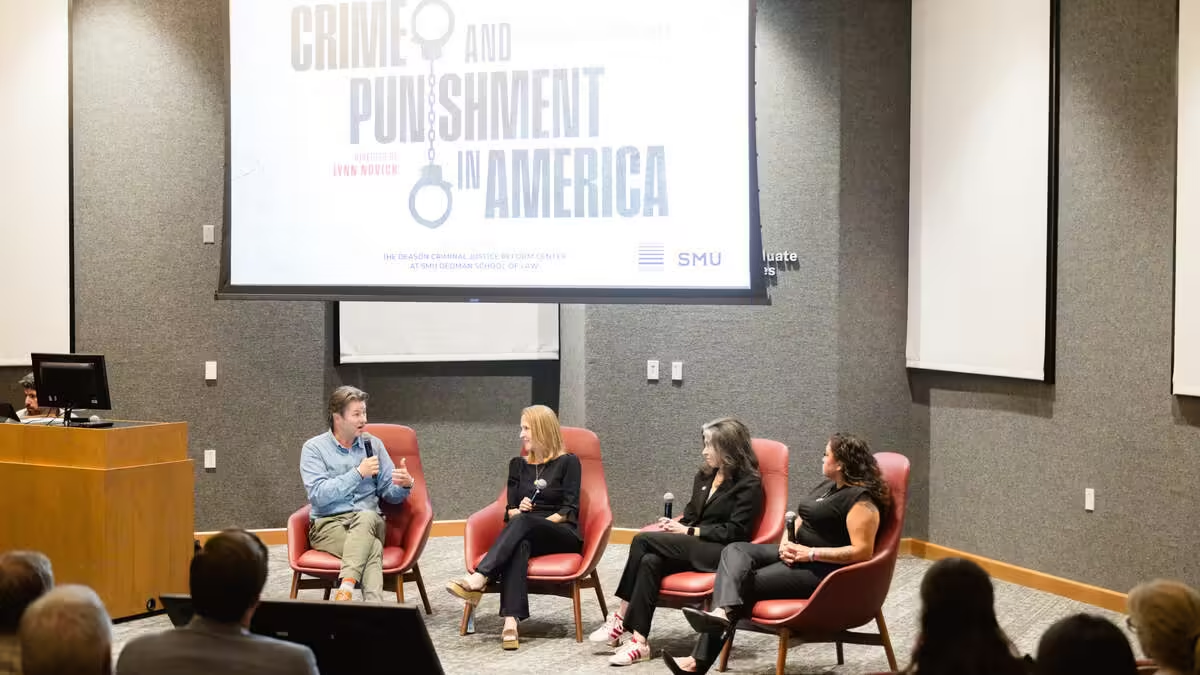

Filmmaker Lynn Novick, second from left, attends a preview screening of her new documentary, “Crime and Punishment in America,” on Monday, Oct. 5, 2026, at SMU’s Moody Hall in Dallas. Joining Novick for a panel discussion were Pamela Metzger (third from left), executive director of SMU’s Deason Criminal Justice Reform Center, and Angelica Zaragoza (far right), who is featured in “Crime and Punishment in America.” Ron Corning, host of KERA’s “NTX Now,” led the discussion.
Courtesy of SMU
Beyond the towering brick walls of the Tarrant County Jail, and every other county jail and state penitentiary in the country, lies an out-of-sight-out-of-mind world that most never see, let alone experience. That is one of the biggest reasons why lasting, meaningful criminal justice reform has remained so elusive in this country for so long, despite the fact that the issue touches so many lives in a nation with the highest incarceration rate of any developed democracy in the world.
A new documentary series titled “Crime and Punishment in America” by the acclaimed filmmaker Lynn Novick, set to premiere on PBS Nov. 16, explains how we got where we are today by presenting an in-depth examination of America’s criminal justice system going back to its roots in the colonial period. And it doesn’t pull any punches when it comes to the factors, such as class and race, which have historically undermined the concept of justice for all.
Last week, Novick was in Dallas for a preview screening of her film hosted by the Deason Criminal Justice Reform Center, which operates under the umbrella of SMU’s Dedman School of Law.
Appearing alongside Novick was Angelica Zaragoza, a mother of four who grew up just outside Dallas and who spent years cycling in and out of jail while she battled a drug addiction that, Zaragoza said, compelled her to do things that she never would have dreamed of doing.
Zaragoza, now 15 years sober, shares her experience in “Crime and Punishment in America,” along with others whose harrowing stories give viewers a vivid picture of what it’s like to be incarcerated or work in the prison system.
In an interview with the Star-Telegram, Novick said the idea for this documentary, which will air as a four-part, eight-hour series, came to her while she was making “College Behind Bars,” released in 2019, which followed inmates in New York who were working toward earning their degrees.
Education gave those inmates purpose, Novick said, which led to transformation. Seeing that gave Novick hope that the criminal justice system might serve a greater purpose beyond simply punishing those who break the law.
An American invention
Novick said the most surprising thing she learned while making “Crime and Punishment in America” was that the concept of housing convicted criminals long term in penitentiaries originated in this country.
Many crimes, including property crimes like burglary or moral sins such as adultery, were punishable by death in the American colonies. Jails were used to hold the accused while they awaited trial. If found guilty, the prisoners remained locked up only until their execution.
One of the people profiled in “Crime and Punishment in America” is Levi Ames, a habitual burglar who was hanged in Boston in 1773. On the day of his execution, it’s said that some 8,000 people came out to watch him die.
“After the revolution, Americans decided that we’re better than that — that this is barbaric and this is bringing out the worst in people,” said Novick.
The idea that criminals could serve sentences behind bars was a more progressive approach to justice in comparison.
“But it didn’t deliver on the promise, almost immediately,” Novick said. “But we still kept on doing it. We didn’t come up with another plan.”
Now, 250 years on, we’re still grappling with that.
Zaragoza compared incarceration with modern slavery, describing the treatment of inmates as inhumane. She pointed out that inmates perform much of the work that keeps prisons running for little or no money while receiving only the bare minimum of nutrition, medical care, comfort and support.
“So you’re coming out in worse condition than when you went in,” said Zaragoza.
In her experience, the criminal justice system doesn’t do nearly enough to rehabilitate the incarcerated and address the underlying issues, often based in trauma, that lead people to commit crimes. And therein lies one of the main questions raised in Novick’s film: Is the system predicated on the desire for vengeance or is it designed to change lives and help people become law-abiding, productive members of society?
If it’s the latter, then we need to confront the ways in which we view and react to people who do wrong, said both Novick and Zaragoza.
“Let’s find out what happened,” Zaragoza said. “Let’s treat you like a human and see what’s going on and try to build you up rather than break you all the way down.”
An unflinching look inside America’s prisons
Throughout “Crime and Punishment in America,” Novick shows what prisoners in this country have experienced from the beginning.
Following the Civil War and Reconstruction, prisons were a way of circumventing the 13th Amendment, which abolished slavery. Blacks in the South were routinely imprisoned on petty or trumped-up charges, then leased out to landowners, mining companies, railroads and factories as unpaid labor.
John Henry, one of the most famous characters in American folklore, was in fact a Black man who died while part of a prison work gang excavating a railway tunnel in western Virginia in the early 1870s.
To this day, underlying racism is blamed for many of the criminal justice system’s failures. Recent statistics show that Blacks make up nearly 40% of the U.S. prison population while accounting for around 13% of the nation’s population as a whole.
Reasons for that are discussed in Novick’s film, as are the hurdles facing people of all races who are accused of crimes but can’t afford legal representation.
“The only thing that distinguishes an arrest from a kidnapping is a lawyer,” said Pamela Metzger, the executive director of the Deason Criminal Justice Reform Center, speaking to attendees at the preview screening of “Crime and Punishment in America.”
Elsewhere in the documentary series, Novick explores the issue of violence in prisons, with former corrections officers describing how guards end up perpetuating a cycle of brutality that takes its toll on everyone involved, resulting in higher rates of divorce, addiction and suicide among those who work in our nation’s prisons.
Then there’s the harsh reality that formerly incarcerated people face when they try and start anew in the outside world. Convicted felons struggle to find jobs and housing, which so often leads to recidivism. Zaragoza said she had tremendous difficulty securing steady employment and an apartment after getting out of jail for the last time in 2016.
“I’m not going to say I’m unhirable, but if you see my application, you’re going to put it away,” said Zaragoza, describing the mindset of hiring managers. “They ask you, ‘Have you ever been convicted of a crime?’. They’re not asking ‘What have you done since that crime?’.”
Novick admitted there are no easy fixes to the problems her documentary highlights, but she said there are examples both at home and abroad that show how the criminal justice system could work better for everyone. Unfortunately, so much about crime and punishment is politicized and sensationalized that even common-sense solutions can seem beyond reach.
But there are glimmers of light in the darkness. Over the past decade, Zaragoza’s life has taken a 180-degree turn. She credited an outreach program she participated in called Girls Embracing Mothers for helping instill in her the desire to change during her last prison stint. Since then, she’s gotten into therapy to address the childhood trauma that led to her addiction and subsequent legal troubles.
Today, Zaragoza runs the nonprofit Janie’s Angels, an organization she founded to support incarcerated mothers and their children. The mission is similar to that of Girls Embracing Mothers, but expanded to include incarcerated women with sons.
The idea behind both organizations is that maintaining family bonds will result in greater success for mothers as they reenter society after being locked up.
“Crime and Punishment in America” will force viewers to reckon with how a society responds when its laws are violated. It will also, Novick and Zaragoza hope, force people to look upon the incarcerated with more empathy, as if those in prison cells were their own sons or daughters.
“If you’re going to incarcerate us, incarcerate us to help us to come out to society where we’re not a threat to everyone else,” Zaragoza said. “Not lock us up, mistreat us and get us more angry and then set us back out on the streets and expect us to be different.”
“Crime and Punishment in America” will air for four nights on KERA beginning Nov. 16. The series will also be available on the PBS streaming platforms.
Fort Worth Star-Telegram
Matt Adams is a news reporter covering Fort Worth, Tarrant County and surrounding areas. He previously wrote about aviation and travel and enjoys a good weekend road trip. Matt joined the Star-Telegram in January 2025.
Source: www.star-telegram.com