



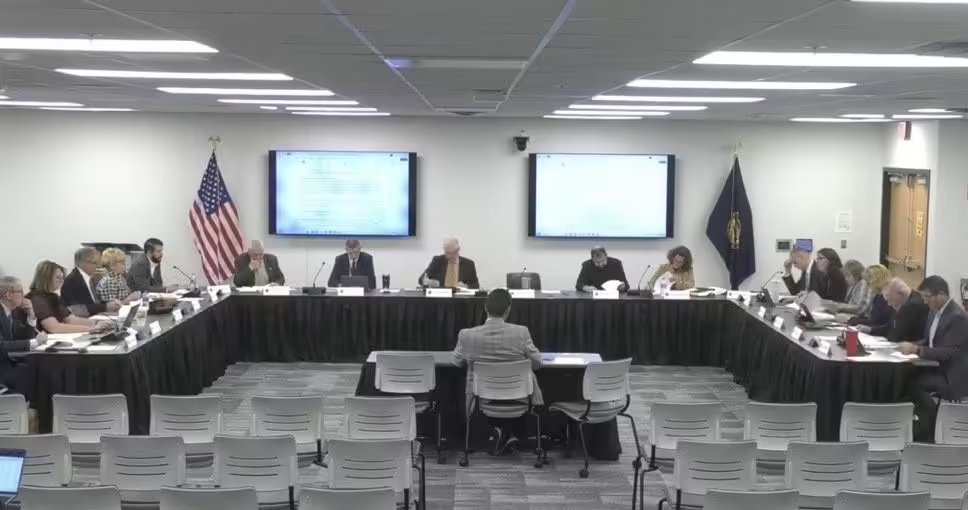

The School Financing Review Commission approved its annual recommendations to the Nebraska Legislature on Tuesday, but with an addition to recognize members’ differing opinions on how much the state should be funding schools.
The Legislature created the School Financing Review Commission to take a look at the school funding formula under the Tax Equity and Educational Opportunities Support Act and make recommendations to prevent an increase of property taxes. The commission is required to send a report of its findings to the Legislature each year by Nov. 1.
This year’s report outlined several recommendations to lower administrative burdens on schools, make the formula less complicated and create more stable year-to-year calculations. These included implementing at least a 4% cost-of-living adjustment in foundation aid that is per-pupil state aid, streamlining or eliminating certain allowances under the funding formula and implementing multi-year averages for the basic funding portion of the equation.
As part of the committee’s findings, the report points out that 51% of school funding comes from the state through various sources, including foundation aid and TEEOSA. The initial draft said members advocated to maintain that level. Tom Briese, a former state senator and state treasurer, said he believes these recommendations aren’t ambitious enough.
“If you keep state contributions at 51%, property tax bills are probably going to go up roughly 3% a year from here on out,” Briese said. “We have to be, I think, more ambitious in our goals, eventually, than maintaining funding at 51%. I think there’s probably a handful of folks in here that would suggest we have a substantially higher number. Personally, I’d like to see it 100%, but you know that’s perhaps not in the cards at this date.”
Briese recommended adding a sentence in parentheses to recognize the committee’s debate on how high the state’s contribution should be. Lou Ann Linehan, a former state senator, agreed.
“I think to turn in a report of this diverse of a group, and say we all agree on everything is like, I wouldn’t, if I was a senator, I would find that doubtful,” Linehan said. “I’d be calling each of you and said, ‘Did you agree with this?’”
Some members supported the final additional language but said they are looking forward to more conversation about how high the state’s contribution should be.
“It has been a full year, whoever made that point, since we last discussed what that funding threshold should be,” said John Schwartz, superintendent of Millard Public Schools. “I don’t know that I have a strong opinion formulated on what that should be. It’s an analytical question in my mind and so I wouldn’t mind having that conversation so I could become more informed and decide what that policy level should be.”
The committee ultimately added that they recommend to “maintain, or increase,” the state’s contribution of 51%, along with adding a sentence in parentheses saying “there is currently no consensus regarding the appropriate level of state funding beyond that threshold.”
Committee members made other minor changes to the report, like fixing numbers or clarifying sentences.
Nebraska Department of Education Commissioner Brian Maher, who is chair of the School Financing Review Commission, said he would bring the report to the executive committee within the next week to ensure the changes reflected Tuesday’s conversations.
Maher thanked the group for their work over the past two years, but said there’s still work to be done.
“As it’s been stated many times today, in some ways, our work is just beginning,” Maher said. “I would also say that I think we’ve given the legislature some things to mull over in this coming session.”
The commission’s next scheduled meeting will be in the first quarter of 2027.
By way of full disclosure, Brian Maher is a commissioner on Nebraska Public Media’s governing board, the Nebraska Educational Telecommunications Commission.
Source: nebraskapublicmedia.org