



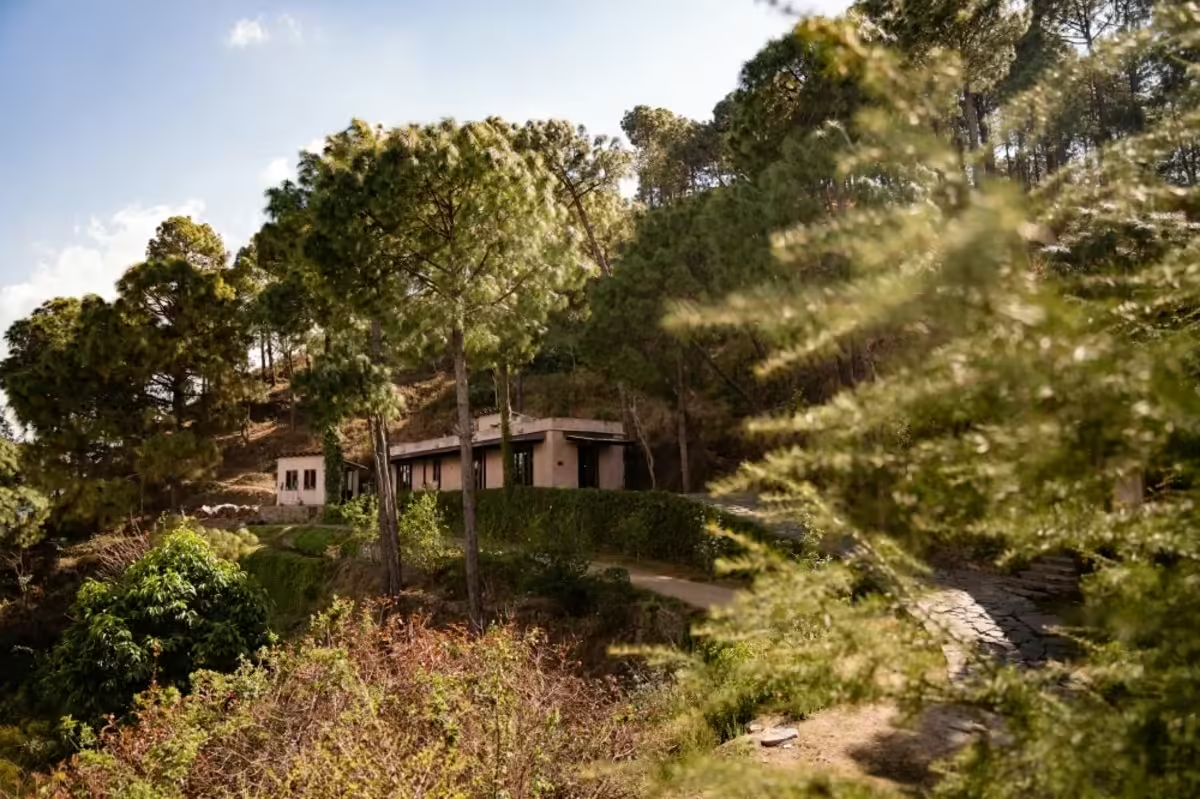

KASAULI, Oct 11 — Writer Salman Rushdie once described the Himalayas as “land’s attempt to metamorphose into sky”; even at its foothills, the world’s tallest mountain range feels otherworldly and awe-inspiring, befitting a place that has long been the backdrop for mythical tales of spirituality and wonder.
Peel away the Orientalist mysticism, however, and a much more grounded — yet no less sublime — picture of the region emerges.
The Himalayas span five countries: Nepal, India, China, Bhutan, and Pakistan. In India alone, the range covers 13 states and union territories, from the disputed region of Kashmir to Himachal Pradesh, home to Shimla, the summer capital of the British Raj.
In the latter state, agriculture and, increasingly, hydropower anchor the economy, with tourism a significant contributor.
And as of 2023, Himachal Pradesh is also home to India’s most ambitious restaurant: NAAR.
Perched at the edge of a cliff above the pine forest, NAAR is part of Amaya, a 25-acre boutique hotel near the remote village of Darwa in the Solan district of Himachal Pradesh.
Few would dispute the description: Kasauli, the nearest town, is 45 minutes away, while the closest airport, in Chandigarh, is a two-and-a-half-hour drive down hairpin bends on steep dirt roads.
NAAR, the Kashmiri word for fire, is Chef Prateek Sadhu’s ode to Himalayan produce and cooking.
After working at some of the most illustrious restaurants around the world and opening one of the best restaurants in India, Chef Prateek Sadhu decided to head up into the Himalayas, which inspired him to open NAAR. — Picture by Pankaj Anand, courtesy of NAAR
After working at some of the most illustrious restaurants around the world and opening one of the best restaurants in India, Chef Prateek Sadhu decided to head up into the Himalayas, which inspired him to open NAAR. — Picture by Pankaj Anand, courtesy of NAAR
A native of Kashmir, Sadhu trained at the Culinary Institute of America before working in the kitchens of Alinea, The French Laundry, Le Bernardin and Noma.
In 2016, he returned to India to open Masque in Mumbai, where he introduced diners to deeply regional cooking rooted in the produce and traditions of Kashmir.
Under him, the restaurant ranked No. 21 on Asia’s 50 Best Restaurants list in 2022 and was named the best restaurant in India that year.
That year, at the height of Masque’s acclaim, Sadhu quit and headed for the Himalayas in search of inspiration.
A year later, NAAR opened. “It was a gamble,” Aashina Kaul, Sadhu’s wife, who runs the restaurant’s operations, told me.
“We were afraid that nobody would be crazy enough to come all the way out here for a meal.”
During my visit on a Tuesday afternoon, the 16-seater restaurant was full, and the busy season hadn’t started yet.
Sadhu told me October typically marks the beginning of it, when affluent Indians travel from across the country to the luxury developments around the region — Shimla is particularly popular — for a winter getaway.
Recognition is arriving alongside the crowds: earlier this year, NAAR ranked No. 30 on Asia’s 50 Best Restaurants list, and this week, Condé Nast Traveller India named it the number one restaurant in India.
The 14-course meal (6,800 INR, RM287) begins with cocktails and snacks at the salon, a small building separate from the main restaurant.
Berries, mushrooms and, unsurprisingly, pines make up the base of many tinctures and liquors, but so does trout.
Though the fish isn’t native to India, it has thrived in Kashmir’s glacial streams since the British introduced it in 1900.
It appears in five courses across the menu, but my first taste of it came in a cocktail: charcoal-filtered tequila infused with smoked trout bone, a pickle of stone fruit, garlic and mustard seed, and trout bone bitters.
It went down like a guilty pleasure cigarette and a filthy martini at the same time, which is to say, wonderfully.
The first snack, a bhangjeera leaf fritter with tomato jhol (a thin gravy) and tomato seed chutney, sets the distinct anise flavour of a perilla leaf against the tang of tomatoes.
Trout reappeared in the second, which Sadhu described as a “trout belly sandwich”. Cubes of trout dressed in a chutney of sorrel and fresh chilli are tucked into a thin, crisp buckwheat flatbread.
A significant crop across the Indian subcontinent, buckwheat is particularly associated with festivals like Shivratri and Janmashtami, when fasting Hindus eat only food made from its flour.
A Kashmiri thujj followed. Typically a skewer of grilled mutton, NAAR’s version uses lamb rump, brined overnight, then grilled with a mustard and chilli glaze.
The onion emulsion served alongside cushions the char and heat of the meat like an allium pillow.

A cocktail made from trout bones (left). ‘Tujj’ is a popular Kashmiri grilled skewer. At NAAR, lamb rump is brined, then glazed and grilled and served with an onion emulsion (right). — Photos by Ethan Lau
A cocktail made from trout bones (left). ‘Tujj’ is a popular Kashmiri grilled skewer. At NAAR, lamb rump is brined, then glazed and grilled and served with an onion emulsion (right). — Photos by Ethan Lau
Next came askalua Himachali snack that resembles a mini deep-fried doughnut.
Traditionally made with rice flour, NAAR’s uses tapioca instead, and is stuffed with duck and topped with a golden raspberry and mountain pepper masala.
The berry, which came into season that week, is much sweeter than its red counterpart.

Golden raspberries, which come into season in September (left). Inside the restaurant at sunset (right). — Picture courtesy of NAAR
Golden raspberries, which come into season in September (left). Inside the restaurant at sunset (right). — Picture courtesy of NAAR
We were moved into the main restaurant for the rest of the meal, where the dark synths of Depeche Mode replaced the funky screeching of James Brown at the salon.
Though the restaurant’s reverence for foraging and hyper-seasonal produce could easily come across as lofty and high-minded, there was a playfulness to the way the team moved and interacted with guests.
Less like self-serious acolytes of a new-age cult, more like curious, earnest children at the best summer camp in the world, if those children were skilled cooks and servers.
A quartet of trout courses followed a bowl of corn custard paired with a chewy sabudana bread, or, as we know it better in Malaysia, sago.
The course that left the most lasting impression was the one where I could recognise every component: a layer of smoked trout roe, glistening under the sun, on an unlikely bed of salted banana custard and banana honey.
The banana’s sweetness stayed on my tongue between bursts of salty roe, opening my mind to an entirely new way of experiencing sweet and salty.
Next came trout trimmings in a crisp, refreshing broth of raw mango and green apple, topped with a dill foam, and then “Dirty Toast”, on the menu since NAAR opened and named for the mess it leaves behind.
A wedge of sourdough inspired by Ladakhi khambir is laden with apple and chilli chutney, onion jus and a Himalayan mustard sauce, and crowned with a thick hunk of lightly charred trout.

‘Dirty Toast’ has been on the menu since NAAR opened (left). — Picture courtesy of NAAR. ‘Sundarkala’ is a type of hand-rolled noodle from Uttarakhand, a state that borders Tibet (right). — Picture by Pankaj Anand, courtesy of NAAR
‘Dirty Toast’ has been on the menu since NAAR opened (left). — Picture courtesy of NAAR. ‘Sundarkala’ is a type of hand-rolled noodle from Uttarakhand, a state that borders Tibet (right). — Picture by Pankaj Anand, courtesy of NAAR
No shade to the lox and bagels and tuna melts of the world, but I doubt I’m topping this anytime soon.
The quartet closed with a portion of trout belly in a curry of trout bones and pickled chillies, to be lapped up with existence.
Known as “the Kashmiri bagel” for its shape, existence has sesame and poppy seeds sprinkled over a crusty exterior that gives way, when torn, to a soft interior.
And then there was a bowl of noodles. Sundarkala are a type of hand-rolled noodle from Uttarakhand, a state to the east of Himachal Pradesh that borders Tibet.
Traditionally made with finger millet and wheat, NAAR’s uses buckwheat instead. Thin and flat like with mien (thick wheat noodles) but without the alkaline spring, they had a tender bite.
They sat in a broth made with timura brighter, more citrusy cousin to the Sichuan peppercorn, alongside lamb plasticinea Tibetan blood sausage.
Meaty depth meets a citrusy, numbing tingle, with buckwheat noodles playing matchmaker.
By the time the penultimate course rolled around family-style, almost three hours had passed and I hadn’t felt a second of it.
Two dishes flanked a large pot of rice infused with tomato chutney: a mild, cream-coloured yoghurt curry with foraged morels, and barbecued pork with a pumpkin seed sauce.

The view from the restaurant. — Picture courtesy of NAAR
The view from the restaurant. — Picture courtesy of NAAR
Sadhu made a point of telling us he wouldn’t tell us how to eat it, though he hadn’t for any of the earlier courses either.
This one needed telling least of all. I spooned hunks of tender pork and meaty morels onto my rice, the spongy caps releasing the rich yoghurt curry all over my plate, then zhuzhed it all up with a few teaspoons of NAAR’s house hot sauce.
A sorbet of sea buckthorn, a very, very sour berry, with timur custard, orange oil and honeycomb cleared the way for a finale of pickled peach with almond cream.
Both were sharp and satisfying, though by then the meal had begun to blur.
NAAR had taken my taste buds on a whirlwind through a famously mythicised region, one specific ingredient and tradition at a time.
I had touched the berries, smelled the shrubs and eaten the leaves, all tangible, and yet, without much context for the centuries of history and millions of people behind them, I felt myself sink into awe.
Afterwards, outside, all I could do was look up at the sky, which felt only slightly out of reach, and my mind began to wander — and wonder.
NASTY
VPO Darwa, Sub Tehsil-Kishangarh,
Kasauli, District Solan,
Himachal Pradesh, India
Open Tuesday to Sunday, 12.30pm—3pm, 6.30pm—11pm
Tel: +91 88004 22053
* Follow us on Instagram @eatdrinkmm for more food gems.
* Follow Ethan Lau on Instagram @eatenlau for more tales of restaurants from all over the world.
Source: malaysia.news.yahoo.com