

One of the most common errors I come across in interpretation of trends in economic losses from extreme weather events is the misuse of economic loss data to infer trends in weather and climate events. Such errors are endemic.
For instance, the authors of the Fifth National Climate Assessment (NCA5) opened their report by claiming that NOAA’s “billion-dollar disasters” tabulation showed an increase due to asset changes and changes in climate — without decomposing the role of each — explaining that in the 1980s the United States experienced one such disaster every four months, and today it experiences one every three weeks. The clear implication was that changes in climate were driving loss trends. That was simply false.
The NCA5 authors are not alone. In my 2025 THB series on insurance and climate change I documented how organizations across the global central banking ecosystem often conflate economic loss trends with trends in weather events.
So I was pleased to have the opportunity last month to present an overview of disaster normalization to the Financial Stability Board (FSB) Regional Consultative Group (RCG) for the Americas — one of six regional groups under the FSB.
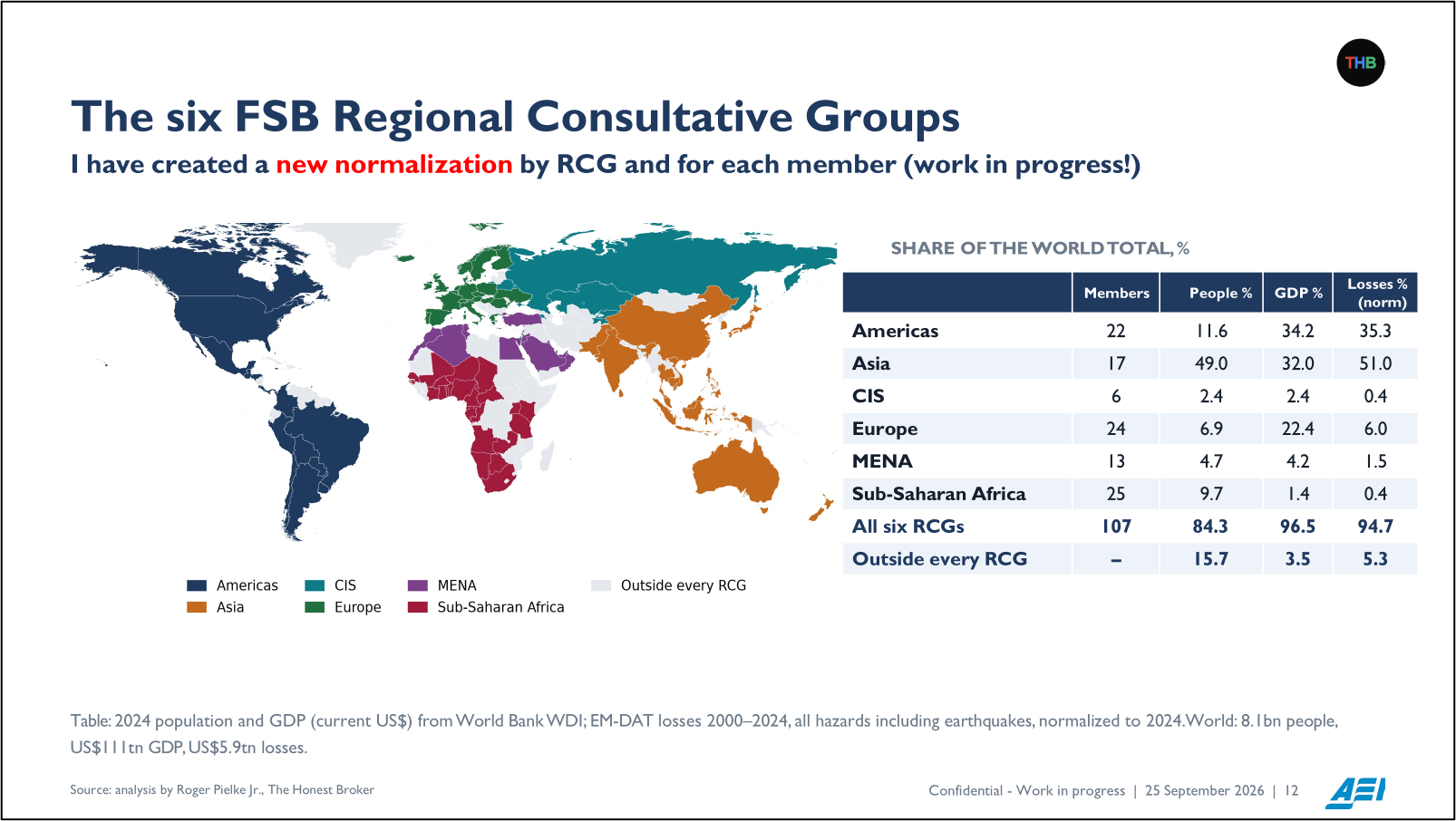
The G20 created the Financial Stability Board in 2009 amid the global financial crisis. Hosted by the Bank for International Settlements in Basel, Switzerland, the FSB brings together national financial authorities and international standard-setting bodies to monitor risks to the global financial system and coordinate regulatory policy.
For my talk I extended and updated our 2003 paper on normalized hurricane losses in Latin America and the Caribbean. I rebuilt every data series from primary sources and applied the normalization methodology to all six FSB Regional Consultative Groups and the 107 jurisdictions that they represent. I delivered an 88-slide deck along with my presentation, representing a new global analysis of normalized disaster losses.
In today’s post I share highlights from my presentation.
Source: rogerpielkejr.substack.com