



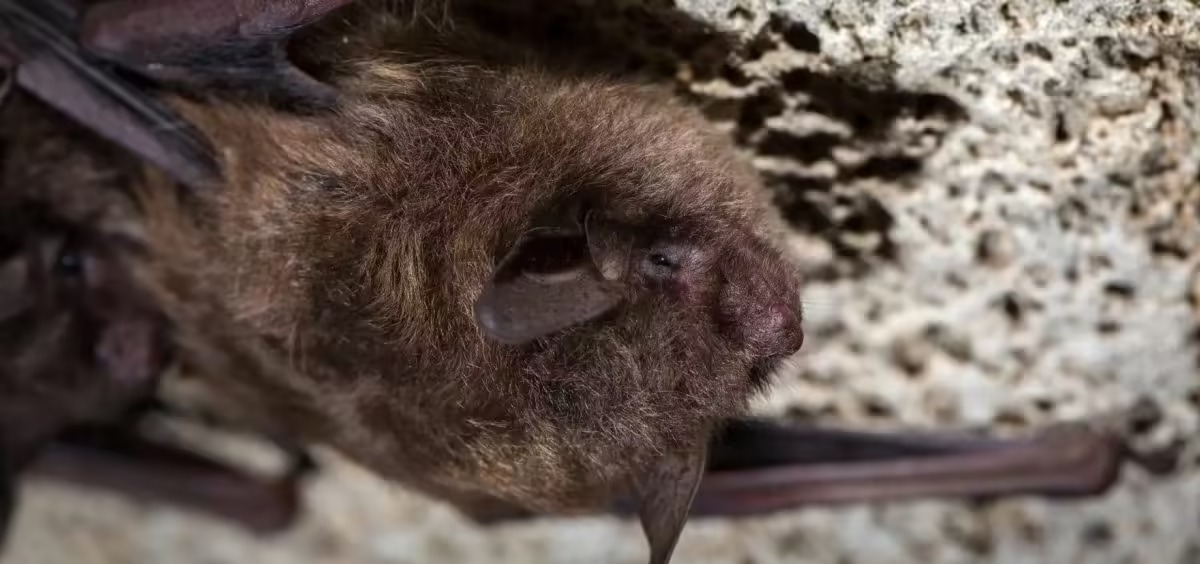

Modern Science: An Ohio University professor studies the mechanisms behind bats using echolocation
By: David Forster
Friday, October 2, 2026
< < Back to
ATHENS, Ohio (WOUB) —There’s a lot we know about how animals navigate their world, but there’s even more we don’t. This included how bats use echolocation until recently.
Peishu Li is an assistant professor of biomedical sciences at the Heritage College of Osteopathic Medicine at Ohio University. They run a lab at the university that, among other things, has been looking into the evolution of super fast muscles and echolocation behavior in bats.
Li sat down to speak with WOUB’s David Forster for “Modern Science.”
This interview has been edited for brevity and clarity.
On how bats use echolocation
“Echolocation is the ability for an animal to create a three-dimensional environment around them using sound alone.
“The way bats do it is they’re able to send out these ultrasonic waves of sounds and then the sound waves are going to bounce off whatever object is around the bat at any given time, and create echoes. The echoes are going to travel back to the bat’s ears and the bats are going to rely on that echo to get a sense about what is in front of it. Is it moving? Is it stationary? Is it something it can eat or is it something it needs to avoid?
“Through that pathway, the bats are able to just create a world around them, even though they’re not able to see it the way we can.”
On what new research shows us about bat behavior
“For a lot of these bats, they’re really good at catching tiny little flying insects almost in total darkness. They really need some kind of way to be able to really quickly localize the position of their prey as they sort of move in for the kill.
“For 70% of the bats today that specialize in catching flying insects, they sort of evolved this ability to sequentially dial up the speed at which they can generate their echolocation calls. They are able to start making a call maybe every two seconds, every five seconds.
“Then as they start snatching on a particular target, they’d be like, ‘There’s some food over there I need to go get.’ They’re going to start ramping up the speed at which they make these calls, so that they can slowly increase the amount of information that’s coming back to them at any given time.
“When they’re making that final lunge at the prey, they can actually make calls up to 100 or even 200 times a second. It’s not just making calls during that tiny little time interval. At the same time they’re making those calls, they’re also interpreting the returning echo to get a sense about how is this little fly moving, and where is the best trajectory I can fly to intercept?
“This really remarkable ability to make sounds at a super fast level is crucial for their evolutionary success. We’re only beginning to learn the secret over the last twenty years or so.”
How bats use an important muscle like no other animal
“One of the things that scientists have learned is that one of the crucial drivers for them to be able to make calls so fast is that these muscles are able to contract at one hundred times, two hundred times, sometimes even two hundred and fifty times a second. This is actually quite remarkable because most of the muscles we have out there in the animal kingdom cannot work that fast.
“If you think about some of the fastest things that we can do as humans, let’s say blinking your eyes, the best you can do is probably five times ten times the blinking per second. Even then, your eyes are going to get sore pretty quickly.
“Bats are able to contract these muscles in their voice box to make these sounds ten times that speed. And they can do that at eight, even to 10 hours every evening for the entirety of their life so that they don’t go home hungry. It’s really these remarkable muscles that kept me going back to work every day, trying to understand what are the sort of key adaptations that make these muscles able to go so fast, and how do these key adaptations actually evolve across this tremendous diversity of bats that we have today.”
The first draft of the transcript used for this story was created in Adobe Podcast, which includes an AI transcription tool. A WOUB news editor then reviewed, corrected and reformatted the transcript before publication.
Source: woub.org