
CAMBRIDGE, Mass. – Applications for the 2027 Tulsa Advanced Sciences Camp, ran by Massachusetts Institute of Technology, opens Oct. 14 for Native American high school students.
At no cost to the student, the program offers a weeklong graduate-level science instruction by MIT and Harvard undergraduates at the University of Tulsa.
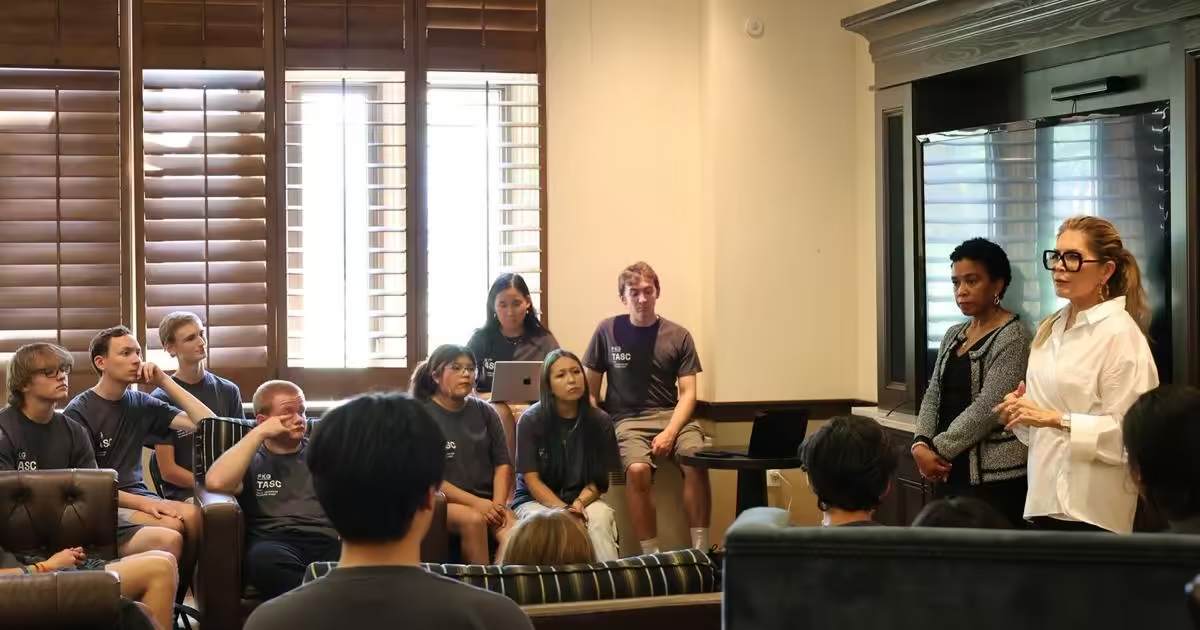
Cherokee Nation citizen Jack Carson, founder of the MIT Tulsa Advanced Sciences Camp (TASC) poses with Principal Chief Chuck Hoskin Jr. at a meet and greet event in John Mabee Hall at the University of Tulsa on July 31.
Known as TASC, it is a program of the Prisilla King Gray Center for Social Impact, an MIT public service center. The program was founded in 2025 by Cherokee Nation citizen Jack Carson, an MIT undergraduate.
The program is built around “a gap in access rather than a gap in ability,” according to tasc.mit.edu.
“Between 10 to 15% of high school in the Cherokee Nation, based on our own survey, have access to a kind of what I would say a BC-level calculus class or an AP-level computer science,” Carson said. “The Cherokees, of course, are one of the best educated of all the tribal nations, and so you can imagine that falls off precipitously as you get into even deeper, less well-resourced tribal nations.”
Carson said students may not only lack the knowledge but the vision to what’s out there for themselves.
“The goal of TASC is not necessarily to teach students calculus so much, as much as it is to give them vision and a sense of possibility to teach themselves the material that maybe they’re lacking in their own communities. Then also just generally to reach for more and (give an) understanding that they can do extraordinary things in the world with their education,” Carson said.
Students will choose one of four tracks to study during the week of camp – chemistry and energy, DNA technology, AI engineering or fundamentals of reality.
No prior coding, lab or advanced math experience is required. The program is meant to be exploratory with no tests, grades or credit.
Workshops are also available to students on reasoning and decision-making – estimating quantities under uncertainty, recognizing rhetorical manipulation, examining inherited values and breaking down personal goals.
During the application process, at least two essays up to 500 words must be given, chosen from four prompts. Carson said ultimately, the program is seeking the next generation of tribal leaders.
“We’re looking for students who have evidence of contributing to their communities, who do a lot outside of school, and who ultimately … can demonstrate that they’ve taken the most out of everything that their community has to offer,” Carson said.
CN citizen Alyssa Theofanidis, of Houston, Texas, is a CN Tribal Youth Councilor, serving in one of the at-large seats. She is 2025 TASC alumni and served as a teaching assistant in this year’s cohort.
Theofanidis said she felt like the camp really gave participants a better understanding of what they might want to pursue in terms of a STEM career.
“While TASC is fairly structured, I think it also leaves a lot of room for discussion and experiential learning in having genuine conversations rather than someone speaking at you, and I think that kind of gets at the ethos of the program, which is to create future tribal leaders,” she said.
In her first year, Theofanidis was in the AI engineering track where she learned about the foundations of machine learning and artificial intelligence like gradient descent and local linearity.
“So, a lot of math. But after that, we had these more philosophical, critical thinking kind of workshops to teach us the best approaches to solving problems and making decisions in our life,” Theofanidis said.
As a teaching assistant, Theofanidis said she saw the impact the program had on others.
“It was really rewarding to see people kind of question their biases and the way that they’re approaching their goals and things like that. Also, it was really cool to be able to kind of … provide my own input into the program,” she said.
CN citizen Isabella Williams, of Owasso, participated in the 2026 cohort and will return in 2027 as a teaching assistant. She encourages students to apply.
“You should still come because you can learn so much,” Williams said. “It’s not about your intellectual ability. It’s what are you going to do with lessons they are teaching you to become better.”
Applicants must be a sophomore, junior or senior and enrolled in a federally recognized tribe with a GPA above 3.0.
Applications for the 2027 cohort opens Oct. 14 for 2027 TASC camp – July 25 to Aug. 3. Early deadline is Jan. 10, 2027, and regular deadline is March 14, 2027. To apply, visit tasc.mit.edu.
Source: www.cherokeephoenix.org