




Using several complementary population genetics analysis techniques, the researchers estimated when microbial strains separated. For many species, those estimates correspond to the timeframe of major prehistoric human migrations out of Africa and into the Americas. The ultimate takeaway: many microbial lineages in these contemporary populations have deep evolutionary roots extending back through ancient human migrations.
“Our study establishes that the hundreds of bacterial species that are rare or missing in industrialized microbiomes were ancient companions of ours as we migrated around the globe, likely passed from generation to generation for millennia,” said senior author Justin Sonnenburg, a Stanford professor of microbiology and immunology. “This long-term association has implications for how such recent biodiversity loss in our microbiome may impact our biology and thus our health.”
Deep genomic analysis
The researchers used deep metagenomic sequencing, a method that characterizes the microbes present in a sample by reading out all the letters of the DNA building blocks. Millions of small sequences of DNA are generated with overlapping stretches of letters indicating where the small sequences match up into longer sequences. Those long sequences are then compared with databases of microbial genomes to identify the detected organism.
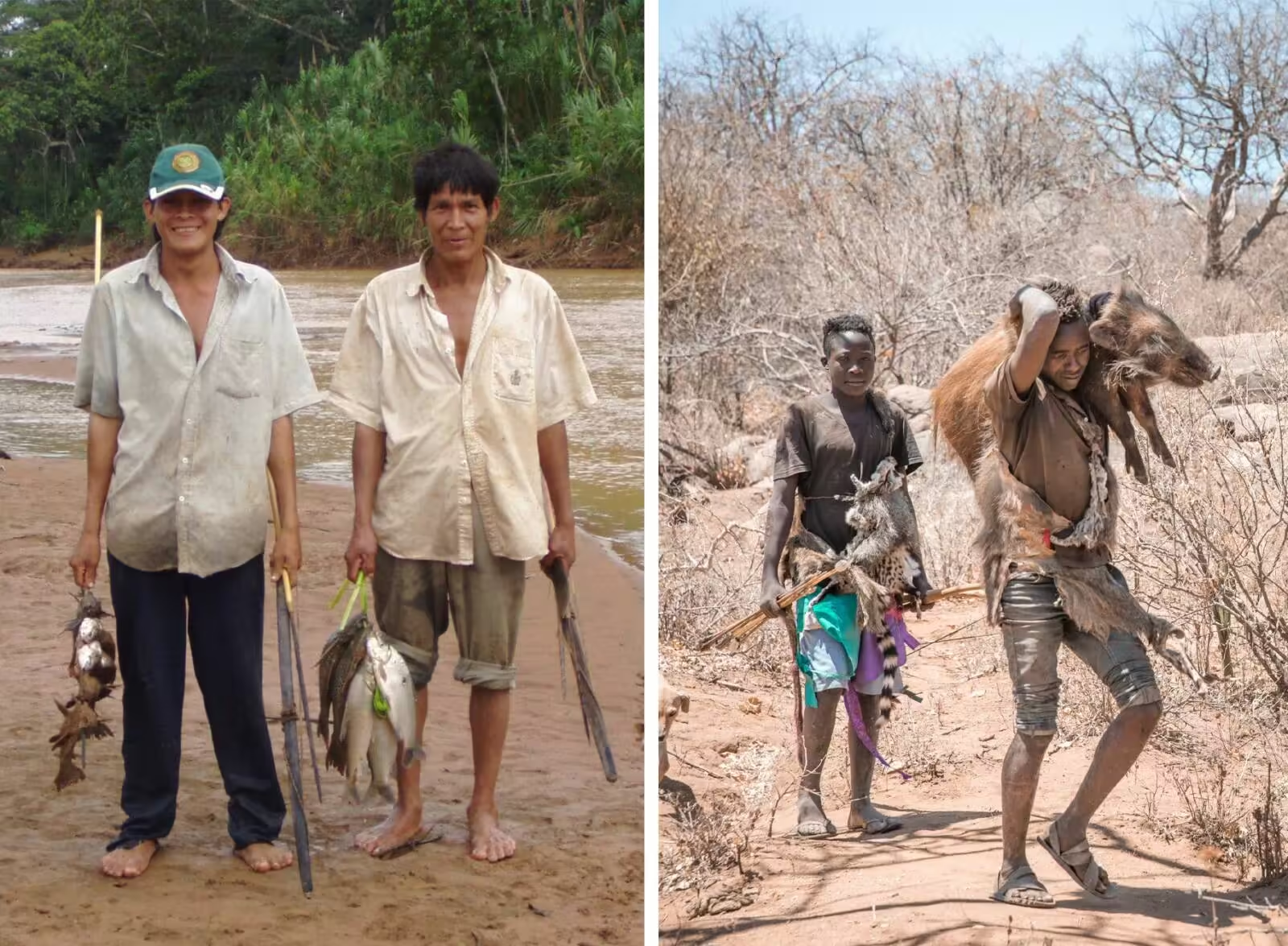
The Tsimané Health and Life History Project team collected voluntary stool samples from the Tsimané. Sonnenburg and colleagues previously completed a metagenomic sequencing on Hadza samples showing, among other findings, that the average Hadza individual has about 750 species in their microbiome, while the average Californian has a mere 250. For the new study, the researchers did the first deep sequencing of the Tsimané samples, which had previously only been sequenced at low resolution.
The sequencing efforts enabled the researchers to build a comprehensive census of the microbes in the respective microbiomes, including hard-to-capture, low-abundance species. Overall, the sampled Tsimané individuals hosted a combined total of about 1,400 different species; remarkably, the Tsimané shared a total of 1,231 of these species (~90%) with the Hadza, according to the new analysis.
“We were really surprised to see that the vast majority of the species in the Tsimané’s microbiome correspond with the Hadza’s,” Sonnenburg said.
Different lifestyles, similar results
Some of that surprise stems from the considerably different diets between the two groups. The Hadza hunt meat from mammals including impala and kudu, along with birds and fish, and forage for fruits and vegetables, including tubers and berries. By contrast, the Tsimané grow much of their food and consume high levels of fiber through plantains, rice, manioc root and corn, along with lean meat from fish, peccary and other forest animals.
Additionally, the two groups have also been separated for tens of thousands of years. Despite this geographic and lifestyle separation, the two microbiomes showed remarkable overlap at the species level.
“That made us wonder if there really is a core set of bacterial and other species that traveled with the ancestors of the Tsimané as they migrated around the globe,” said Stanford’s Benjamin Good, Ph.D., the study’s senior co-author and an assistant professor of applied physics who specializes in investigating evolutionary dynamics and population genetics of the human gut microbiome.
“Could these bugs have been in continual interaction with us since long before the ancestors of today’s Hadza and Tsimané became geographically separated?” Sonnenburg asked. “To answer that, we turned to Ben’s team, and what they found blew our minds.”
An interwoven biology goes way back
Unpacking the evolutionary history of a microbiome overall has proven daunting given complexities posed by how quickly microbes evolve and the changes a given person’s microbiome can undergo from season to season, or based on other aspects of food availability.
Good’s group sought to get around these issues. Bacteria complicate evolutionary reconstruction because they not only inherit DNA from their ancestors but also frequently exchange DNA with other strains in a process known as horizontal gene transfer, The researchers therefore looked for several independent genomic signatures to distinguish deep shared ancestry from more recent microbial exchange. Looking at mutation rates in vertically inherited DNA also helped estimate when species diverged from a common ancestor because mutations accumulate at a steady pace, like ticks of a clock.
That analysis squarely indicated that many of the shared bacterial species between the nonindustrialized groups’ microbiomes have evolutionary histories that trace back over thousands of years. These detailed analyses of genetic isolation of strains produced time estimates consistent with the timing of major human migrations.
“What’s amazing is that Tsimané and Hadza share so many of the same endangered bacterial species in their guts, not because they both live in rural areas with low access to antibiotics — but because they’ve been carrying these same species for hundreds of generations,” Gurven explained. “The analysis shows strong evidence that their ancestors, and presumably all of us, had these same bacteria long ago.”
Source: news.ucsb.edu