




Mexico is increasing funding for science, technology, and innovation projects by 111% in 2026, adding MX$1.676 billion and supporting 1,340 new projects as SECIHTI seeks to connect research with national strategic priorities.
Mexico is putting more resources behind a science and technology strategy designed to move research beyond individual institutions and toward coordinated projects with potential economic, technological, and social applications. In 2026, the government increased funding for research, technological development and innovation projects by 111% compared with 2025, adding MX$1.68 billion (US$92.7 million) to the budget.
The increase was presented alongside a broader effort to connect universities, public research centers, national laboratories, government institutions, and productive sectors around specific national objectives. The approach is intended to strengthen domestic capabilities in areas including semiconductors, artificial intelligence, electromobility, satellite technology, high-performance computing, and medical devices.
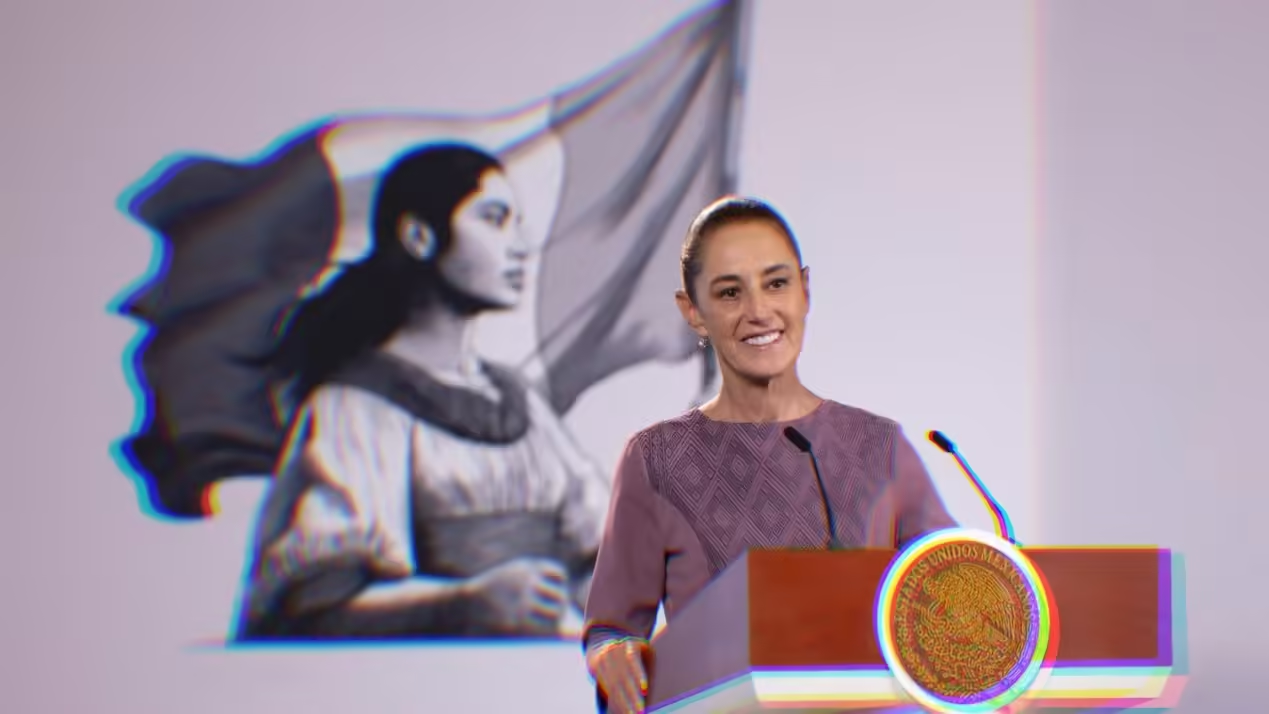
“Besides having increased the budget, an effort with a specific objective had rarely been made,” says President Claudia Sheinbaum. “It is the great innovation that we are presenting and that will produce results, or is already producing results, because they have very specific objectives for national development.”
The strategy places the newly established Secretariat of Science, Humanities, Technology, and Innovation (SECIHTI) at the center of that coordination effort. According to the sector report presented on Oct. 1, the agency coordinates 108 National Laboratories, 27 Public Research Centers, 2,536 programs within the National Postgraduate System, and 48,000 researchers in the National System of Researchers.
SECIHTI also coordinates 1,139 Researchers for Mexico, more than 100,000 scholarships and student support programs, 12 collaboration networks, 3,142 active research projects, and 13 strategic projects.
From Research Capacity to Strategic Projects
The government’s strategy seeks to change how public research capabilities are connected. Rather than supporting isolated research efforts, SECIHTI is organizing multidisciplinary collaboration around projects intended to address specific national priorities.
Sheinbaum points to Olinia as an example. More than 70 researchers from different public universities are working on electromobility for the Mexican electric minivehicle project. The objective is to establish a model in which public researchers develop capabilities and technologies before private companies are invited to participate, particularly in production.
“The vision is completely different. It is the link between researchers, mainly from public institutions, with an objective, and if this promotes development, the possible production of this development with the private sector is considered,” Sheinbaum states.
This model is also reflected in Coachmanwhich seeks to strengthen Mexico’s semiconductor value chain through a National Design Center with three locations. The project also includes a national plan and links with high-performance computing infrastructure. Semiconductors are particularly relevant to Mexico’s technology ambitions because domestic capabilities in design and related activities could complement the country’s broader participation in electronics and advanced manufacturing.
Another strategic project, Coatlicueis focused on high-performance computing and AI. Its planned infrastructure includes a supercomputing cluster and connected nodes designed to provide services to government, academia, and industry.
Technology for Infrastructure, Resilience, and Industry
The portfolio extends beyond computing and semiconductors. Ixtli is being developed as a constellation of Earth-observation satellites. The first satellite is in the design stage and is expected to generate images with a resolution of 4.7 meters, creating domestic capabilities for Earth observation.
Apixqui focuses on meteorological and oceanographic monitoring and early warning systems. According to the SECIHTI report, the project is designed to generate 30 times more observations in near-real time to improve forecasts. Quetzalmeanwhile, is developing unmanned aerial vehicles. Its prototype has an autonomy of up to six hours, an altitude range of 5,000 feet and a 50-kilometer route.
Other projects apply scientific and technological capabilities to sectors closer to everyday economic activity. The Maíz y Frijol initiative includes improved seeds, four prototypes of Mexican agricultural machinery and sustainable practices aimed at increasing production.
In healthcare, SECIHTI is developing medical devices, including dialysis and hemodialysis equipment. The agency reports successful functional tests of prototypes, signaling an effort to develop domestic capabilities for medical technology.
The strategy also addresses environmental challenges. A network of 150 experts is working on the comprehensive use of sargassum, covering the origin of the phenomenon, containment, collection, disposal and monitoring.
More Funding, More Projects, and a Larger Talent Base
The funding increase is already reflected in the number of projects supported, say authorities. SECIHTI reports that 1,340 new projects received support in 2026compared with 902 in 2025, representing a 48% increase. Women scientists account for 44.7% of those responsible for the new projects. The additional funding totals MX$1.676 billion for research, technological development and innovation.
The government also increased resources for postgraduate scholarships and student support. More than 100,000 scholarships and support programs are being provided in Mexico and abroad, with the number of beneficiaries increasing 5.8% from 2025. The 2026 budget for these programs stands at MX$16.551 billion, up 12.3% from the previous year.
The talent strategy also includes the creation of 200 positions for highly qualified researchers at Secihti Public Research Centers. The program received applications from 37 countries and involved 82 host institutions.
The scale of the research infrastructure provides a base for the strategy. The 27 Public Research Centers graduated 1,355 people in 2025 and recorded 160 patents, equivalent to 16% of all patents granted in Mexico that year. They also include 4,838 people working in science, technology, and humanities.
Source: mexicobusiness.news