As the legendary executive editor of The Washington Post and The Boston GlobeBaron led newsrooms to multiple Pulitzer Prizes and navigated some of the most turbulent eras in political history. In a sweeping conversation, he broke down the failure of mainstream politicians to grasp voter anxiety, the crisis of trust in traditional media, and why the shockwaves of the Trump era will likely outlast Donald Trump himself.
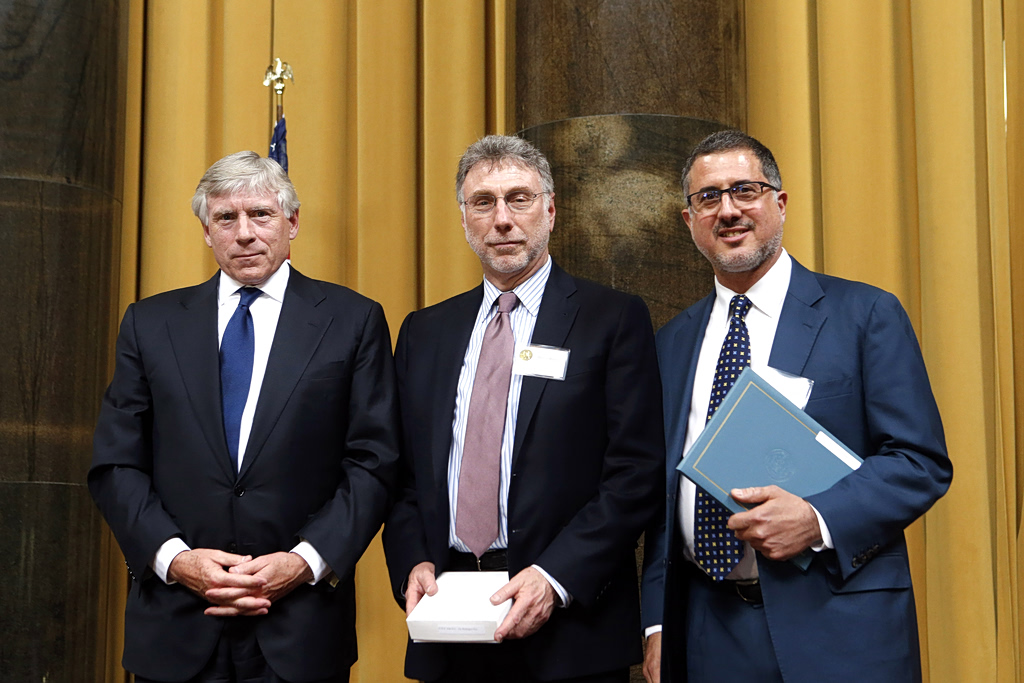
Martin Baron, center, and Bart Gellman, right, of the Washington Post, co-winners of the 2014 Pulitzer Prize for Public Service, pose for a photo with Columbia University President Lee Bollinger during the award’s ceremony at Columbia University’s Low Library, Wednesday, May 28, 2014, in New York. (AP Photo/Jason DeCrow)
With the rise of populism and the far right in Europe and the US, do you think the mainstream media has a responsibility to help people understand what is at stake for democracy?
It’s the obligation of the media to tell the public what it needs and deserves to know about their government and about people who hold power and institutions that have power, so that people can decide for themselves in a democracy what to do about it.
Certainly in the United States the mainstream media has done very good work. Actually, everything we know about Trump comes primarily from traditional journalists: about the level of corruption, about efforts to manipulate the elections, about violations of the rule of law, about what’s happening with the war in Iran. And our journalists continue to do their job despite enormous political pressure.
And even though Trump says he’s the most transparent president ever, he’s completely not. He’s accessible, but he isn’t transparent. And there’s a difference between being accessible and being transparent. And there’s a difference between being accessible and telling the truth, just as being accessible and having respect for the Constitution are two different things.
He doesn’t have respect for the Constitution. He’s not respectful of the rule of law, and he’s not transparent.
It’s up to the public to decide what to do. The media can only tell people what’s going on, and then it’s up to the public to decide.
And there are other factors, too. So you have to ask yourself, why did Trump get elected again? A lot of that had to do with the enormous amount of immigration, undocumented immigration across the southern border, and the very high rate of inflation.
Why do you think so many ordinary voters are turning to the far right and leaders like Trump? What are mainstream politicians failing to understand?
Hillary Clinton infamously called people “deplorables”. You can’t call people deplorables. You may not agree with them on their policies, but they’re ordinary human beings struggling with their lives, trying to make a living, trying to get ahead, trying to create a better life for their kids, live in safety—all the normal things people want for themselves and their families.
The Democratic Party and the Biden administration made an enormous mistake in allowing huge levels of immigration—a million people a year. How many countries can absorb that, and how many populations will tolerate that?
So immigration is a hugely potent issue, and so is inflation and the economy generally. People feel high prices, and they’re struggling more because of it.
But now high prices are hurting Trump, and even his immigration policy isn’t helping him because of the way he has executed it and the cruelty behind it.
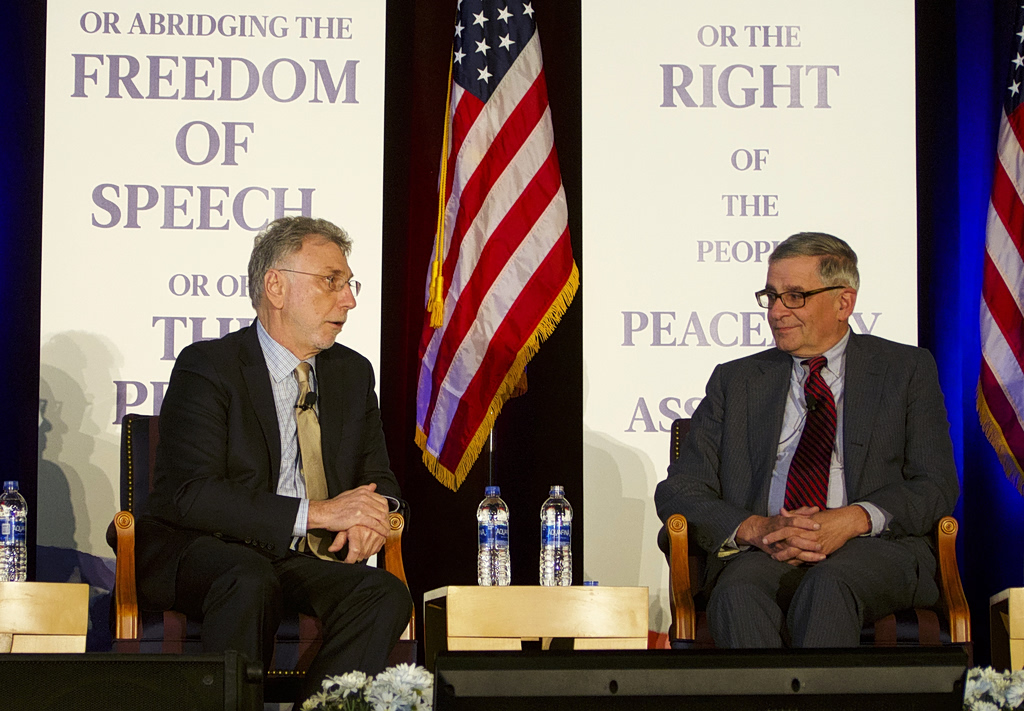
Martin Baron, left, executive editor of The Washington Post, speaks as David Shribman, executive editor of Pittsburgh Post-Gazette, listens at the National First Amendment Conference in Pittsburgh on Monday, Oct. 22, 2018. Journalists, scholars and government officials past and present have gathered in Pittsburgh to emphasize the First Amendment’s continuing importance in American society. (AP Photo/Ted Anthony)
Are you worried that people are increasingly getting their news from social media? How can they know what is true and what isn’t?
And from chatbots now, a lot. So yes, I am concerned about that. To be a truly informed member of society, to be a fully engaged citizen, one has to be well-informed. And it’s very hard to be well-informed when you’ve only watched a 15-second video about a subject. Because a subject as complicated as the Middle East, and many others besides, can’t be explained in a 15-second TikTok video. And then people are trusting individuals who don’t necessarily deserve trust. They communicate authenticity, they seem authentic, and so people give them credit as authorities. In our business, as journalists, we have always focused on our authority, on the verification of information. But we haven’t focused much on our authenticity, and we don’t communicate with the public effectively, the way many influencers do, for example. Which gives these others the advantage, unless we change our ways and start focusing on our authenticity. But I think it is concerning, because we now live in a society where we don’t share a common set of facts. And I am constantly saying it’s actually worse than that, because we can’t even agree on how to determine a fact, and that’s because the elements we have traditionally used since the Enlightenment to determine facts have all been devalued, denigrated, dismissed, and outright denied. What are these elements? Education, expertise, experience—two types: what you’ve personally experienced, but also how long you’ve been in the field—and, finally and most importantly, actual evidence. Though people will sometimes deny what you can see with your own eyes and hear with your own ears, too.
So we live in an era, the digital age, when anybody can be a media outlet. You turn on your computer, turn on the camera, turn on audio—and you’re a media channel. And people are taking advantage of that. And I think that, while there are some very good influencers, who are very well informed in their fields and do a very good job and have ethical standards and all of that, there are many others who don’t, and who are exploiting the current digital environment for their own personal, professional, commercial, or political ends.
Would it be a solution for the big newspapers like The Washington Post, The New York Times, The Wall Street Journal to have their own influencers?
I think it’s a good idea. I think we should. Absolutely. It’s important to find people on the staff who can communicate effectively with the public. And some have begun to do just that, actually. And, certainly, many institutions—for example, The New York Times—are placing a heavy emphasis on video, encouraging their staff to use video and helping to train people how to do it right.
So, the Boston Globewhere I used to work, discovered somebody who was really good at this by chance, and in essence they made her the person who recounts the news in short-form videos. And she had this very thick Boston-area accent, and people were captivated by it. So, she went viral, and then they said, ‘well, what if we do this regularly?’ And she is now. So, yes, I do think media outlets should learn from influencers, because for now they’re communicating far more effectively than we are. We work for communications companies, but we’re finding out that we’re not very good at communicating. So we need to get better at that and learn from whoever we can learn from—we shouldn’t be arrogant about it and think we don’t have anything to learn from other people. We do have things to learn from others, so let’s learn them and put them into practice.
You had a good relationship with Jeff Bezos. What changed, and what does it mean for the future of The Washington Post?
I did have a very good relationship with him. I think he was a very good owner when I was there. He stood up to Trump. He resisted Trump. Trump threatened him in so many different ways and threatened his businesses. He tried to increase the postal delivery rates on Amazon packages. He interfered in a $10 billion cloud computing contract with the Defense Department. And he attacked Bezos personally all the time, called him names, you name it.
So I think what changed is that, after January 6, 2021, Bezos, along with just about everybody else, thought we were finished with Donald Trump. And then he rose like a phoenix from the dead, the political dead, and he was back.
And toward the end of the election, it looked like there was a very good chance he would win the presidency. Joe Biden had been a weak president, then he took forever to get out of the race, then Kamala Harris became a candidate with only three months left. And she wasn’t a particularly great candidate either.
I think Bezos was very worried about what the consequences would be, because Trump said during the campaign that he was going to seek vengeance on his perceived political enemies.
Bezos was perceived as a political enemy for one reason and one reason only, and that was the coverage of The Washington Post. And I think he felt that Amazon would not get new contracts with the federal government for cloud computing services, a big area of growth for Amazon. He felt they might cancel the existing contracts with Amazon. He also is the owner of a private space company, Blue Origin, which was struggling to compete with SpaceX and had fallen well behind. But it was at a critical juncture, and needed federal contracts to succeed.
And, as I always remind people, while Amazon is the source of his wealth, Blue Origin is the object of his passion… and The Washington Post is neither. And so it may not even be sufficient to say he’s deprioritized The Washington Post—I’m not even sure it ranks as a priority at all at this stage. I think he just doesn’t want it to be a headache for him as he tries to navigate this second Trump term.
But I do think it’s important to emphasize that the news department of The Washington Post continues to do really excellent work. And I admire them for that. I celebrate what they’re doing and think that should be supported. They’ve done a tremendous job of holding Trump accountable. And Bezos hasn’t interfered in the coverage of the news department, which is entirely separate from the opinion department.
But I think that Bezos’ behavior with respect to Trump, his efforts to repair his relations with Trump, and the way he’s gone about it has done enormous damage to the reputation of The Washington Post. I think the Post will survive this. I do. I think it’s already surviving it.
And do you think democracy in the United States will survive?
I think it’s a very perilous time for democracy in the United States. I remain optimistic that we’ll survive, but there’s no question that Trump is attacking every fundamental pillar of American democracy. He’s attacking the rule of law. He’s attacking freedom of expression, including freedom of the Press. And he doesn’t respect the notion that there are other branches of government. I think he’s causing a lot of damage to American democracy, and he’s done so in a very, very short period of time. It hasn’t even been two years yet, and he has more than two years left. So I think he represents a huge danger to American democracy.
And it’s important that everyone fights that. It’s crucial the judges do their jobs appropriately, regardless of the threats; it’s vital the press does its job regardless of the threats; it’s critical that others speak out whose expression is threatened, whether they be academic researchers or historians or statisticians for the government or business executives who don’t feel free to express themselves for fear of reprisals from Donald Trump.
Do you think the Trump era will end with Donald Trump?
The effect of Trump is permanent in a certain way. I think he’s dramatically changed the nature of American politics in a lot of different ways. But I don’t think his successor in the Republican Party, whoever they may be, will have the same effect as Donald Trump.
There’s a bit of a cult of personality around Trump, which would be very hard to transfer to somebody else. I certainly don’t see anybody, including JD Vance, who could continue it. It’s hard to explain, but it is a cult of personality, and I think it is distinct to Donald Trump.
Thank you so much.
Thank you for the time.
Martin Baron participated in the Athens Democracy Forum
Source: www.tovima.com