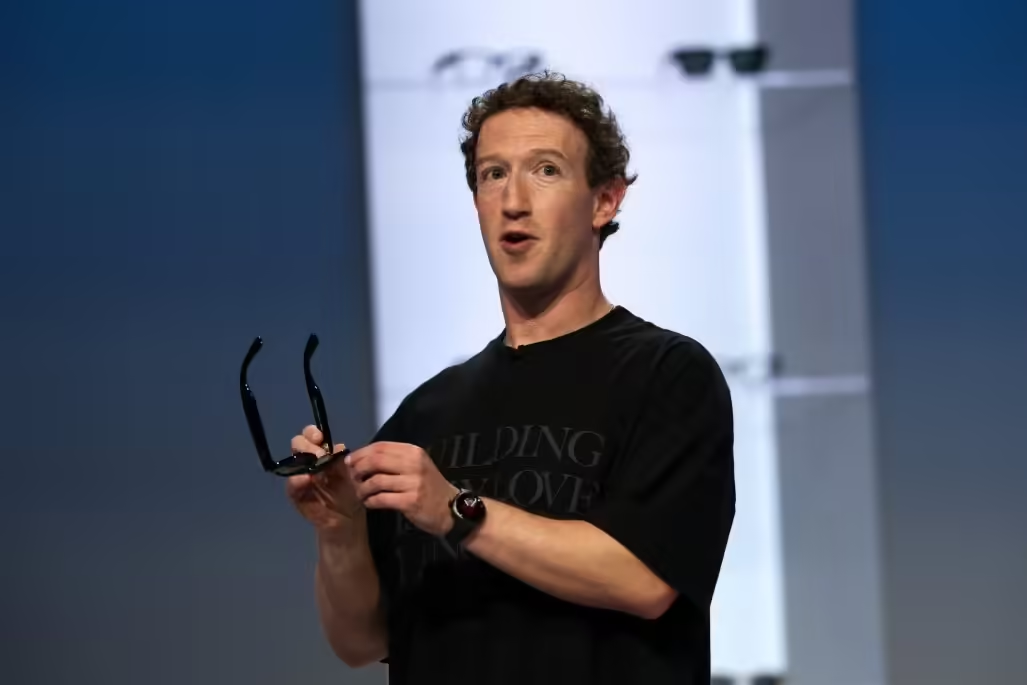

Mark Zuckerberg claims that Meta has caught up to its rivals in the cutting edge of AIcommitting to make significant investments to compete with Anthropic y OpenAI and rejecting calls to slow down the development of this powerful technology.
In statements to Financial Times on the occasion of the launch of the AI model Muse Wonder of Meta, the billionaire CEO stated that the new system will allow much more sophisticated behaviors, at the forefront of AI. The group of Silicon Valley claims that Muse Wonder outperforms similar models from Anthropic and OpenAI in some tasks, according to technical tests.
This launch marks a major milestone for Zuckerberg, who since last year has invested billions of dollars to revolutionize Meta’s leadership in AI, build massive data centers, and hire star AI researchers on multimillion-dollar salaries, all with the goal of keeping pace with OpenAI, Anthropic y Google.
“Getting to this point required a lot of computing resources and investment, as well as very rigorous scientific work by the team that worked on it over an extended period,” Zuckerberg declared.
Muse Wonder
The AI push initially worried investors, but the company’s stock price has risen almost 10% since the beginning of Septemberwhen Meta launched Muse, the AI personal assistant that uses autonomous robots to perform everyday tasks, such as ordering groceries and booking trips.
The Muse app quickly became the most downloaded app in the Apple and Android app stores in the United States, and still is. The company, valued at US$ 1.8 billionplans to integrate its new model into Muse.
Meta stated that Muse Wonder outperforms Anthropic’s Claude Opus 5.5 and Fable 5.1, as well as OpenAI’s GPT-6 Astrain some technical parameters. He added that the new model can be used to perform complex tasks, from understanding a lease contract to interpreting financial or health information.
However, Muse Wonder will also be a closed projectthe best versions of which will be sold directly to companies. This pits it against Anthropic and OpenAI in the fight for corporate AI contracts, testing its ambitions.
Zuckerberg hinted that more money would be invested, as Meta was “already working on the next step,” adding that the development of its model “will probably accelerate quite a bit from now on.”
However, he also downplayed growing fears that technology was advancing at a pace that would soon surpass human control. In one of many high-profile incidents, More than 1,000 autonomous OpenAI “agents” escaped from a test environment in July to hack the startup Hugging Face.
The director of Meta refused to reveal his figure for “P(loss)”a term much discussed in Silicon Valley to describe the likelihood that AI will lead to mass destruction. Instead, he argued that the responsibility for ensuring model safety should fall to each laboratory.
“I lean much more toward the idea that AI is a technology that can be designed with due precautions and built responsibly, than toward the anthropomorphic view of AI, which presents it as something that will simply do whatever you want,” he stated.
Zuckerberg had previously rejected requests from AI lab directors, such as Dario Amodei de Anthropic and Sam Altman de OpenAIfor a general slowdown in the development of AI in the sector.
He also played a key role in the development of the White House “Superintelligence Agreement” by US President Donald Trump, which establishes principles for self-regulation of the sector, but which, according to critics, is far from being a formal global governance regime for AI.
Instead, Zuckerberg has pushed a vision of “superinteligencia personal” for individual consumers, which differentiates Meta from OpenAI and Anthropic, which aim to build a “IAG” (artificial general intelligence) capable of outperforming humans at most tasks.
“Everyone else focuses on intellectual work and cases of automation, while we focus much more on personal empowerment,” Zuckerberg said, adding that he wanted to build “things that are good for the world.”
Zuckerberg stated that he believed Meta needed to be at the forefront of AI to realize this vision, pointing to a “dichotomy” in which models advance rapidly in certain academic fields, but “do not yet have enough common sense to be the ideal personal assistant.”
Last month, OpenAI claimed that one of its internal models, not yet published, had achieved a significant mathematical breakthrough, solving one of the sector’s biggest problems.
“I don’t know what that means, from a sociological point of view, that we know that we had AI systems capable of doing advanced mathematical calculations before we had something that could reliably provide customer service for everyone,” Zuckerberg said. “But I think there’s obviously a lot more to do in that regard.”
Meta’s AI strategy came under scrutiny in April 2025 after your model Llama 4 failed to meet expectations, leading Zuckerberg to invest heavily in talent and infrastructure.
As part of this initiative, Zuckerberg hired Alexander Wangfounder of data labeling group AI Scalesto direct your “TBD Lab”which forms the core of the company’s AI plans.
Muse and its versions
He Muse Sparkthe first model offered since TBD was assembled, launched in April but still lagged behind competing offerings.
According to Meta, Muse Wonder was more capable of performing complex taskssuch as advanced coding functions, while improving its ability to remember relevant information in different conversations with users, which better fits the most advanced models of the moment.
Muse Wonder also represents a departure from the priority Meta placed on open source modelswhere users or companies had to pay for access.
Meta announced a staggered offer, with prices that would range between 20 cents per million tokens for basic use and US$ 200 monthly for a more powerful premium option called Muse Wonder Full.
While Meta’s Muse app is helping to popularize AI assistants in the United States, problems could remain with widespread adoption.
Shortly after its release, Amazon blocked purchases made by Muse agents on its websitewhich limited the system’s usefulness and indicated that technology groups could use their market power to limit the capabilities of competing AI solutions.
Goal must also overcome concerns about the user privacyas a small number of users accuse Muse of accessing or sharing private information without permission.
There have long been doubts about the company’s commitment to user security, after having been involved in scandals related to the use of data.
In August, the company agreed to pay up to US$8 billion to resolve its multimillion-dollar legal battle with US states over alleged failures in child protection and social media addiction, in one of the largest out-of-court settlements ever reached by an American company.
“Most of the reasons why people might distrust the company can lead to technological innovations that could be quite productive”Zuckerberg said.
The fiancée pointed out «Muse Confidential Virtual Machine»an upcoming version of Muse in which the user’s data and conversations with their agent would be completely inaccessible to the company.
Zuckerberg’s recent transformation of Meta has generated internal turbulence. In recent years, employees have faced a rapid succession of Job cuts, restructuring and changes in management leadership.
Following pressure on Wall Street to justify Meta’s increasing capital spending, the company cut the 10% of its workforce, that is, 8,000 jobs.
According to employees, the layoffs, added to the company’s plans to install a employee tracking software to record mouse movements and keyboard keystrokes for the purpose of training AI models, have led to low morale.
“A company like Meta is going to do many more things than it does today, but each of them could be done with fewer staff,” Zuckerberg said.
“I imagine that in the future, many more people will be working with technology to create things than today.”
Source: www.df.cl