

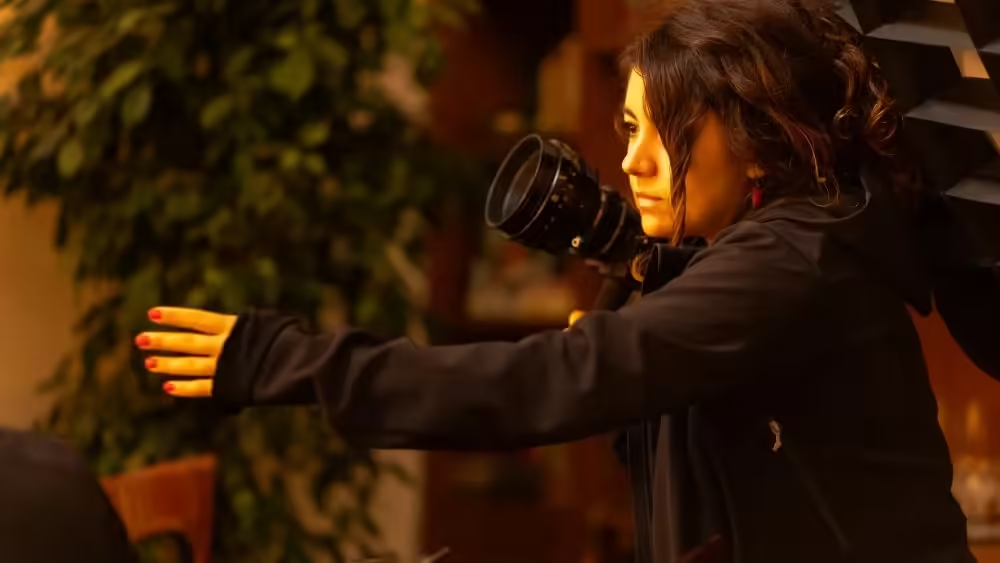

Debuting Italian director Margherita Ferrari is at the Busan International Film Festival with “Föa – Once Upon a Future,” an innovative coming-of-age drama that also marks Paolo Sorrentino‘s debut as a producer.
Set in Genoa during the tragic days in July 2001 when the G8 summit led to deathly clashes between protesters and police, “Once Upon a Future” tells the story of Nicole, an 18-year-old girl who is eight months pregnant and takes three protesters into her home. Using a fable-like tone, the film provides a fresh perspective on the G8 violence that became a watershed moment in the anti-globalization movement.
“’Föa’ begins with a wound that history never quite managed to close,” Sorrentino said in a statement to Variety. “Margherita Ferrari turns the memory of Genoa into something intimate and dreamlike, where the past quietly returns to question the future.”
“Föa – Once Upon a Future,” which stars emerging talents Gaia Ravina, Clara Tramontano, Iker Urgoiti and Gabriele Falsetta, was co-produced by Sorrentino′s production company Numero 10, with The Apartment and PiperFilm. PiperPlay is handling international sales.
“At a time when imagination needs to be protected, supporting new authors and their singular visions feels more important than ever,” Sorrentino continued. “I am particularly proud that Numero 10 begins this journey with a film told through such a powerful female gaze — a story that reminds us that even after the future seems to have disappeared, it may still be waiting for us.”
The film started as Ferrari’s graduation short at Rome’s Centro Sperimentale film school, after which she had the opportunity to pitch the expanded project to Sorrentino. Below, Ferrari speaks to Variety about what sparked “Once Upon a Future” creatively and its fortuitous production journey.
How did the “Föa – Once Upon a Future” story germinate?
On July 20, 2001, I was only 4. I remember the windows and the typical green shutters of our living room in Genoa had to be closed because outside there was smoke and noise. So, even though it was summer and sweltering inside, we had to barricade ourselves in, staying in the dark. Shut away. That image came back to me during the pandemic. I had sought out that same feeling — of solitude, isolation and even powerlessness — while something much bigger than me and all of us, something powerfully collective, was happening outside. On a more personal level, I’ve always felt a certain disillusionment regarding the limits of my own power; how little impact I can actually have on the world or on contemporary reality. It’s a feeling that hits me every time I speak about this subject.
Tell me more.
I know I’m not just talking about me. I see this reflected in so many of my peers, and perhaps in people in general, who are experiencing the world as it is today. So there is that, combined with the lingering wound of those days and all the traces they left behind. Speaking as someone from Genoa, I felt a desire to tell a story that, even though it’s set in 2001, is really about the future and about today. How do you do that? Usually, fairy tales are set in the distant past. Yet they’re actually meant to speak to the present. So, that’s more or less how it all came about.
Starting with the title, “Föa – Once Upon a Future,” this film is a fable of sorts. Talk to me about this narrative choice, which is unusual in dealing with historical fact.
The Genoese term “Föa” actually means “story,” in the sense of a made-up story, a little tale or a fable. That aspect interested us [myself and my co-writers] partly because we wanted to blend history with a capital H, the kind you study in books, with a fictional tale about a character who doesn’t exist. It also suggests that to tell the truth about reality, you somehow need invention and metaphors, and therefore cinema and fables too. We also wanted to approach this historical event from a more emotional, dreamlike perspective, focusing on the almost unconscious traces that were left within us by those days. This applies even to those, like us, who experienced the aftermath of the Genoa G8 events. In a way, we always felt like we were inside Nicole’s womb, so to speak. The child Nicole is carrying in the film would be 25 or 26 years old today. In a sense, he has been carrying the same question we have, which is: “What will the future awaiting us actually be like?”
I’d like to add that I hope this film offers more than just the questions that are raised by those events. I hope it allows the audience to imagine that things might turn out a bit better. It’s like in fairy tales, I always envisioned a moment of relief at the end, a breath of fresh air that leaves room for that possibility.
What was it like to have Paolo Sorrentino as your producer?
Paolo was very involved during both the initial writing phase and the editing process. But not on set. He treaded lightly in that phase. He just stopped by once to say hello. I tried to get him involved, but he didn’t want to. Basically, he was very keen on not being intrusive and to respect the boundaries of the set. I view that gesture as an act of great tenderness on his part. Even though I’ve always loved getting his advice, it never scared me, I find Paolo to be very patient. I think he had often already thought out certain solutions before we did. But he waited for me, or for me and the editor, to get there on our own, to reach the direction in which the film needed to go. He helped me pursue and protect my vision all the way to the end, while supporting my work as a director through every single phase. It was a beautiful creative process from the start. It also helped me grow, helped me bring the film to the screen and become the person I am today. That’s more or less how it went.
Courtesy PiperPlay
Source: variety.com