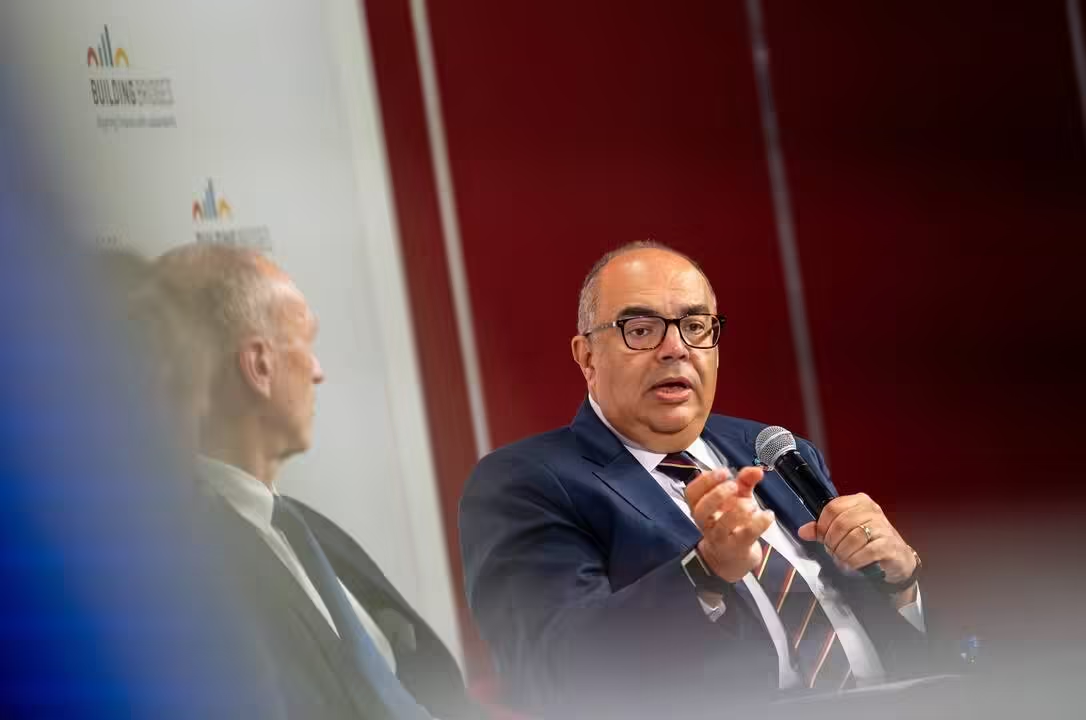

As thousands of finance leaders gather in Thailand for IMF and World Bank meetings, the Egyptian economist warns that tackling today’s biggest development challenges will require looking beyond the existing international financial system to more localised solutions.
Mahmoud Mohieldin has spent much of his career mobilising financing to tackle the world’s greatest development challenges. A former senior executive at the World Bank and at the International Monetary Fund, he became the UN secretary-general’s special envoy on financing the 2030 Agenda in 2020, just as the Covid-19 pandemic began and further derailed progress towards the Sustainable Development Goals (SDGs).
With less than four years left until the 2030 deadline, the goals remain badly off track. Developing countries face mounting debt burdens, while geopolitical tensions have weakened the international cooperation needed to address them. Mohieldin, who served as Egypt’s climate champion ahead of COP27 in 2022, argues that governments must do more to mobilise national resources, attract private investment and reform international financial institutions. In Geneva to attend the Building Bridges finance summit last week, he spoke with Geneva Solutions about the future of development finance, the upcoming climate summit in Antalya, and what it will take to turn global pledges into practical results.
Geneva Solutions: We’re less than four years from 2030, and the UN’s own figures show that only 36 per cent of SDG targets are on track or making moderate progress. At the same time, development financing is under severe pressure. What has gone wrong and what prospects do you see for the agenda beyond 2030?
Mahmoud Mohieldin: The 2026 SDGs report was really disappointing. Politicians tend to blame global economic shocks, from Covid to the wars in Ukraine and the Gulf. But the 2019 update showed that even then, the world was not on track. Instead, I would blame a lack of leadership; a lack of trust in the global system; limited capacity and capital for multilateral development banks to support development finance for developing economies; and finance ministers’ failure to prioritise the SDGs in their budgets. We have also seen excessive borrowing to the point that many countries now spend more on debt service than on education, health, and essential services combined. This kind of political, economic, and fiscal environment doesn’t really help in achieving any kind of meaningful goal for humanity or the planet. That said, we cannot ignore some notable successes. We also cannot ignore that China declared the end of extreme poverty, the first goal of the SDGs, in 2020. In 2024, India announced the same, and many OECD and Nordic countries have done well on their SDGs.
Development progress will not end in 2030. We need to start the next decade on a better note. This means more mobilisation of finance, more capacity- building and use of technology, and more incentives, including from governments and key economic agents. Without adequate finance and preparedness, artificial intelligence could become another source of inequality. Higher energy costs also mean more constraints on the public purse, leaving less money for development finance and for education, health and infrastructure.
The additional financing developing countries need is estimated at around $4 trillion annually. Where does that money need to come from?
We keep talking about the huge $4 trillion-a-year bill to achieve the SDGs, but most of it really is infrastructure-related, and here we need to be more innovative. We need a new architecture for infrastructure finance. We have seen a great deal of myopia in terms of priorities, with the private sector crowded out of many essential logistical projects by governments where they should be crowding it in.
In today’s world, it would be ridiculous to borrow to build your next airport or seaport. That should be the job of public-private partnerships through build-operate-transfer schemes or something like that. Borrowing should be reserved for areas the private sector is not ready to engage in and where public-sector budgets lack sufficient funds.
The UN secretary general race is in full swing. The person who takes over on 1 January 2027 will inherit unfinished SDGs and the job of shaping whatever comes after 2030. Candidates have expressed different opinions on what they would do – where do you stand?
The UN’s primary function is peace and security, and we shouldn’t forget the price we pay for war, hostilities, and the trust deficit. We need to strengthen the interlinkages among the UN’s three pillars: security and peace, humanitarian work, and development. Secondly, humanitarian finance and the humanitarian support system require a revolution. It needs to be built based on adequate insurance mechanisms and prior investment in prevention – and that would require a completely different architecture.
And last but not least, we cannot ignore the role of legacy institutions like the World Bank, regional development banks, and national development finance institutions. The UN’s work should be complementary and provide catalytic resources. It can really help by enhancing countries’ capacity to improve their partnerships with development finance institutions and the private sector.
You were Egypt’s UN climate champion ahead of Cop27 in 2022. We’re now just weeks away from the next summit in Turkey. Has there been a political disengagement from climate action as governments prioritise security, energy and the economy?
The climate agenda was, to a great extent, hijacked by some advanced economies, which focused only on mitigation and decarbonisation and forgot the importance of a balanced approach between mitigation and adaptation, as outlined in the Paris Agreement.
Read also: Egypt’s Cop27 climate champion: ‘loss and damage is being ignored’
Now, Global South countries have started to hold very strong views that climate action should not be distanced from development action. Climate action is development action, just as climate finance is development finance. If you invest in renewables, it supports energy and SDG 7. If you invest in adaptation, this means water, agriculture and food. These are all part of the SDGs.
Second, there was also more preaching and political motivation pushing the climate agenda rather than reliance on science and practical solutions. Now, people are taking a more pragmatic approach, realising that climate solutions are affordable and serve communities affected by climate change. As FT journalist Gillian Tett has aptly described, the world is moving from greenwashing to greenhushing. In the past, people claimed they were doing more on climate action than they really were. Now they might be doing more, but because of concerns in some jurisdictions, like the US, they are doing it in silence.
COP29 put a $300bn annual climate-finance goal on the table for developing countries by 2035, alongside an ambition to scale overall flows to $1.3 trillion. What needs to happen at Cop31 to make these pledges credible?
The story of these pledges, commitments and delivery is really a sad one. Some people claim the previous $100bn commitment was delivered based on some methodology, but because of double, if not multiple, counting, and the use of dedicated funds for purposes beyond climate action, we never achieved it.
My advice to developing economies is to keep at it. We need to keep monitoring commitments and hold those who promise and pledge to deliver. But there are also many things we can do at home, regionally and nationally, to mobilise funding. We should not limit the work to external financing; we definitely need to do a better job of mobilising finance domestically, locally and regionally.
COP31, hosted by Turkey and Australia, faces difficult questions over fossil fuels. Are you pessimistic about the prospects for meaningful progress on the energy transition?
I’m betting not on Cops. I’m betting on technology. Daniel Yergin, an influential scholar, reminds us in his book, The New Map: Energy, Climate, and the Clash of Nations, that the shift from one energy source to another is primarily a function of technology, not declarations.
The cost of producing electricity from solar or wind today is a fraction of what it was ten years ago. That makes people move towards these sources because it makes economic sense. Technology is telling us that, even if you are stubborn today and resist change, it is upon us.
At IMF and World Bank meetings, global policymakers are set to discuss the huge challenges facing developing countries, from rising debt and energy costs to other crises. Can the international financial system respond?
The crises we face today are far beyond our institutions’ capacity. They have a lot to do with the tough geopolitical environment, which does not make cooperative solutions the first option. We are at a low point in international cooperation.
Many reports offer specific, practical solutions to deal with debt crises, but very few have been fully adopted. We are victims of one of the worst geopolitical moments, with the worst deficits in trust in modern history since the Second World War. That has economic and financial implications.
I see solutions becoming more localised, more nationalised and more regional. If we wait for international institutions to do what they did in the past, we will put a burden on them that, given the tough geopolitics, they will not be able to handle.
What reform of the international financial architecture could make the greatest difference to developing countries?
One major reform would concern voice, governance, agency, and even-handedness in the international financial institutions. That would be a good start to build trust. The weight of developing economies and emerging markets today is very different from their weight in 1945. Changes in shareholders’ agreements, voice, influence and representation have not adequately reflected this, despite some slight improvements. We need to make these institutions more representative, well-respected, relevant and fit for purpose. Otherwise, they will become empty shells, and their relevance will diminish over time.
Source: genevasolutions.news