
All charges in a decades-old murder cold case that were laid two years ago after genetic genealogy testing are being withdrawn in Prince Edward Island, after police said they had lost the majority of the physical evidence.
The Crown Attorney’s Office says Charlottetown Police lost crucial evidence from the investigation into Byron Carr’s 1988 death, meaning there is no longer a reasonable likelihood of conviction.
Byron Carr’s 1988 murder shook Prince Edward Island to “its core,” Charlottetown’s police chief said in 2024.
Provided/Charlottetown Police Services
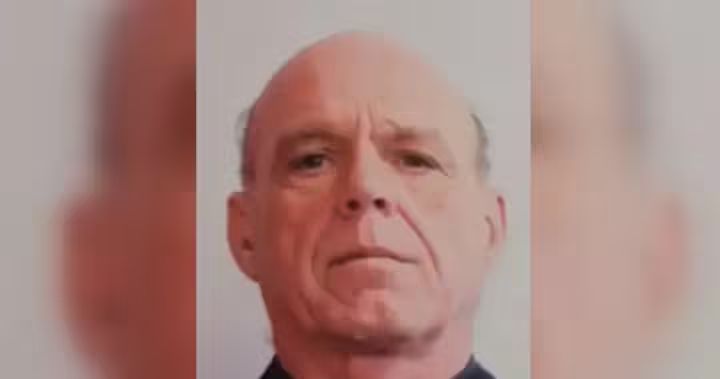
Todd Joseph Gallant, 59, who was also known as Todd Joseph Irving, was charged with first-degree murder and interfering with human remains in 2024.
Carr, a former teacher, was 36 years old when he was found strangled and stabbed to death in his bedroom on Nov. 11, 1988.

Get breaking National news
Get breaking Canada news delivered to your inbox as it happens so you won’t miss a trending story.
One of the most chilling details at the crime scene was a note written on a wall in the killer’s apparent handwriting: “I WILL KILL AGAIN.”
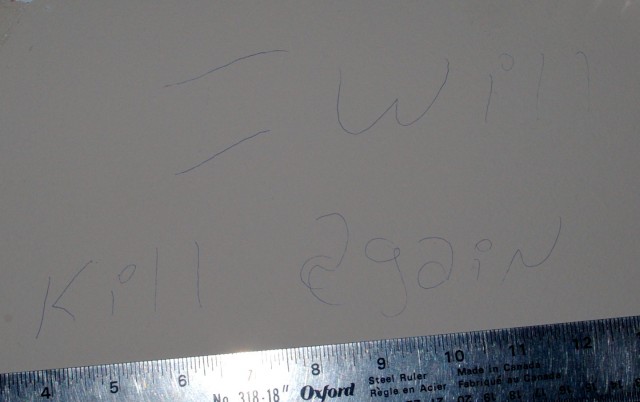
A note left at the crime scene where Byron Carr’s body was found.
Provided/Charlottetown Police Services
The cold case was reopened in 2007, and while there were no new leads at the time, investigators did have DNA evidence. Specifically, a pair of underwear believed to belong to the killer was found at the scene.
During a news conference in January 2024, then-police Chief Brad MacConnell said the “bigger development” in the case began in 2022 when police started using genetic genealogy.
He went on to say that crime scene exhibits were used to create a DNA profile that was uploaded to family genealogy sites to find common relatives.
“Genetic genealogy is a game-changer for police in how we investigate major crimes,” MacConnell said.
A pair of underwear was recovered at the murder scene.
Provided/Charlottetown Police Services
MacConnell said Gallant, who would have been 21 at the time of the murder, had been identified as a suspect much earlier in the investigation.
Gallant had pleaded not guilty to the charges and a jury trial was scheduled for next month.
— with a file from The Canadian Press
© 2026 Global News, a division of Corus Entertainment Inc.
Source: globalnews.ca