



A sold-out Oct. 14 event at the Historic New Orleans Collection demonstrates the partnerships the new LGBT+ Archives Project of Louisiana is pursuing with archives, libraries and collecting museums to preserve and present local queer history.
“Preserving the Party: The Legacy of Halloween New Orleans” will combine video clips with an in-person conversation to revisit the 40-year tradition of the annual Project Lazarus costume parties.
The speakers will be longtime event chair Arthur Roger and Ian Bicko, executive director of Project Lazarus, founded as a hospice service in 1985 at the peak of the AIDS crisis. The nonprofit organization continues its work today, serving people living with HIV. The material acquired by the HNOC, some of which will screen at the event, covers the years 1997 to 2018 and is being digitized for online viewing.
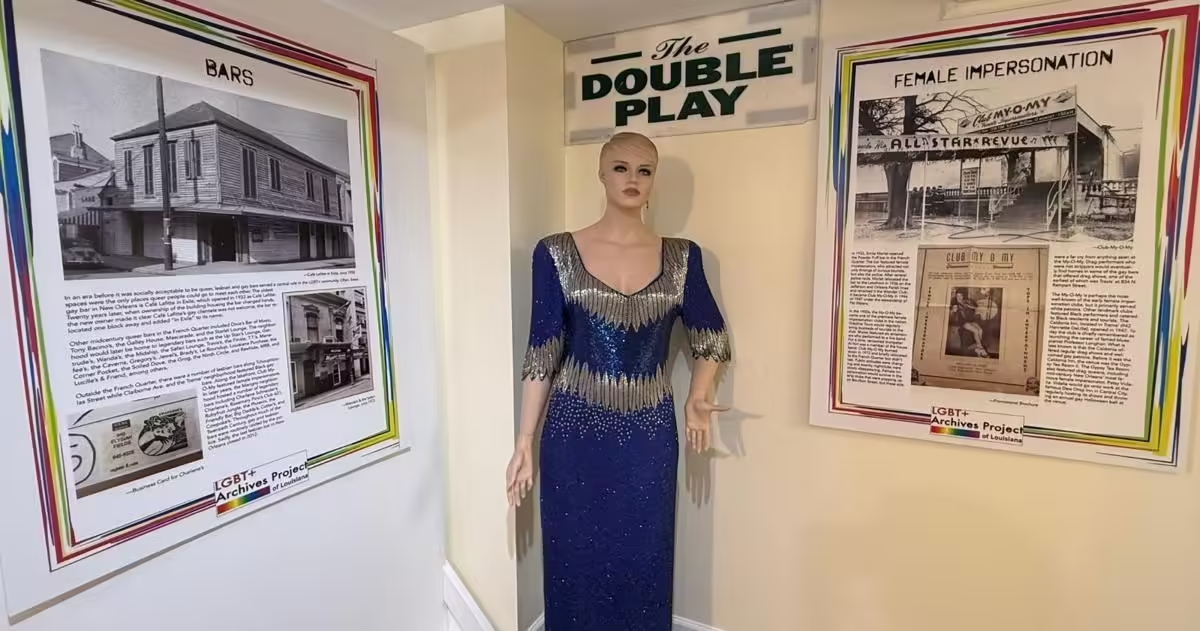
At the event, board President Eugene “Guy” Lamothe will represent the Archives Project, which earlier this year expanded its mission to include its own exhibition space, a small gallery at 311 Burgundy Street that tracks local queer history using panel presentations, photos and a few objects, such as publications and vintage ball invitations.
A timeline at the back of the small gallery tracks the queer community’s often-halting progress, from the first written reference to homosexuality in New Orleans in 1724 to the 2014 founding of the New Orleans Pride Center, a community hub on Orleans Avenue.
More than a dozen displays around the room document progress (Gay Carnival, Pride, Southern Decadence) and tragedy (the Upstairs Lounge Fire, the AIDS crisis, entrenched homophobia). Panels celebrate queer contributions to local literature, music, art and historic preservation. QR codes on some of the panels take visitors to digital spaces for further study.
This is a place where locals and tourists can learn about the legendary Club My-O-My on the lakefront, where buses would deliver tourists during the 1940s and 1950s to partake in floor shows performed by female impersonators. Or the protests that met anti-gay crusader Anita Bryant at a 1977 Municipal Auditorium concert. It’s also the starting point for by-appointment tours of French Quarter queer landmarks.
‘A very deep, rich, and long queer history’
An important element of New Orleans queer history now missing from the gallery is Frank Perez. Co-founder of the LGBT+ Archives Project in 2014, he was its executive director until his death in August of cancer. An author, historian, organizer and community advocate, Perez left many legacies. The Queer History Exhibit Space is one of them.
I met him there for a tour just a few weeks before his death. Perez was in a wheelchair and struggling with his energy, but he was determined to tell me the gallery’s story, including a behind-the-scenes visit to where donated artifacts and documents were being cataloged and digitized.
“The Archives Project has a three-pronged approach,” Perez said. “We want to raise awareness about queer history, which is what this space does. But we also want to assist people, whether they’re professors who are developing curricula or teachers or podcasters — anybody working on queer history projects.”
Perez’ work, including the gallery, will continue. The LGBT+ Archives Project’s board includes historians, writers, activists and administrators.
“New Orleans has a very rich, deep and long queer history that has been generally neglected in most historical narratives,” Perez said. “I think that an awareness, a recovery of that history, is more important than ever in times like these, especially given the political climate … .”
“My thinking is, you want to erase us, you want to render us invisible? Well, let me give you a middle finger and open a queer history exhibit center and be more visible, right?”
Listed hours of operation for the LGBT+ Archives Project of Louisiana Queer History Exhibit Space are 10 a.m. to 4 p.m. every day except Wednesday. Information about walking-tour appointments can be found at lgbtarchiveslouisiana.org.
Source: www.nola.com