






Data released today shows carriers and related businesses have now seen more jobs go than in the 2008-2011 recruitment collapse
US employers barely added jobs in September, and insurance remains one of the weakest parts of the labor market.
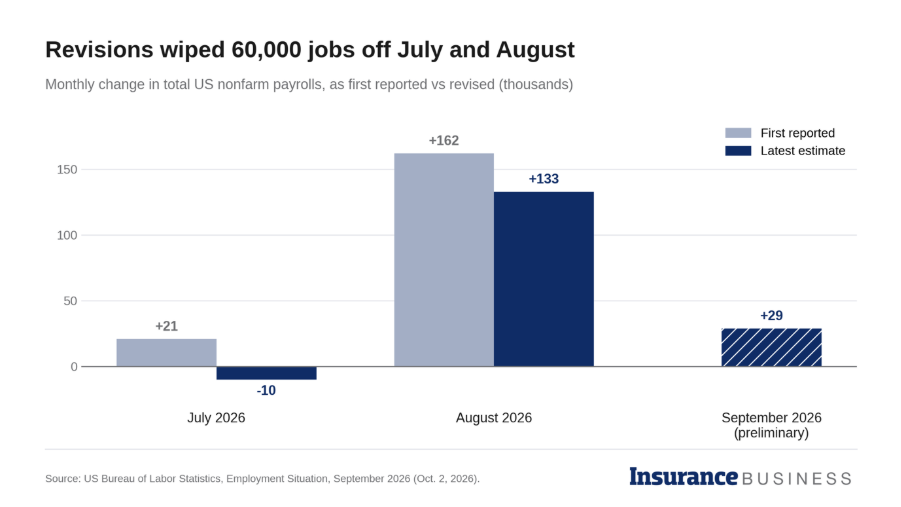
Employers added a net 29,000 jobs last month, according to the Bureau of Labor Statistics’ September employment report, released Friday morning. That was well short of the 88,000 economists surveyed by Bloomberg had expected, and below the 45,000-a-month average of the previous year. The unemployment rate edged up to 4.2% from 4.1% in August.
The release also shows how much of the financial sector’s decline has come from insurance. Financial activities employment fell by 7,000 in September and is now 129,000 below its May 2025 peak, the bureau said. Insurance carriers and related activities account for about 90,000 of those losses, or roughly 70%.
The bureau’s industry detail shows insurance lost another 2,300 jobs in September, its 11th consecutive monthly decline, though the smallest of the streak. The sector now employs about 2.93 million people, down 76,000, or 2.5%, from a year earlier and its lowest level since September 2022.
Two years ago the trend ran the other way. In the summer of 2024, the industry crossed the 3 million mark, helped largely by agency and brokerage hiring.
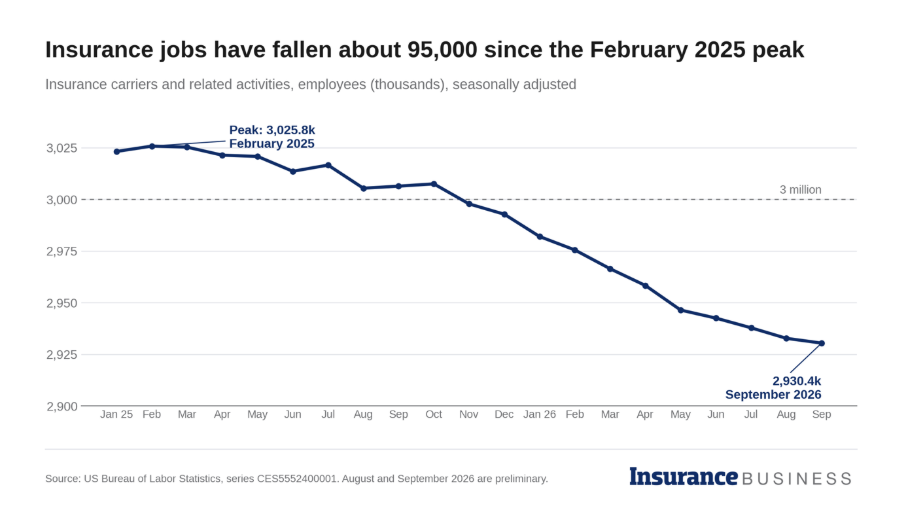
Headcount has fallen in every month of 2026 so far.
Read next: Insurers keep saying they’re not cutting staff. The payroll data tells a different story
Where the cuts are being felt
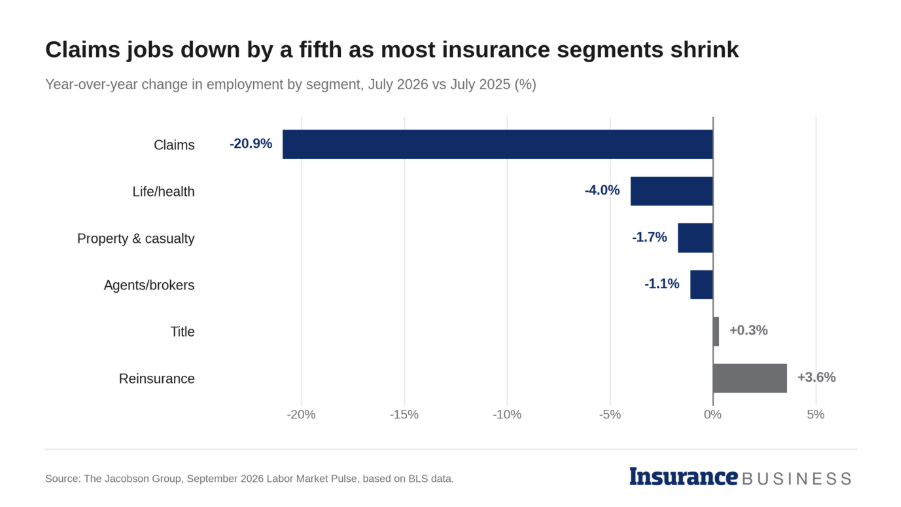
Losses vary widely by segment. Year-over-year figures for July, published in talent firm The Jacobson Group’s September 2026 Labor Market Pulse, show claims employment down 20.9%, life and health carriers down 4%, property and casualty down 1.7%, and agents and brokers down 1.1%. Reinsurance (up 3.6%) and title (up 0.3%) were the only segments to grow.
Jacobson put unemployment among insurance workers at 3.1% in August. Its estimate of that month’s job loss, 6,300, has since been revised by the BLS to about 5,100.
Job losses have accelerated this year. Insurers lost about 1,900 jobs a month on average in 2025 and roughly 6,900 a month so far in 2026, according to BLS data. Employment is now about 95,000 below its February 2025 peak of 3.03 million.
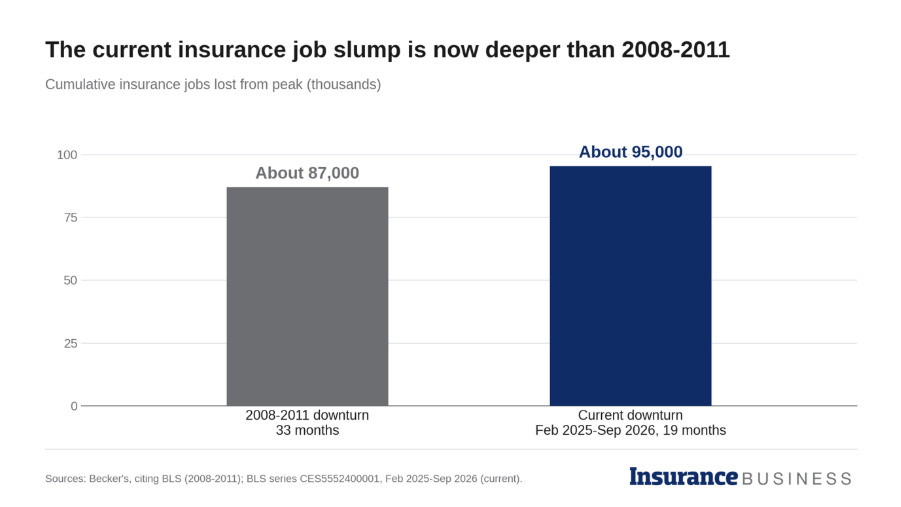
That already exceeds the 86,800 jobs the industry lost between July 2008 and early 2011, although the industry is larger now, so the current decline is smaller as a share of the workforce: 3.2%, compared with 3.6% then.
Insurers’ own hiring plans point the other way. In the Q3 2026 Insurance Labor Market Study by The Jacobson Group and Aon, released in August, 49% of participating companies said they expect to add staff over the next 12 months and 11% plan cuts. If those plans hold, the study projects industry employment will grow 0.78%.
Last year’s plans proved too optimistic. In the July 2025 survey, 13% of property and casualty respondents planned to shrink; in this year’s survey, 26% reported they had. Among life and health companies, 10% planned cuts and 29% reported making them. Headcount at participating companies grew 0.21% over the year, against the 1.03% they had projected, and property and casualty headcount rose just 0.02%.
Among companies planning cuts, automation is now the most common reason given, followed by overstaffing and reorganization. Large companies have also scaled back. Of those with more than 1,000 employees, 28% plan to add staff, down from 38% in January.
Some firms have tied cuts directly to technology. In May, brokerage Acrisure said it would cut 2,250 jobs, about 11% of its global workforce, citing advances in AI and automation.
Read next: Insurance jobs slashed
Earlier months revised down
The BLS now estimates that July lost 10,000 jobs, rather than the 21,000 gain first reported, and it lowered August to 133,000 from 162,000. Combined, the two months are 60,000 jobs lower than previously reported.
Health care added 17,000 jobs, about half its average monthly gain of 33,000 over the past year. Ambulatory services (up 13,000) and hospitals (up 12,000) grew, while nursing and residential care facilities lost 9,000.
Construction added 11,000 jobs, close to its 10,000 monthly average, with nonresidential specialty trade contractors up 12,000. Manufacturing added 9,000 and is up 72,000 since a low in December 2025.
Wage growth slowed. Average hourly earnings on private payrolls rose 5 cents, or 0.1%, to $37.81, and were up 3.0% from a year earlier. Workers’ compensation premiums are largely based on payroll, so slower hiring and smaller wage gains could mean slower exposure growth for comp carriers.
The report arrives just over two weeks after the Federal Reserve raised rates for the first time since 2023. On Sept. 16 the Federal Open Market Committee voted 12–0 to lift its target range by a quarter point to 3.75%–4%.
Fed Chair Kevin Warsh had cited the strength of the labor market as one reason for that increase, the Financial Times reported. After Friday’s report, traders lowered the odds of another hike in October to about 20%, from 29% before the release. The two-year Treasury yield fell as much as 0.09 percentage points to 4.69% before recovering most of that move to 4.78%, according to the FT. Traders still put the chance of higher rates by year-end at roughly 80%.
Thomas Simons, chief US economist at Jefferies, said the figure should be “the nail in the coffin for an October hike,” the FT reported.
Rate increases generally help property and casualty insurers sooner than life insurers, because their shorter-duration bond portfolios reinvest at higher yields more quickly. A pause in hikes would slow that boost to investment income.
Read next: US insurers turn bullish on 2026 despite inflation fears
What to watch
The BLS will release its October jobs report on Nov. 6. More detailed insurance data, broken out by carriers, agencies and brokerages, claims adjusters and third-party administrators, is published with a lag of about two months.
Source: www.insurancebusinessmag.com