



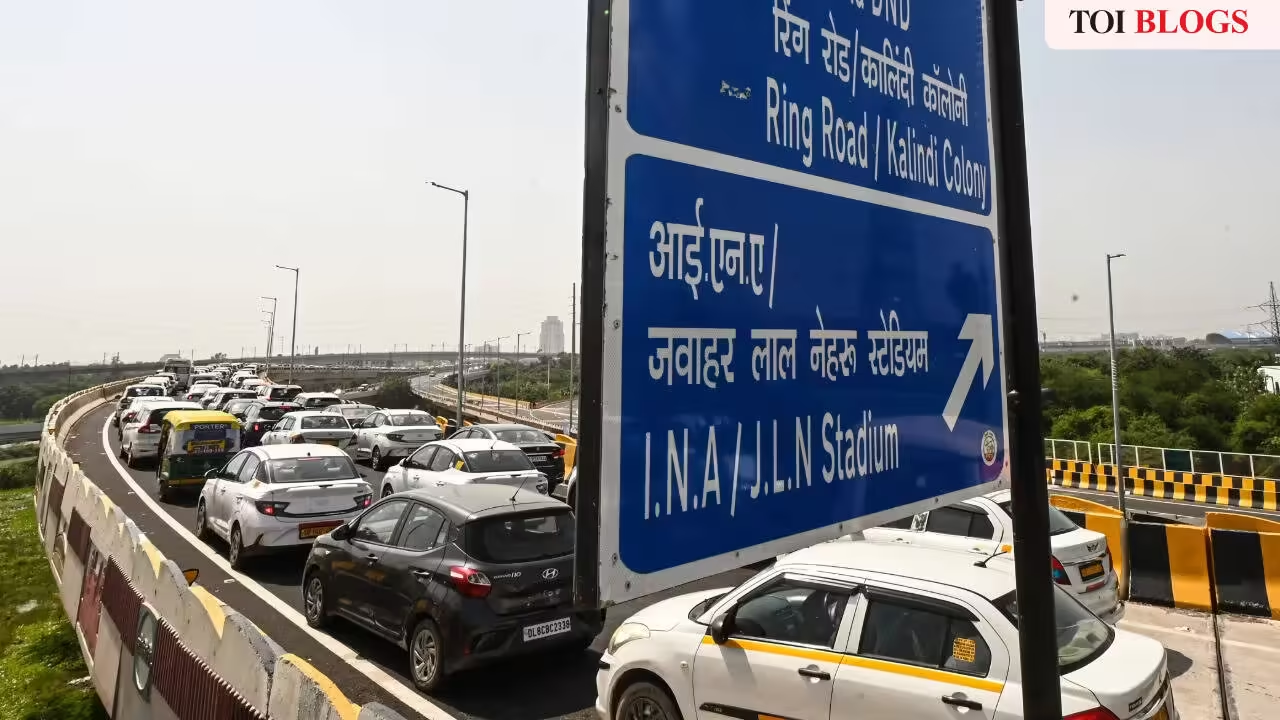

Delhi’s Rs 1,635-cr Barapullah Phase III, meant to put AIIMS 15 minutes from east Delhi, jammed within days of opening because, as a senior traffic officer said, “six lanes try to merge into three”. Three days after Goa’s Rs 641-cr Porvorim corridor was inaugurated, a crash at one of its exits killed two people, and two-wheelers were barred. In Andheri, the rebuilt Gokhale bridge opened in 2024 about six feet above the flyover it was meant to meet. Each was sold as a traffic solution. These are different failures with a common root. Barapullah and Porvorim were planned without the roads they join. At Andheri, two agencies failed to meet. When a structure fails to deliver, the response is a barricade, a ban or a suspension. The next project begins the same way.A Newslaundry tally of media reports counted 170 bridge collapses and 202 deaths across India between 2021 and mid-2025. There is no national tally of flyovers that fail without falling: those that jam, cause fatalities, or must be redesigned. A state that keeps no full record of its failures will not know how to correct them.
Concrete is not development
A city is a promise. People move to them for a better life, and infrastructure is how the city keeps its word. We know what a flyover costs. Do we ever learn what it achieved? The right measure is what it does for people: minutes saved for the many, lives not lost, a child able to cross the road to school. It’s not always about money being scarce. In Mumbai, for instance, the BMC’s 2026-27 budget gives its roads and bridges department Rs 9,650 cr, more than its Rs 7,457-cr health budget. MMRDA adds Rs 18,360 cr for roads, bridges and tunnels. Till Feb, more than half of the BMC’s 2025-26 capital budget was unspent. What is scarce is the capacity to choose and build well. Every rupee spent building twice is taken from the bus, the footpath and the clinic.
Decide right
The system that plans, builds and maintains our infrastructure does not fail by accident; it fails by design. Every stage needs its own fix, but the first decision matters most. A wrong project built well is still a waste. Every flyover, underpass and grade separator, whatever its cost, should pass a mandatory review. It must begin with a problem defined in the city’s Comprehensive Mobility Plan. It must beat costed alternatives: junction redesign, signal timing, bus priority, parking pricing. A transport model must test the whole network, because many flyovers only move the queue to the next junction. Barapullah shows the cost of getting this wrong.India already demands this discipline of metro cities. Since 2017, any metro seeking central funds must first compare alternative modes. It is not the perfect system, but extend the same rule to every grade separator in Mumbai and all metros. The review must be independent of the agency that wants to build. Since 2005, Norway has required outside experts to examine the choice of concept for large state projects before the Cabinet decides. The project report should be public, and citizens heard before the design is fixed. Then tie money to appraisal: no state or central funds without a favourable independent review.
Spend well
Today we only pay for a bridge’s opening day. We should pay for its entire lifetime cost. Every design should be independently proof-checked. A bridge that crosses a railway or another agency’s road should have one owner, one design and one contract, with clearances settled before tender. Contracts should reward quality as well as price and hold builders to the structure’s condition for ten years. No structure should open without an independent safety audit. Maintenance should be funded at sanction. Every city should publish the condition of its bridges and flyovers, rated by an independent auditor, not by the agency that owns them.
Close the loop
Since 2002, England has evaluated every major national road scheme after opening and published the results. A 2019 review found traffic forecasts within 15% of reality for only 59% of schemes. England knows how often it is wrong. Indian cities rarely ask whether a flyover worked. Every grade separator should report its outcomes: travel time, crashes, who uses it. Every failure should go to an independent investigator whose findings are published, as they are for air accidents.Indian cities are over-engineered and under-designed. We reach for the biggest structure first and examine the problem last. Design is choice: options weighed, trade-offs owned, outcomes measured. At Andheri, hydraulic jacks closed the six-foot gap between two bridges. Who will close the gap between the agencies that built them?
Disclaimer: Views expressed above are the author’s own.
Source: timesofindia.indiatimes.com