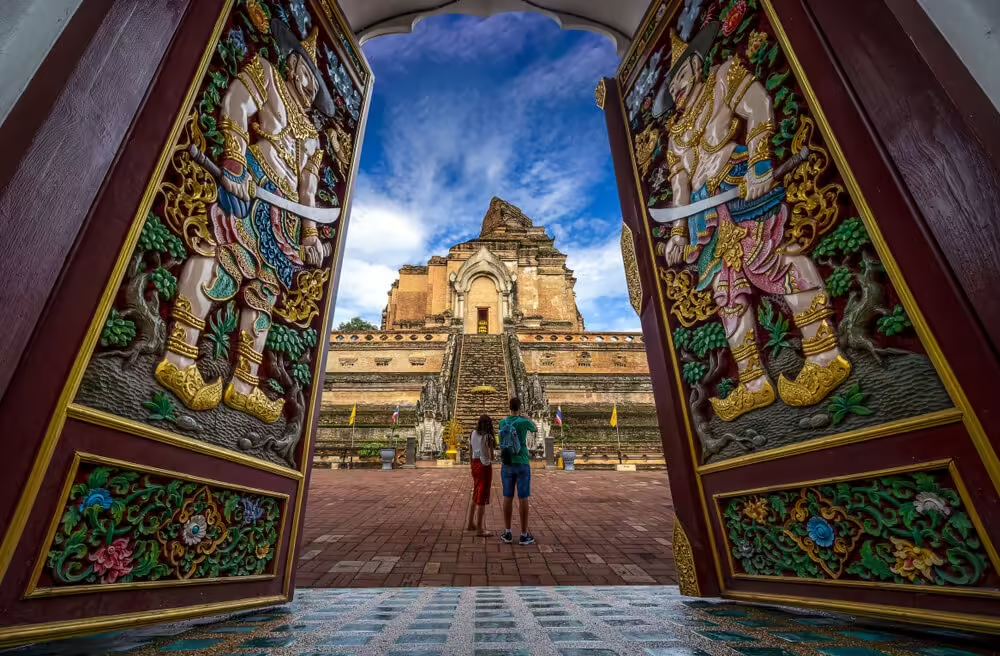

In honor of today’s official Indigenous Peoples’ Day, travel advisors have an opportunity to take a moment to think about the role they play in helping clients travel respectfully, experiencing destinations sustainably without diminishing what makes those places worth visiting.
One of the great promises of travel is the chance to encounter something different: another culture, another history, another way of living. But as more travelers seek out the same photogenic neighborhoods, beaches, historic sites, and cultural experiences, there is a growing question for the travel industry: How can visitors experience a place without overwhelming—or disrespecting—the people who call it home?
For travel advisors, socially responsible tourism does not necessarily require reinventing how they plan vacations. In many cases, it starts with something they already do well: preparing clients for the destination.
The Advisor as Cultural Interpreter
Most travelers would never intentionally disrespect a local community. But good intentions do not automatically translate into good behavior.
Customs that seem intuitive at home can be inappropriate elsewhere, while behaviors travelers barely think about—how loudly they speak, where they take photographs, what they wear, whether they enter a sacred space, or how they interact with local residents—can carry greater significance in another culture.
This knowledge creates an opportunity for advisors to add another layer of understanding and sensitivity to pre-trip conversations. Along with discussing passports, transfers, restaurant reservations, and sightseeing, advisors can prepare clients for the cultural expectations they will encounter. A short conversation about etiquette can prevent an uncomfortable interaction, while helping travelers better understand the destination.
“Before clients’ travel, I discuss the customs most relevant to their destination, including appropriate clothing, tipping practices, greetings, photography etiquette, religious traditions, and expectations at sacred or historic sites,” says Paula L. Killion, CTC, DS, president, Travel Designer’s, LLC. “I also remind clients that something considered normal at home may be viewed differently elsewhere.”
Support Community-Lead Experiences
Advisors can also encourage clients to choose authentic, community-led activities in destination, whereby more of their tourism dollars benefit the local people.
“We prioritize experiences led by local guides, families, artisans, chefs, and small businesses, especially those where the community has control over how its culture is represented and benefits financially from the experience,” describes Killion.
“I look beyond the marketing and ask who operates the experience, where the money goes, how large the groups are, and whether local traditions are being shared respectfully rather than performed or altered simply to entertain visitors. The most meaningful experiences usually create genuine interaction and education, not just a photo opportunity.”
Laura Murdoch, travel advisor, Black Pearl Luxury Services/Morris Columbus Travel, gives examples of experiences that are authentic and community led versus those created primarily for tourists.
“I had another travel agent tell me that she was in Brazil recently and the tour company she traveled with set up a tour through the favelas in Rio de Janeiro,” Murdoch says. “She felt like it was a sightseeing show saying something like, ‘Come see how impoverished and poor these people are.” She said it didn’t benefit them at all and felt like the people that lived there were somehow made to feel ‘less than.’ She said it was an experience that was for the sole benefit of the tour operator to make more money.
“Alternatively, a few years ago I did a cooking class in the slums of Bangkok. The purpose of the class wasn’t to show off the slums, but to give jobs to some people in the area and benefit the local community. There was also a lot of community support around this class.
“I don’t think an experience has to be completely undiscovered to be authentic, but it is important to know who is telling the story and who benefits financially from the traveler being there.”
Steer Clients Away From Certain Experiences
Sometimes an advisor’s toughest role might be steering a client away from an experience or behavior they feel could be culturally or socially inappropriate.
“At times, that has meant recommending a more ethical alternative to a wildlife attraction, discouraging photography where it may be intrusive or prohibited, or explaining why certain clothing or behavior would be inappropriate at a religious site,” notes Killion. “I never want a client to feel judged, so I frame these conversations around respect and awareness. Most travelers appreciate the guidance once they understand the cultural or ethical concerns.”
And from Murdoch’s perspective, “Animal tourism is a big no-no. Years ago, it was common to swim with dolphins, ride elephants, pet drugged-out tigers, etc. Many times, people did it for the Instagram shot. However, we now know that it’s neither culturally appropriate or good for the animals. Elephants, for example, were beaten and drugged to give people the opportunity to climb aboard them and ride around. I usually end up telling a client, ‘You can do it, but I don’t recommend it. Here’s why…’ There are now other ways to see the animals and get a good photo without distressing or harming the animals.”
Help Clients Look Beyond the Photo Opp
Social media has made it possible for a previously little-known beach, street, restaurant, or viewpoint to become an international attraction almost overnight. What travelers see online, however, is rarely the complete story.
Trusted travel advisors have the important opportunity to put social media-driven travel trends into perspective for their clients.
“Social media is wonderful for inspiration, but it often shows only one carefully framed moment,” says Killion. “I remind clients that a viral location may involve crowds, long waits, restrictions, or an experience that feels very different in person.
“Rather than building an entire trip around recreating one photograph, I ask what attracted them to the image, the scenery, atmosphere, architecture, or sense of adventure. We can often create a more personal and rewarding experience that captures the same feeling without following the exact same itinerary as everyone else.”
Advisors can also help clients avoid a major potential vacation mishap resulting from social media distortions.
Murdoch recounts this story: “I’m currently working with a client going to Iceland. She has a bucket list of ideas … all things she’s seen on Instagram and Tik Tok. I had to laugh when I saw her list because many of her “must-see” photo ops had to be done at golden hour. I looked at the itinerary and told her 1) the driving distance between some of the photo ops was too great to accomplish what she wanted to, and 2) she had more ‘golden hours’ on her must-do list than she had nights on the itinerary.
“I love that social media gets people excited about seeing a particular place, but I remind clients that sometimes the most photographed place is not always the best experience. I also want to manage expectations because sometimes seeing a much photographed or Instagrammed place doesn’t look the same in person. Sometimes a place a mile down the road becomes the memory instead of the popular option.”
Overtourism Is Part of the Conversation
Respecting a destination also means considering when and where clients travel, as overtourism has become one of the travel industry’s most visible challenges.
UNESCO describes it as more than simply having too many people in one place. Excessive visitor numbers can affect residents’ access to amenities, contribute to environmental and cultural deterioration, and ultimately change the character of the destination itself.
“I think the easiest ways that travel advisors can help regulate overtourism is by suggesting that clients travel to popular destinations in off-peak or shoulder seasons,” recommends Murdoch.
“We don’t necessarily need to tell people to skip Venice or Santorini, but to change how and when they visit those destinations. Venice in October or November is lovely. Travelers won’t have the crowds and will enjoy the area and experiences more. It’s also easier to get tickets to main attractions when they aren’t traveling in peak season.
“I also recommend using local guides and tour companies when possible. I like to use local DMCs. I feel they represent the country and community well and know what to suggest to avoid some of the overtourism.”
Making Travel a Richer Experience for Everyone
Ultimately, responsible travel is not about making clients feel guilty for traveling. Quite the opposite. The goal is to make travel a richer experience for everyone involved.
The more travelers understand about the places they visit, the more likely they are to notice what lies beyond the landmarks and photo opportunities. And the more thoughtfully advisors prepare them, the better chance those destinations have of remaining places worth experiencing for generations to come.
FROM THE SPONSOR:
With more than 50 years in business, Delta Vacations — a Delta Air Lines company — is one of the largest vacation providers in the U.S., delivering elevated, all-in-one, customized and flexible vacation experiences designed for SkyMiles® Members. From world class flights and the elevated service you expect from Delta Air Lines® packaged with 4- and 5-star premium hotels to unique experiences and adventures — you’ll find it all in Delta Vacations. Choose from handpicked options and expert recommendations in over 330 destinations while you book flights, hotels, rides and activities all over the world, all in one place. Plus, your clients can earn exclusive SkyMiles® Member benefits only available through Delta Vacations. Travel professionals can find more information about Delta Vacations at deltavacationspro.com or by calling 1-800-727-1111.
Source: www.travelmarketreport.com