




Simon Usherwood argues that, should the UK seek to rejoin the European Union, the ‘accession’ process from application to membership is likely to take a long time.
Andy Burnham’s announcement last month that he wanted to start a dialogue about the UK’s future relationship with the European Union has prompted a wave of contributions pitching the advantages of various particular models.
But, as we move into what the Prime Minister says he intends to be a careful discussion about how European policy fits into his wider vision for the UK, it seems useful to provide some more context around particular claims being made.
One such instance is the question of how long it might take the UK to once again become a full member of the EU.
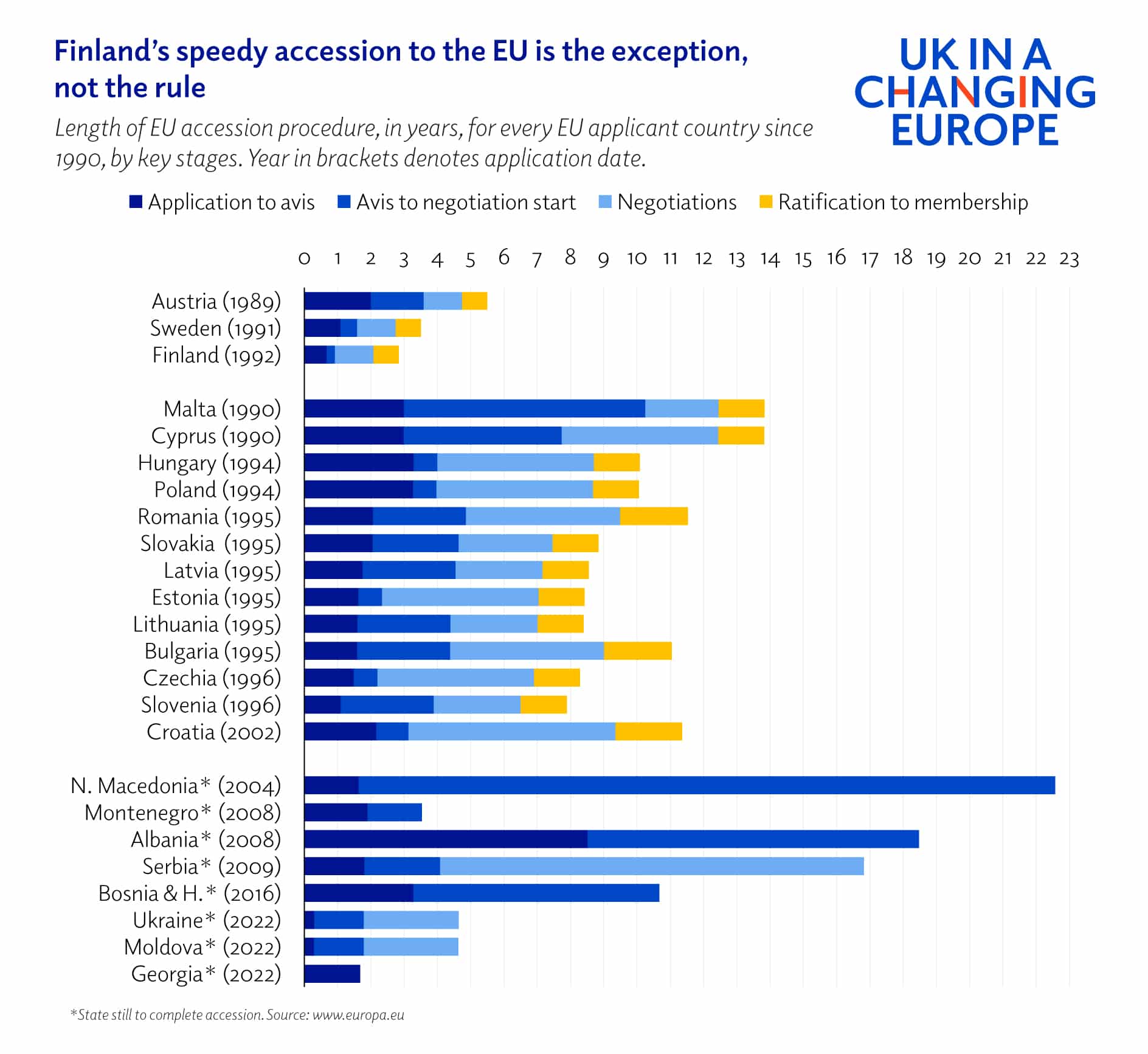
For those critical of such an option, there are plenty of cases highlighting how it is no quick fix: Serbia is into its twelfth year of negotiations, North Macedonia has been an official candidate for membership since 2005 and has still not started substantive negotiations. Even in the much-heralded urgent case of Ukraine , which sped from submitting an application to join in February 2022 to opening negotiations 22 months later, there is no suggestion that these will close any time soon.
Of course, the UK is neither a relatively small West Balkan state, nor a war-torn Ukraine. Indeed, it might be argued (as it in a recent report from Best for Britain) that where there is a high level of existing policy alignment and clear political will then things can move much faster.
Finland is the poster-child of the ‘speedy’ accession. From applying in in March 1992, it took only two years and nine months to become a member state in January 1995.
This speed can be explained by a number of factors. Most obviously, Finland had spent the two years prior to its application negotiating participation in the European Economic Area (EEA), which effectively extended the EU’s single market into neighbouring countries. Given that the bulk of what the EU did at that time was linked to that domain, this left relatively little to be covering in the accession negotiations.
Second, Finland was one of the least picky accession states: as David Arter has notedthe country did not ask for any exemptions or opt-outs from EU policy, unlike its neighbour Sweden. Apart from some difficulties in translating the Common Agricultural Policy to marginal Arctic cultivation, there were minimal points of friction, further aided by the relatively small size of the Finnish economy overall, as compared to the EU’s.
Finally, Finland had come out of a fundamental change in its geopolitical situation. Having had to practise delicate non-alignment under the shadow of the Soviet Union, the collapse of communism (and much associated trade), the country had to make a conscious choice about reorientation. The lack of realistic alternatives to the EU, especially once Sweden had decided that the EEA was insufficient, helped to underpin the political choice. While it would be wrong to claim very broad and deep political consensus for membership, it was certainly still the most enthusiastic of the countries looking to join the EU immediately after the end of the Cold War.
So where does this leave the UK?
Like Finland, the UK has substantial areas of regulatory policy that still maps closely to the EU. While some divergence has occurredthe country has much less distance to close than states that have never previously been part of the EU.
However, apart from this it is hard to draw many useful parallels between the two.
Notwithstanding the changes in the geopolitical realm since the 2016 referendum, the UK has not undergone the same kind of transition that Finland did in the early 1990s; indeed, we are only now producing the start of a debate about whether Brexit arrangements still work. It is notable in this context that Burnham’s starting point was not geopolitics, but barriers to trade.
Moreover, as has been clear in recent months, the UK is unlikely to be a relatively pliant partner to the EU in any accession negotiations, but rather one with significant interests and a desire for special treatment.
British pushback on raising tariffs on Chinese EVs as a price for participation in the Made in Europe package under discussion in Brussels joins resistance to EU students paying domestic university fees as topics to be resolved ahead of the November summit. And such issues pale in comparison to the discussions that will ensue during an accession process on British participation in the Euro and the Schengen zoneas well as budgetary contributions.
And the EU itself has cooled on enlargement in general: no country that has joined this century has managed to do it in less than 7 years and 11 months, start to finish. That is partly because the states involved have had further to travel in transitioning their economics and polities to the EU’s requirements, but it is also because member states have become increasingly worried about the impacts that enlargement has on them (namely in terms of migration and financial assistance). Those are both quite marginal concerns in the UK’s case, but there is also a wider concern about how increasing membership dilutes the weight of any one member, making them less able to secure their interests: here, the arrival of a large country like the UK is liable to unsettle many of the arrangements put in place since it left.
And it is this very fact of being a re-accession that will cause perhaps the biggest difficulties. From the EU’s perspective, the UK decided barely a decade ago to leave the Union. There is understandable concern in European capitals that the current swing towards closer integration might be followed in relatively short order by a swing back to radical divergence: the fragmentation of party politicsin the run up to the next general election make the prospect of a Reform or Conservative-led government a clear possibility. All this even before (not always correct) memories of the UK as an ‘awkward partner’ during its membership make EU politicians ask whether the costs of a UK return outweigh the benefits.
Any credible estimation of how long re-accession would take needs to be mindful of this and recognise that the chances of managing it within the life of a single parliament are very small indeed.
By Simon Usherwood, Professor of Politics and International Studies, The Open University and Senior Fellow, UK in a Changing Europe.
Source: ukandeu.ac.uk