



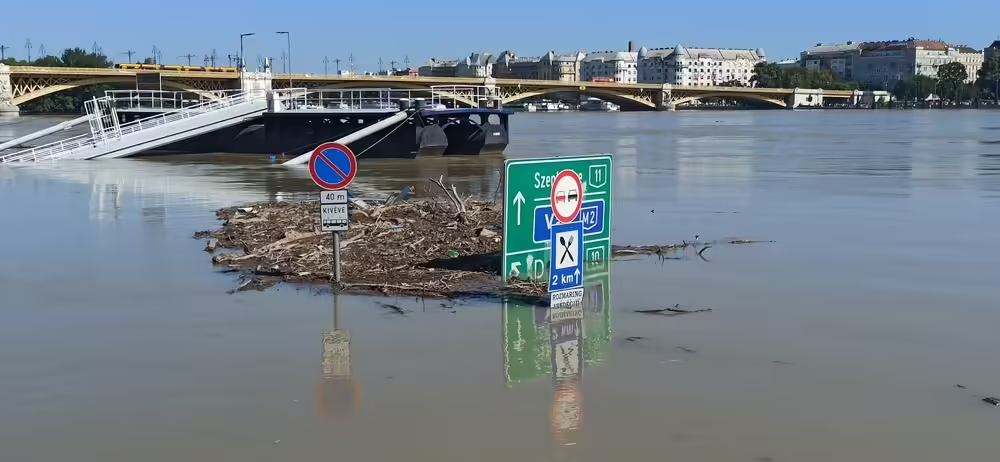

Europe is entering a new phase of flood adaptation.
Instead of relying solely on higher barriers and larger drainage systems, cities and governments are increasingly redesigning the infrastructure around rivers, coastlines and urban areas to cope with water when extreme events occur.
The shift is being driven by a simple problem: much of Europe’s infrastructure was designed around historical weather patterns, while roads, railways, energy networks, hospitals and cities are expected to remain operational for decades. The European Environment Agency (EEA) has identified infrastructure as one of the areas facing major climate risks, with floods already causing damage to transport networks and other critical systems.
As a result, flood-resilient infrastructure is becoming less about keeping every drop of water out and more about designing places and systems that can withstand flooding, safely manage excess water and recover quickly afterwards.
Designing infrastructure around future flood risk
The challenge for European planners is not simply to respond to the floods being experienced today. Infrastructure built now may remain in use for many decades, meaning decisions made during construction can determine how vulnerable a road, railway, hospital or neighbourhood will be in the future.
The European Commission has increasingly adopted the principle of “resilience by design”, under which investments exposed to climate hazards should be designed to withstand risks that could occur during their lifetime without unacceptable losses in their value or usefulness.
This matters particularly for transport infrastructure. Roads, bridges and railway lines are expensive to replace and can themselves take decades to plan and construct. The European Commission has warned that all modes of the Trans-European Transport Network will face greater exposure to climate extremes and says climate adaptation needs to be incorporated into investment in the network.
For flood resilience, that can mean raising vulnerable sections of infrastructure, strengthening structures, improving drainage, protecting electrical equipment or creating alternative routes so that one flooded section does not bring an entire network to a halt.
The Netherlands: Making room for water
Few countries illustrate the evolution of flood infrastructure more clearly than the Netherlands.
For decades, Dutch flood protection was strongly associated with dikes and other structures designed to keep water away from populated areas. But major river floods in 1993 and 1995 prompted a significant change in thinking.
Rather than continually raising dikes, the Netherlands began giving rivers more space to spread safely during periods of high water. The resulting Room for the River programme introduced measures including flood channels, lowered floodplains, relocated dikes and wider riverbeds.
At Nijmegen, the approach involved moving a dike around 350 metres inland and excavating a new three-kilometre-long channel alongside the River Waal. Completed in 2016, the project reduced the river’s water level by 35 centimetres during high flows, exceeding its original 27-centimetre target. The new channel also created an island that became an urban river park.
The wider programme involved measures at 34 locations and was officially completed with the opening of the Reevediep flood channel in 2019. According to Rijkswaterstaat, it improved safety and spatial quality for around four million people and cost €2.3bn.
The Netherlands is now taking the approach further. Its Room for the River 2.0 programme, launched in 2025, is examining how the river system can be redesigned to manage high water while also responding to problems such as riverbed erosion and drought. Planning is looking towards the needs of the river basin through 2100 and beyond.
The Dutch example demonstrates an important principle of flood-resilient infrastructure: sometimes the most effective engineering solution is not a bigger barrier, but changing the landscape so the water has somewhere safer to go.
Copenhagen turns streets into flood infrastructure
Urban flooding creates a different challenge.
When intense rainfall overwhelms drainage systems, water can quickly accumulate on streets and enter buildings. Copenhagen has responded by redesigning parts of the city so that streets, parks and public spaces can temporarily become components of its stormwater system.
The approach followed a major cloudburst in 2011 that caused damage estimated at more than €1bn. Copenhagen subsequently developed its Cloudburst Management Plan, combining conventional drainage infrastructure with surface-level measures designed to store, redirect and slow down rainwater.
The programme envisages around 300 projects, including roads designed to transport stormwater, detention roads that can temporarily store water, parks that can become retention areas and green streets capable of holding smaller volumes of runoff.
At Sankt Annæ Plads in central Copenhagen, for example, the landscape has been reshaped into a cloudburst street. The square is designed so that heavy rainfall is directed away from surrounding buildings and towards the harbour, with underground pipes helping move water through the system.
This is a different model of flood-resilient infrastructure. The road is still a road, and the park remains a public space, but during an extreme rainfall event they take on another function.
Hamburg builds above the flood
In Hamburg, flood resilience is being incorporated directly into a major urban development.
HafenCity occupies land alongside the River Elbe and is exposed to flooding. Instead of relying solely on conventional dikes around the development, buildings and infrastructure have been constructed on raised platforms known as Warften.
Buildings are generally positioned on artificial plinths around 8–9 metres above sea level, while streets and bridges are also located at flood-protected levels. The design is intended to allow movement through the district and maintain access during severe flooding.

The approach effectively changes the elevation of the city itself.
HafenCity combines these raised structures with flood gates and other protective measures. The result is infrastructure that is designed around the reality of its waterfront location rather than attempting to eliminate the relationship between the city and the river.
Hamburg’s wider flood protection system still includes dikes, flood walls, gates, locks and other technical structures. The HafenCity approach therefore illustrates how conventional flood defences and flood-resilient urban design can operate together.
Protecting infrastructure that cannot simply be moved
Flood resilience becomes particularly important when infrastructure provides an essential service.
A flooded park can be repaired. A flooded electricity substation, hospital or railway line can have consequences far beyond the immediate site.
The EEA has highlighted the vulnerability of critical infrastructure to climate extremes, while European research has examined how flooding can create cascading impacts when essential systems fail.
One example comes from the UK’s electricity network. Several substations are located in floodplains, and their failure can disrupt other services that depend on electricity, including water supply, healthcare, transport and communications.
A flood-defence framework developed for National Grid substations therefore focuses on identifying vulnerable assets and implementing appropriate protection.
The lesson is broader than the individual substation. Building flood-resilient infrastructure means understanding how different systems depend on each other.
Protecting a railway may not be enough if the electricity supply to the railway is vulnerable. Protecting a hospital building may not guarantee continuity if surrounding roads become impassable or its power supply is disrupted.
Railway resilience in the Austrian Alps
Transport networks face another challenge in mountainous regions, where rivers, flooding, landslides and debris flows can affect the same infrastructure.
Austria’s railway network is particularly exposed because routes through the Alps often follow river valleys and steep terrain. The country’s federal railway operator, ÖBB, has introduced structural and operational measures alongside weather monitoring to improve resilience and maintain passenger safety and service continuity.

The example highlights why flood resilience cannot be reduced to a single engineering intervention.
Infrastructure operators increasingly need to combine physical protection with monitoring, forecasting, operational planning and contingency measures. A railway line may still be exposed to extreme weather, but better information and protective measures can reduce the likelihood that an event becomes a prolonged disruption.
Hospitals need resilience too
Some infrastructure has particularly little room for failure.
At Førde Central Hospital in Norway, a flood protection system completed in 2020 was designed to protect both existing and new hospital buildings against a 1,000-year flood.
The approximately 750-metre system combines sheet piling, concrete walls and embankments with a pumping station capable of moving two cubic metres of water per second. An emergency power supply was also installed to keep the pumping system operational.
The project demonstrates how flood-resilient infrastructure can be designed around continuity of service, rather than simply preventing physical damage.
For critical facilities, keeping the building operational during an extreme event can be just as important as protecting the structure itself.
Infrastructure that works with nature
Across Europe, another trend is emerging alongside conventional engineering: infrastructure that uses natural systems to manage water.
The EEA identifies restoring floodplains and expanding urban green spaces as measures that can strengthen climate resilience. In Wrocław, Poland, for example, the EU Mission on Adaptation to Climate Change is supporting approaches including rain gardens, swales, vegetation and permeable surfaces to address both flooding and urban heat.
The EU is also supporting projects that restore the ability of landscapes and soils to absorb, store and gradually release water. The SpongeWorks project is examining how these natural “sponge” functions can reduce both flood and drought risks.
This does not mean replacing engineered infrastructure with nature. Increasingly, European projects are combining the two.
The challenge is adapting what already exists
Building new infrastructure with future flood risks in mind is only part of the problem.
Europe already has an enormous stock of roads, railways, bridges, power networks, hospitals, industrial facilities and buildings. Many were designed when climate risks were assessed differently, leaving governments with the much harder task of deciding what should be protected, upgraded, relocated or replaced.
That makes prioritisation essential.

The European Commission’s work on climate adaptation for the Trans-European Transport Network, for example, has highlighted the scale of investment required to make transport infrastructure more resilient.
There is also a growing recognition that flood resilience cannot be delivered by infrastructure agencies alone. Land-use planning, environmental management, emergency services, local authorities and infrastructure operators all have a role.
The EU’s Mission on Adaptation to Climate Change now includes more than 400 regional and local authorities, while its 2026 project portfolio includes initiatives addressing flooding through infrastructure adaptation, ecosystem restoration and urban regeneration.
From defending against water to living with it
Europe’s emerging approach to flooding is not about abandoning traditional flood defences. Dikes, barriers, walls and drainage systems will remain essential in many locations.
But the examples from Nijmegen, Copenhagen, Hamburg, Austria’s railway network and elsewhere show that the definition of flood protection is becoming broader.
A resilient city may allow a park to flood temporarily. A road may be deliberately shaped to carry stormwater. A river may be given more space rather than confined behind increasingly high embankments.
A hospital may be surrounded by a dedicated flood barrier and emergency pumping system. A railway operator may combine physical protection with weather monitoring and operational measures.
Together, these approaches represent a shift from trying to control every aspect of flooding towards designing infrastructure that can anticipate, absorb, withstand and recover from disruption.
As Europe faces a future in which extreme weather puts greater pressure on infrastructure, that distinction is likely to become increasingly important.
The question is no longer simply where to build the next flood defence, but how to ensure the infrastructure behind it continues working when the water arrives.
Source: www.innovationnewsnetwork.com