



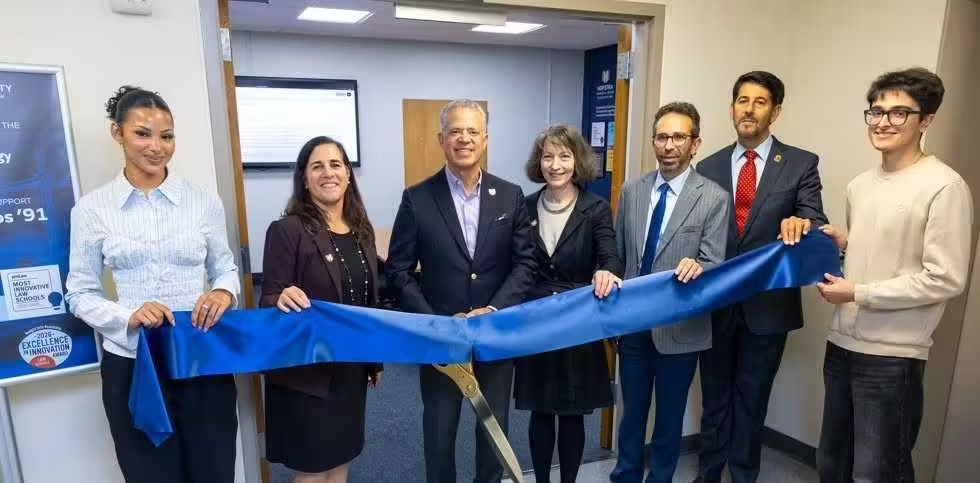

Hofstra University’s law school recently announced a new technology institute that will serve to bolster existing legal research around cryptocurrency, artificial intelligence, and technology’s impact on access to justice initiatives.
Boosted by a $1 million gift from alumnus Samuel Ramos, the law school’s Institute for Legal Technology & Innovation will bring together several different technological themes under one umbrella.
“I’m excited to see what the faculty and students do with it — what innovations that they’re going to bring and the cutting-edge new scholarship, teaching, and ideas that they’re gonna come up with under the umbrella of the new institute,” Maurice A. Deane School of Law Dean Jenny Roberts told amNewYork Law.
Roberts called the new institute a central hub for a number of existing legal technology programs at the law school and “a hub to spur innovation and interdisciplinary collaboration” between law and technology.
Though the impact that artificial intelligence is having on the legal profession and workforce generally is the issue of the day, the timing of the new institute is not timed to that issue necessarily, Roberts said.
In its announcement, the law school described the new institute as focused on technological literacy, research, and using tech to offer solutions to social problems. Hofstra’s legal tech course offerings and workshops for law students run the gamut of AI regulation, lawyering ethics, and cryptocurrency regulation.
Roberts said that the institute will also add new opportunities for the law school to develop scholarship around technology that involves, but is not limited to AI.
“The intersection of law, AI, and ethics would be one example, but in the founding documents for the institute, we are dedicated to focusing on digital assets, so that brings up all sorts of issues around regulation,” Roberts said, adding that access to justice is another potential topic within its scope.
The law school’s connection with the other engineering and technology disciplines on the Hofstra campus already offers law students unique opportunities to collaborate with its science and technology programs. One example is the Legal-Tech Fellow program, which partners with the university’s school of engineering to both study the legal ramifications of new technology and create new tools for the legal system. The law school also offers the National Legal Innovation Tournament, where law and STEM students collaborate to design new software ideas.
Another new technology course that Roberts brought up pulls law, business, and information technology students together in a course that simulates the experience of managing a cyber incident.
“We’re lucky we’re a law school on a campus with an engineering school, a medical school, a business school,” Roberts said. “Not every law school sits on a campus with this many points of intersection because law is everywhere and in everything.”
Ramos, a former legal officer for an insurance and retirement services company, earned his law degree from Hofstra in 1991 and said he wanted to give back to the school that helped prepare him for the financial services industry.
“The legal profession is at an inflection point, and law schools have a responsibility to prepare the next generation of attorneys for that reality. This Institute exists to give students hands-on exposure to the technologies and ideas reshaping legal practice and society at large,” he said.
Source: www.amny.com