



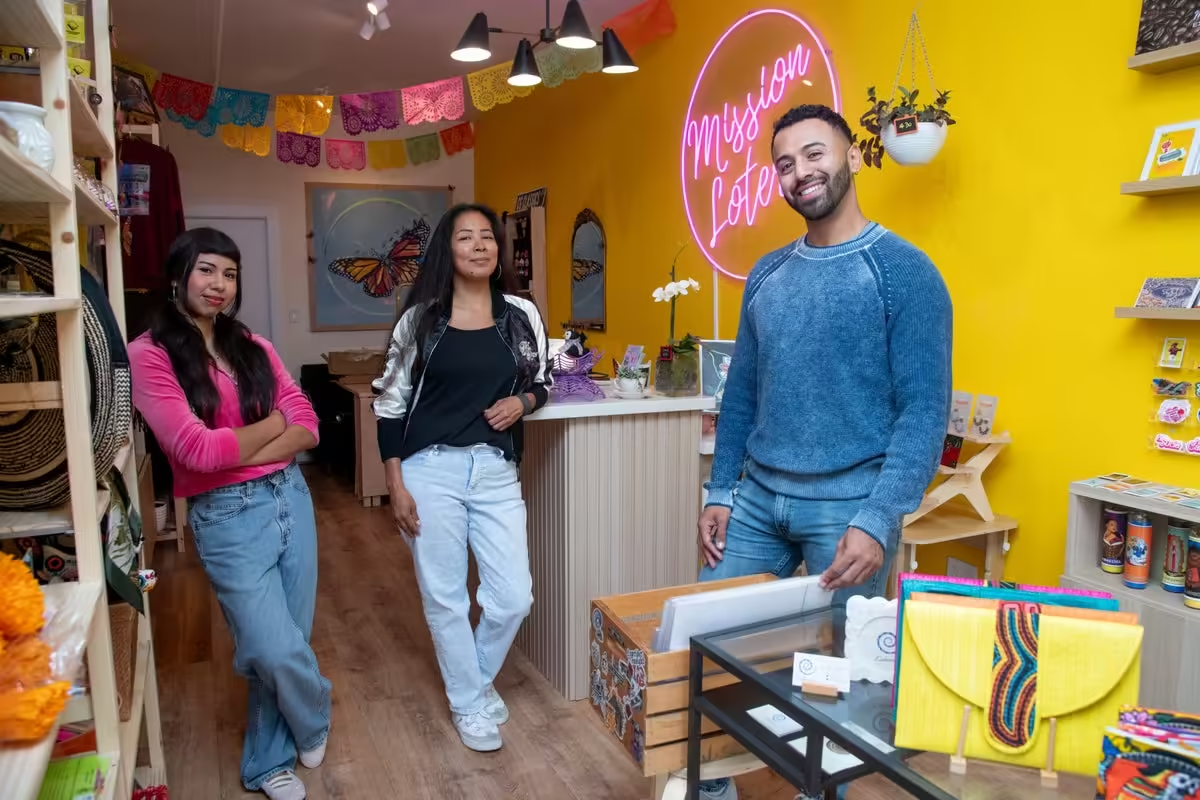

From the pink neon sign on the bright yellow wall to the multicolored Mexican paper garlands, the Mission Lotería location radiates cultural pride everywhere you look.
After seven years of promoting local businesses in the Mission district of San Franciscoa predominantly Latino area, the nonprofit has a physical location that reflects its passion for the neighborhood. Now, beyond organizing events such as taco routes or imitation contests Bad Bunnycan offer a place for Latino entrepreneurs and artists to sell their products.
Luis Quiroz, founder of Mission Lotería, is still nervous about reaching monthly goals in the midst of a complicated economy and in one of the most expensive cities in the country. However, he and his team believe strongly in their—for lack of a better word—mission.
“What’s the economic term? High risk, high reward,” Quiroz said. “I feel like we’re in a really good place. Almost every day people come in and say, ‘Oh my God, I’ve been following you for a long time.'”
Despite rising costs and fear of immigration crackdowns, some Latinos have made it their mission to support other Latino entrepreneurs. And they go beyond offering shelf space: they provide artists and entrepreneurs with advice, resources, and access to a broader audience. The complex political and economic climate has only intensified his desire to invest his own time and resources to promote other Latin and Hispanic creators. More and more places are beginning to recognize Latino businesses and the inherent disadvantages they face.
Yesi Chávez has sold Trader Jose’s greeting cards, magnets and small tote bags with handles at Mission Lotería since it opened, just before the start of National Hispanic Heritage Month. This has been a boost for his brand, as the store’s customers recognize his products when he sells them at pop-up markets. For Chávez, who works full time as an events manager at a hotel, it is also special to exhibit her creations alongside those of other Latinos.
“I feel like Latinos, from what I’ve seen, really come together and try to support their own, and try to make sure that especially Latina women are well supported,” she said.
Hispanic women face more obstacles in the business world
Amor Collective, where you can find cute items created entirely by Latinas, like panettone-shaped earrings or Day of the Dead candles, opened its doors in August in downtown Phoenixafter operating discreetly in the city’s suburbs. Stephanie Vasquez, its founder, made the bold decision to move the business even though it meant paying higher rent. A location next to his cafe became available and the store, in Vasquez’s opinion, deserved to be in the bustling center of the city.
The grand opening “was emotional,” Vasquez said. “I must say that the Latin community really supports us.”
A decade ago, Vásquez founded a nonprofit organization called “Empowering Latina Leaders in Arizona,” known by its acronym ELLA. She did so after noticing how large and persistent the wage gap is that affects Latinas. In fact, Hispanic women who work full time earn 79% of the median income of their white counterparts, placing them at the lowest wage level by race and gender, according to a quarterly report published in July by the US Bureau of Labor Statistics.
Vasquez began organizing pop-up markets for Latina entrepreneurs every month. Having a permanent location seemed like the logical next step, so he opened Amor Collective four years ago in Peoria, a town outside of Phoenix.
“It is an incubation space for businesswomen to meet, mitigate risks. So now their risk is so low that they can dare more and can really experiment with their businesses,” she explained.
More than 35 entrepreneurs have signed one-year rental contracts with Amor Collective. They are invited to monthly meetings where Vasquez hosts talks with guest speakers on topics such as public relations and banking. Since some members were afraid to attend because their relatives have been detained by the United States Immigration and Customs Enforcement Service (ICE), participation was also enabled via Zoom.
“It is very clear that coming together as a community is something very necessary,” Vasquez said. “This is where I think it’s important for the consumer, if they have the privilege of not being afraid to go out, to go to spaces like this and support communities that might need it.”
Cities large and small see the economic potential of Latino businesses
The current sentiment of Latinos throughout the country is divided regarding achieving the so-called “American dream.” Almost a fifth of Latino adults say that it is unattainable for them, according to the Pew Research Center, a group of experts that provides information on attitudes, trends and problems in the United States and the world. About 3 in 10 (27%) responded that the American dream doesn’t even exist.
In addition to advocacy groups, more cities are now recognizing the potential of Latino businesses with resources like grants. Quiroz says Mission Lotería, a name that alludes to a Mexican board game, would not have opened its doors if the team had not presented its vision to a committee in charge of managing municipal subsidies for commercial premises.
“I think that, simply because of the investments we bring to the community, to the neighborhood, it seemed like a good option that benefited both parties,” said Quiroz. “We finally received a grant of $50,000. That money was used up very quickly with our remodeling work.”
The North Central Chamber of Commerce Massachusettswhich represents more than 25 cities and rural communities located about 50 miles (80 kilometers) west of Boston, launched the Latino Initiative for Entrepreneurship and Resource Development, or LIDER, in July. LIDER provides Latino-run businesses with training and networking opportunities to fill the “access gap.” Some events and materials are offered in Spanish.
“For many years now we have seen a growing trend of businesses being created or run by Latinos here in the region,” said Roy Nascimento, president and CEO of the Chamber. “Latinos are creating businesses at three times the rate of the general population.”
The Chamber has not received negative criticism for this initiative, nor has it been described as an organization that favors diversity, equity and inclusion.
“Chambers of commerce are very inclusive by their very nature,” Nascimento added. “Our mission is to boost the economy of north-central Massachusetts.”
The stores aspire to be thriving hubs for the Hispanic community
Amor Collective seeks to be a space for events that goes beyond simple meetings and workshops. Craft classes will also be held in a corner equipped with tables, chairs and a television screen. And some DJs have already started mixing music on Sundays.
“I would love to have event spaces. Like everything our community needs, I would like to be the place that offers all of that in one place,” Vasquez said.
Quiroz, who was undocumented during his childhood and now always carries proof of his legal permanent resident status, wants Mission Lotería to be a welcoming space for the Latino and Hispanic community, whether they were born in the United States or another country.
Among his future plans is the creation of content to publicize entrepreneurs through social networks, YouTube and a podcast. The renovation works currently underway include the provision of a room to record podcasts in the back.
“People can really hear the stories of these entrepreneurs and their journey,” Quiroz said. “Whenever I have the opportunity to talk to them, their stories are truly fascinating.”
Source: www.independentespanol.com