





General Motors: Maintaining Steady Revenue Scale
General Motors (GM +1.56%) primarily generates revenue by designing, manufacturing, and distributing trucks, sport utility vehicles, passenger cars, and automotive parts for retail consumers and commercial fleet operations, while also offering automotive financing, insurance solutions, and subscription-based connected services to customers worldwide.
It recently entered a multi-year global partnership with 3M to provide advanced materials for its racing team, while it also partnered with PG&E to launch a new residential charging bundle that provides California customers with home charging hardware and monthly bill credits.
Tesla: Experiencing Higher Revenue Growth and Volatility
Tesla (TSLA -0.74%) primarily earns revenue by developing, manufacturing, and directly selling electric passenger cars, commercial transport vehicles, and large-scale energy generation and storage systems, alongside offering post-sale vehicle maintenance services, retail merchandise, and automotive regulatory credits to global buyers.
It recently held a public launch event in Texas for its purpose-built Cybercab autonomous vehicle, and it secured a contract to supply 2,500 electric commercial tractors to a transportation coalition with initial deliveries expected to begin in the fourth quarter of 2026.
GM & TSLA: Performance Comparison
Key Financial Metrics
GM – General Motors
$82.25
+1.56% (+$1.26)

TSLA – Tesla
$375.00
–0.74% (–$2.81)
Market Cap
$71B
52wk Range
$54.33 – $91.85
Gross Margin
5.74%
P/E Ratio
40.85
EPS (TTM)
$1.98
Dividend & Yield
$0.69 (0.85%)
Market Cap
$1.5T
52wk Range
$297.38 – $498.83
Gross Margin
18.85%
P/E Ratio
351.03
EPS (TTM)
$1.08
Dividend & Yield
N/A

GM – General Motors
$82.25
+1.56% (+$1.26)
Market Cap
$71B
52wk Range
$54.33 – $91.85
Gross Margin
5.74%
P/E Ratio
40.85
EPS (TTM)
$1.98
Dividend & Yield
$0.69 (0.85%)
TSLA – Tesla
$375.00
–0.74% (–$2.81)
Market Cap
$1.5T
52wk Range
$297.38 – $498.83
Gross Margin
18.85%
P/E Ratio
351.03
EPS (TTM)
$1.08
Dividend & Yield
N/A
Why Revenue Matters for Investors
Revenue serves as a starting point to help investors understand the total amount of money a business brings in before deducting any operational expenses. This metric helps investors measure a company’s overall size, market footprint, and long-term trajectory.
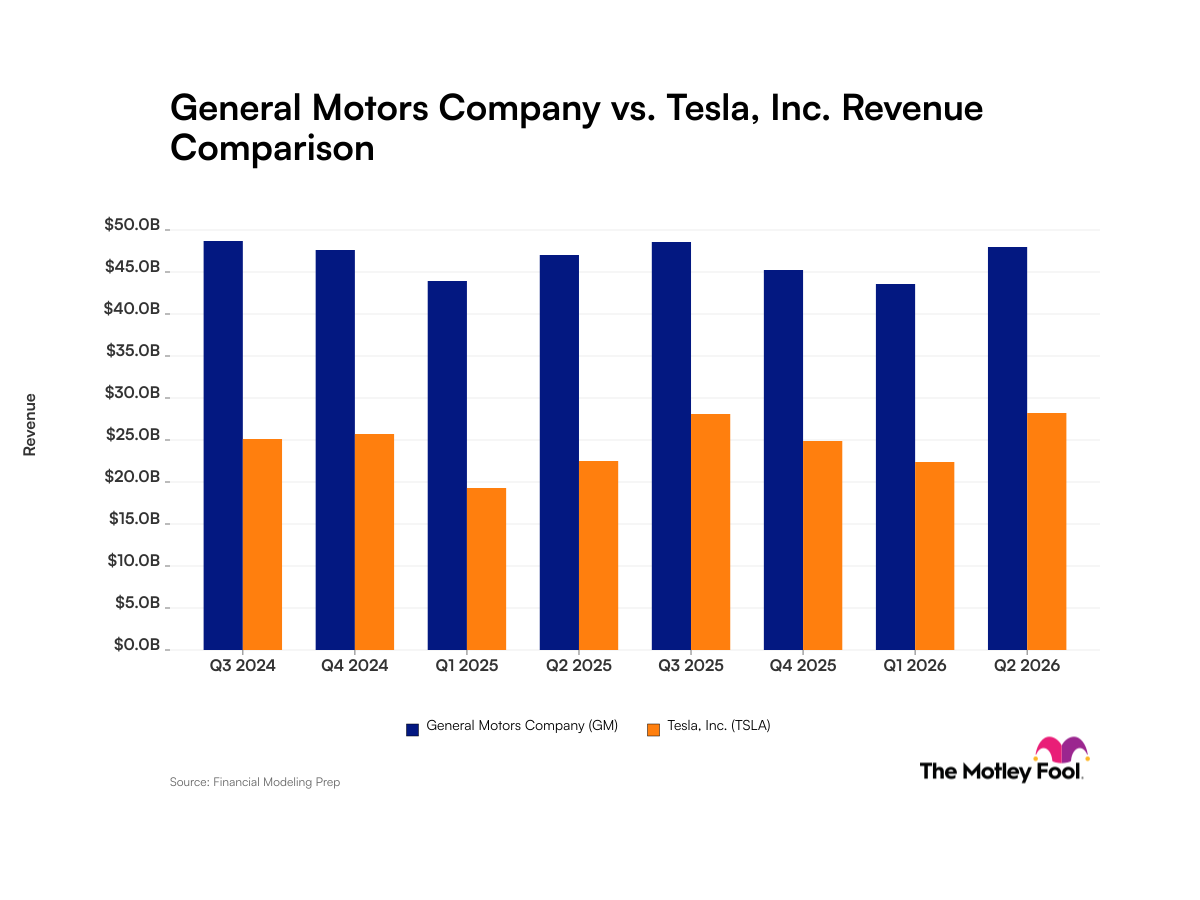
Quarterly Revenue for General Motors and Tesla
| Calendar quarter | General Motors Revenue | Tesla Revenue |
|---|---|---|
| Q3 2024 | $48.8 billion (quarter ended Sept. 30, 2024) | $25.2 billion (quarter ended Sept. 30, 2024) |
| Q4 2024 | $47.7 billion (quarter ended Dec. 31, 2024) | $25.7 billion (quarter ended Dec. 31, 2024) |
| Q1 2025 | $44.0 billion (quarter ended March 31, 2025) | $19.3 billion (quarter ended March 31, 2025) |
| Q2 2025 | $47.1 billion (quarter ended June 30, 2025) | $22.5 billion (quarter ended June 30, 2025) |
| Q3 2025 | $48.6 billion (quarter ended Sept. 30, 2025) | $28.1 billion (quarter ended Sept. 30, 2025) |
| Q4 2025 | $45.3 billion (quarter ended Dec. 31, 2025) | $24.9 billion (quarter ended Dec. 31, 2025) |
| Q1 2026 | $43.6 billion (quarter ended March 31, 2026) | $22.4 billion (quarter ended March 31, 2026) |
| Q2 2026 | $48.0 billion (quarter ended June 30, 2026) | $28.2 billion (quarter ended June 30, 2026) |
Data source: Financial Modeling Prep. Data as of Sept. 25, 2026.
Foolish Take
A comparison of revenue trends between General Motors and Tesla reveals the latter is experiencing outsized sales growth. In the second quarter, Tesla’s $28.2 billion represented a strong 26% year-over-year increase, while General Motors’ $48 billion may be far larger in absolute terms, but was only a 2% jump up from 2025.
Tesla’s revenue growth trajectory is all the more impressive considering federal EV tax credits expired in September of 2025. Meanwhile, GM has not been successful with its line of electric vehicles (EVs), with EV sales down 43% year over year through the first nine months of 2026, and the company reducing its EV production due to the loss of the tax credits and poor sales.
Instead, General Motors is relying on hybrid and traditional gas-powered autos to keep its sales afloat. Another bright spot is that the company is leaning into the artificial intelligence boom by building on its OnStar brand to implement in-car AI.
That said, Tesla is clearly the dominant automaker in the EV market between these two companies. Its third-quarter deliveries of 486,532 topped Wall Street consensus estimates by about 25,000 vehicles, reinforcing the company’s near-term demand momentum, and pointing to a continuation of the revenue growth trend it’s seeing in 2026.
Source: www.fool.com