
Oleksandr Shepotylo explains how Brexit has significantly hurt the UK car industry, and argues that upcoming EU trade rule changes could cause further damage.
This is a shortened version of a piece originally published on the author’s blog.
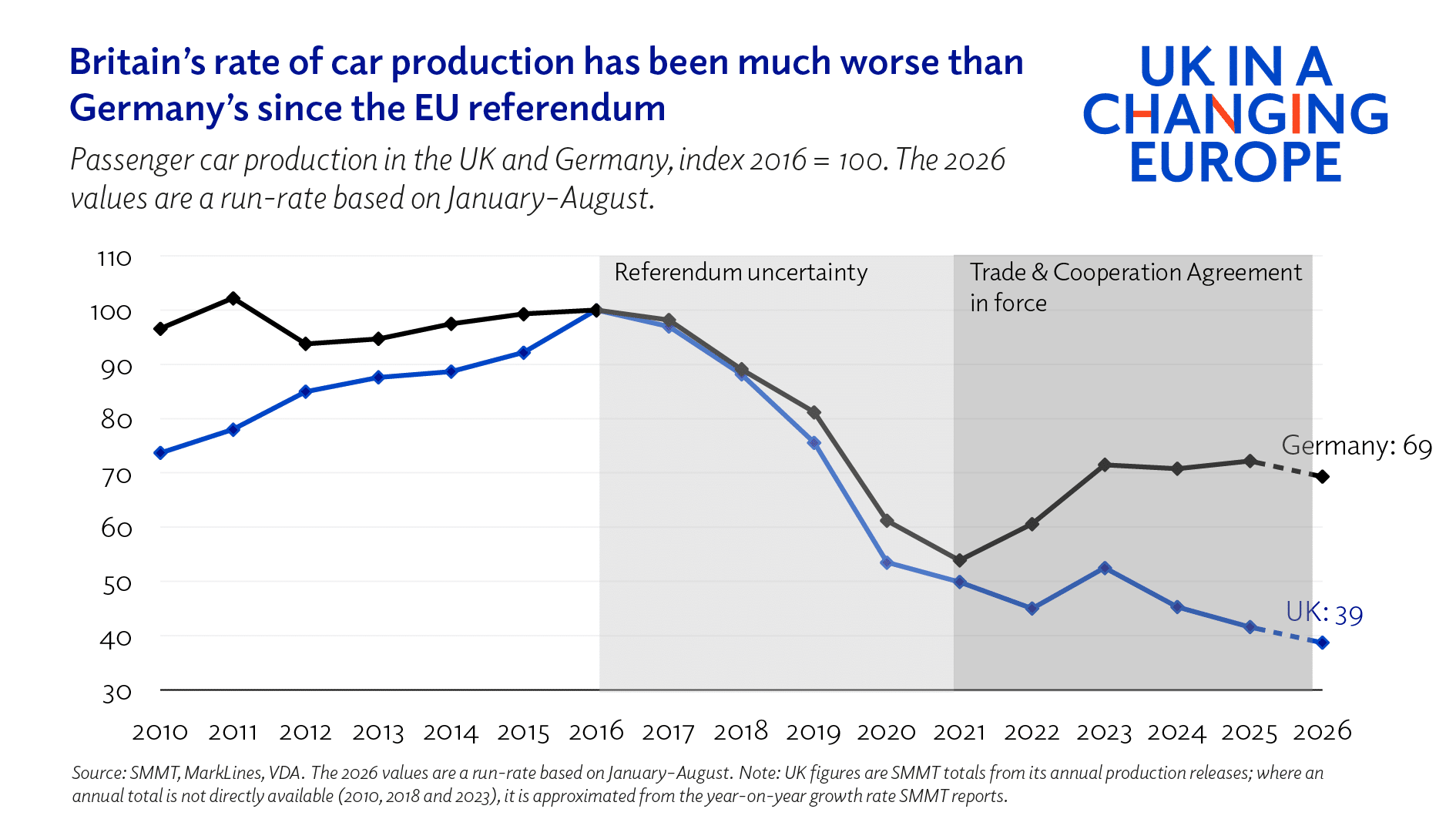
In 2016, British factories built 1.7 million cars, more than in any year since 1999. Last year they built 717,371. German output also fell over the same decade, from 5.75 million to 4.15 million, but the difference in scale is striking: Germany lost just over a quarter of its production, Britain almost three-fifths. In 2016, the UK built 30 cars for every 100 made in Germany. Today it builds 17.
It is tempting to blame a turbulent decade of diesel scandals, pandemic closures and chip shortages. But Germany went through all of those too. What it did not go through was Brexit. Using Germany as a benchmark, Britain’s decline came in two Brexit stages: years of uncertainty post-referendum weakened the industry, before the trade arrangements that replaced EU membership did more lasting damage.
The second act, from 2017 to 2020, was a slowdown under uncertainty. Both countries were hit by collapsing diesel demand, tougher emissions testing and then the pandemic, but the UK contracted faster: by 14.5% a year, against 11.6% in Germany. In the first half of 2019, the year of no-deal brinkmanship, new investment in the sector fell to £90m, against an annual average of around £2.7bn over the previous seven years. Honda announced the closure of Swindon, and Nissan dropped plans to build the next X-Trail in Sunderland. Formally nothing had changed yet, but carmakers decide where to invest years in advance, and they had started pricing in the risk of leaving.
The third act began when that risk became reality. Since the UK-EU Trade and Cooperation Agreement (TCA) came into force in January 2021, German car output has risen by 18% while British output has fallen by 22%. Germany has recovered to about 72% of its 2016 level; Britain has fallen to 42%, and on this year’s trend will end 2026 below 40%.
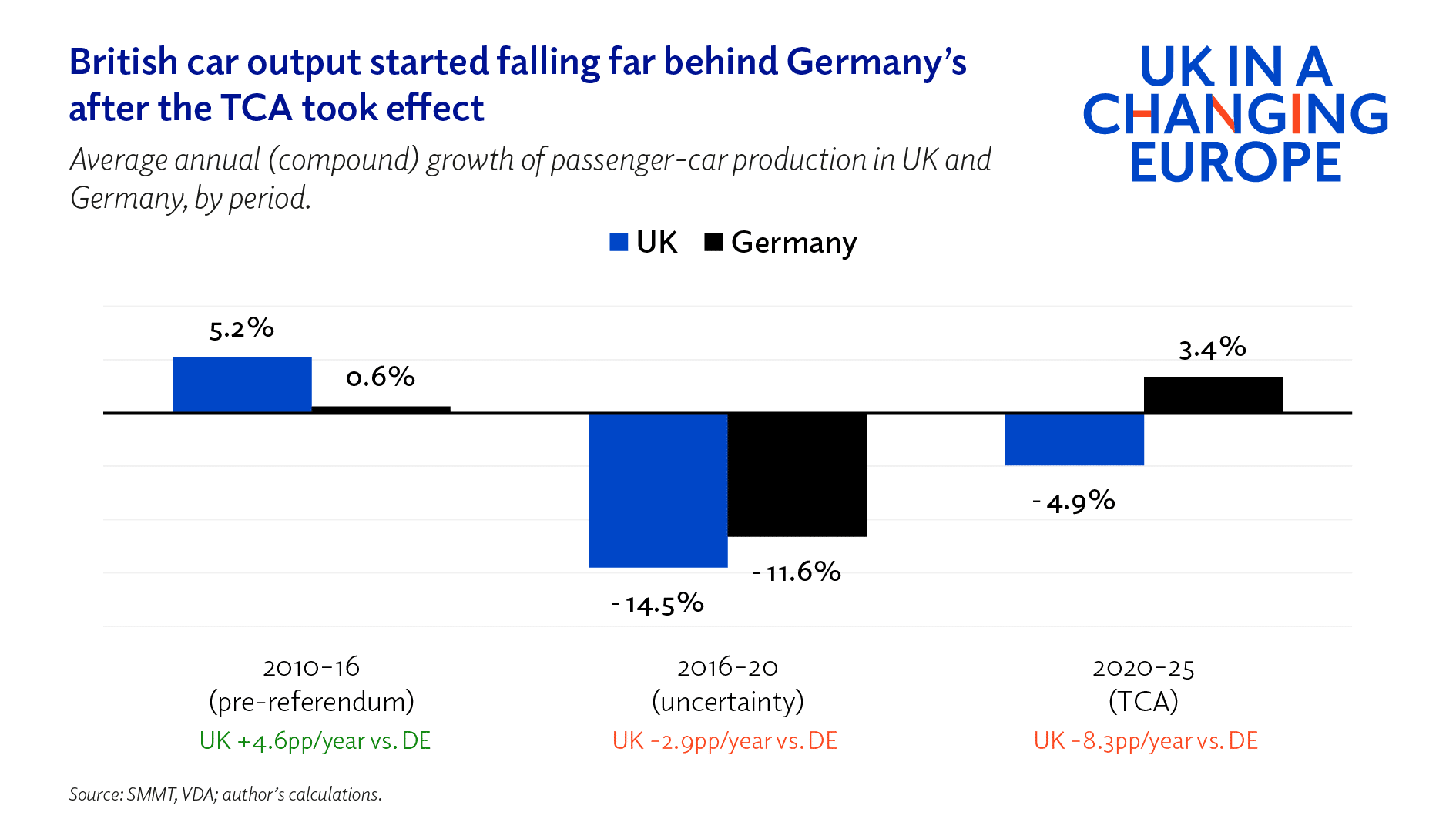
Before 2016, UK car output grew 4.6 percentage points a year faster than Germany’s. Since 2020, it has grown more than eight points a year slower. Uncertainty cost the industry ground; the new trade arrangements cost it nearly three times as much. Uncertainty delays decisions, but a trade agreement changes costs for good, and the TCA changed them in three ways that matter for cars.
First, rules of origin. The TCA’s zero tariffs apply only if enough of a car’s value comes from the UK or the EU, documented across hundreds of components and tiers of suppliers. For electric vehicles, whose batteries are largely made in Asia, these rules have been phased in gently, but from January 2027 they apply in full. The SMMT estimates that most electric and plug-in hybrid models traded across the Channel will then face tariffs costing at least £1.4bn.
Second, supply chains. Car parts cross borders several times before a vehicle is finished, and customs and safety paperwork adds up across a production line. Research with my Aston colleagues Jun Du and Yujie Shi finds that UK exports to the EU are 16.5% below where they would otherwise have been, and the number of products exported has more than halved. But where firms are bound together by shared production networks, as in car components, trade has largely held up. A model already in production keeps its suppliers, because switching mid-cycle costs more than the paperwork. When it reaches the end of its life, though, and the carmaker decides where to build its replacement, those ties are cheapest to cut. So the damage is slow rather than sudden, and it falls at the moment that matters most: the allocation of new models.
Third, the ‘Made in Europe’ agenda. The European Commission’s proposed Industrial Accelerator Act, published in March 2026, would tie public support and procurement for electric vehicles to a 70% European-content threshold. Whether the UK will count as a trusted partner whose components are ‘European’ is undecided. The SMMT warns that, in its draft form, the proposal would make UK-built cars uncompetitive in their largest market, and Nissan has reportedly said Sunderland’s future depends on the final outcome. An industry that exports more than three-quarters of its output, mostly to the EU, cannot be indifferent to whether its cars count as European.
Two caveats apply to the above. In 2021, the chip shortage hit German plants harder, so the divergence in output only becomes unmistakable from 2022. And Britain had shocks of its own, such as the end of Astra production at Ellesmere Port and the 2025 cyberattack on Jaguar Land Rover. The eight-point gap is an upper bound on the TCA’s effect, not a precise estimate. But the sequence – faster growth, then slower growth under uncertainty, then a sharp break under the new regime – is hard to explain with disruptions that hit both countries.
A decade ago, Britain was one of Europe’s fastest-growing car producers. The TCA turned a slowdown into a divergence, not through a single shock but through the gradual loss of new models as existing supply chains reached the end of their lives. Deep integration protects what already exists; it does not secure what comes next.
The next two years will test whether the UK can still compete in the EU markets, but it is badly positioned. Four brands make 96% of British cars, so output hinges on a handful of decisions at a handful of plants. And Britain makes few of the fully electric cars which stand to benefit most from upcoming EU rule changes: these models constitute about a quarter of German output this year, while in Britain, Nissan’s new Leaf is the only one in production. With stricter rules of origin due in January 2027 and a European content test under negotiation in Brussels, the industry’s future will be decided by trade policy at least as much as by engineering. On current trends, the UK is not winning enough.
By Oleksandr Shepotylo, Reader in Economics and Director of the Centre for Business Prosperity, Aston Business School.
Source: ukandeu.ac.uk