



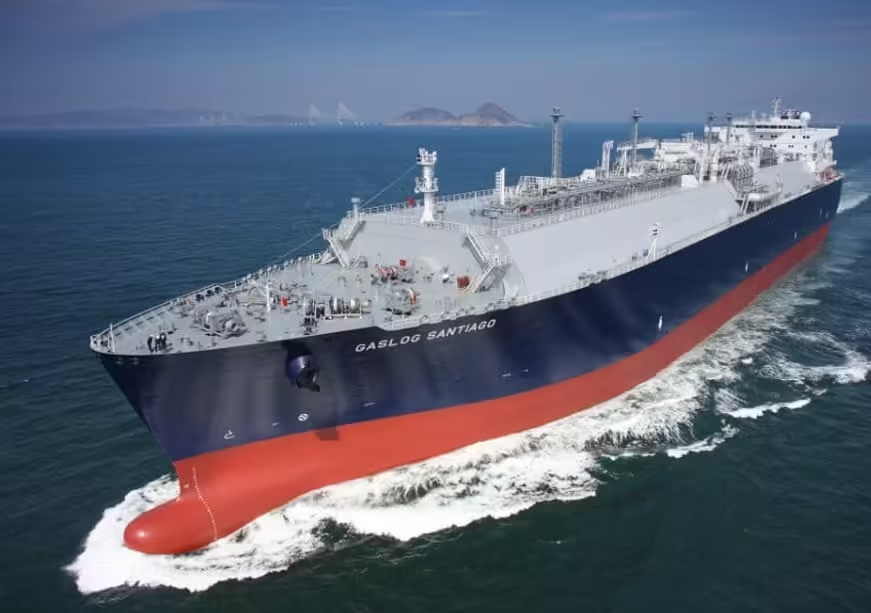

The maritime sector carries around 80 percent of global trade by volume, equivalent to more than 12 billion tonnes of cargo. Global climate policy increasingly focuses on maritime decarbonisation, yet the issue remains largely absent from India’s energy transition discussions. The international shipping sector, responsible for about 3 percent of global greenhouse gas (GHG) emissions, aims to achieve net-zero emissions by 2050, with annual GHG reduction targets of up to 80 percent by 2040. The revised strategy of the International Maritime Organization (IMO) targets at least 5 percent adoption of zero- or near-zero-GHG-emission energy sources by 2030. Building on this, the IMO has proposed integrating a mandatory fuel standard with a global GHG pricing mechanism for international shipping.
These developments underscore a growing international regulatory framework to reduce shipping’s GHG fuel intensity (GFI) from the 2008 baseline of 93.3 gCO2eq/MJ. Under IMO regulations, ships of 5,000 gross tonnes and above, which account for approximately 85 percent of international shipping emissions, must report fuel-consumption data. Separately, the 2025 FuelEU Maritime regulation sets different standards for GHG intensity for ships calling at European ports. These regulations create strong economic incentives for scalable low-carbon marine fuels, including biofuels. They also highlight the need for diverse technologies to decarbonise shipping and position marine biomass as a complementary pathway in the biofuel transition.
Marine Biofuel and the Importance of Feedstock
In policy discussions, the term ‘marine biofuel’ is often used interchangeably for both biofuels used in the maritime sector, regardless of feedstock, and biofuels produced from marine biomass, such as microalgae and seaweed. In this context, marine biofuels refer specifically to biofuels derived from marine biomass. The biofuels currently used in shipping are largely sourced from land-based feedstocks. Depending on its composition, marine biomass can be converted into biofuels through various pathways. In terms of commercial viability, the main challenge lies in biomass harvesting and processing rather than conversion technology. For instance, concentrating microalgae cultures is energy-intensive because of low solid content (0.1–0.5 percent). This could be improved by integrating these processes with industrial waste heat or carbon emissions.
The term ‘marine biofuel’ is often used interchangeably for both biofuels used in the maritime sector, regardless of feedstock, and biofuels produced from marine biomass, such as microalgae and seaweed.
The marine biofuels sectorcurrently valued at approximately US$4.2 billion, is expected to reach US$7.0 billion by 2033, at an annual growth rate of 7.5 percent. Europe accounts for one-third of the market, supported by FuelEU Maritime, while Asia-Pacific is emerging as the fastest-growing region. The global algae biofuel market is valued at US$10–13 billionalthough these market projections also include aviation, chemicals, and other applications. Singapore, the world’s largest bunkering hub, has recorded a rapid increase in the use of biofuel-blended bunker fuel, from 0.52 million tonnes in 2023 to 1.36 million tonnes in 2025.
As India’s transport sector faces growing biofuel demand, the sector could explore marine-biomass feedstocks rather than relying more on sugarcane and other foodgrains to meet mandates such as 20 percent ethanol blending in petrol (E20), which has fuelled the food-versus-fuel debate. While official reports warn of mileage reductions of up to 5 percent, 60 percent of petrol car owners have reported mileage drops of more than 10 percentalongside higher corrosion rates in older, ethanol-incompatible vehicles, which raise repair and maintenance costs. The shipping sector faces a similar challenge, as most vessels rely on sulphur-containing crude oil derivatives such as heavy fuel oil (HFO) and very low-sulphur fuel oil (VLSFO), emitting particulate matter and black carbon and remaining vulnerable to global fuel-price fluctuations. Marine biofuelssuch as those derived from microalgae or seaweedaddress these challenges because the biomass can be cultivated in seawater without competing with land-based food production, and the fuels can be used in existing ship engines without major modifications. Wider adoption, however, remains constrained as scale-up is costly and energy-intensive.
Independent techno-economic analyses estimate microalgae biodiesel production costs at US$300–2,600 per barrel equivalent. In comparison, crude oil costs US$40–80 per barrelhighlighting the techno-economic challenges associated with marine biomass-based biofuels. Pilot-scale production of algae biofuels costs approximately US$12–16 per gallon of gasoline equivalent. The water footprint of an open-pond algae cultivation system is approximately 600–1,900 litres of water per litre of fuel. These land-based limitations give marine algae an important advantage by reducing competition for freshwater and land. However, shifting cultivation to marine environments introduces new challenges, including infrastructure, maintenance, and exposure to extreme weather conditions.
Co-product valorization can significantly improve economic feasibility. Instead of using the biomass for a single product (fuel), lipids, carbohydrates, proteins, and other biochemicals can serve as feedstocks for industries such as pharmaceuticals, nutraceuticals, cosmetics, and biodegradable materials. This approach can reduce the minimum selling price of the fuel from US$8 to US$2.5 GGEhighlighting the need for policy focus on biorefinery-based marine-biofuel approaches rather than subsidised fuel production alone.
India’s Marine Biomass Potential
India’s vast natural resources lend it a strong advantage. However, policy support at present remains fragmented. More than 800 seaweed species have been identified, along with over 0.26 million tonnes of utilisable biomass. To date, roughly 20,000 tonnes have been harvested. With an investment of around US$128 million, Kappaphycus cultivation could scale to 26,000 hectares, generate approximately US$96 million in revenue and create more than 100,000 full-time jobs, while delivering 63 percent higher economic returns than conventional aquaculture.
India’s vast natural resources lend it a strong advantage. However, policy support at present remains fragmented.
India’s policy framework is beginning to recognise the potential of seaweed and algae. The revised 2022 National Policy on Biofuels has expanded its support to include algae- and seaweed-based advanced biofuels, in addition to forestry- and agricultural-residue-based biofuels. This potential places marine biomass within the broader blue economy agenda. However, scaling up marine biomass production should be accompanied by appropriate environmental safeguards, including frameworks for feedstock cultivation, processing, and certification.
Policy recommendations
- Infrastructure development for blending and bunkering: Scaling up marine-biofuel production will require state-of-the-art infrastructure, including blending tanks, storage facilities, and mass-flow meters, along with monitoring, regulation, and certification systems. Singapore’s infrastructure-first approach could serve as an example. Its investments in mass-flow metering, simultaneous operations (SIMOPS), and digital bunkering have helped increase biofuel sales from 0.5 million in 2023 to 1.4 million in 2025. India can adopt a similar approach to install the required infrastructure, under the Sagarmala Programme’s green port framework.
- Phased biofuel blending mandate at major ports: India could draw lessons from the European Union’s (EU) FuelEU Maritime framework, which sets progressive GHG reduction mandates. India’s ethanol blending has risen from 1.53 percent in 2014 to 20 percent in 2025. Rather than introducing a high blending target at the outset, India could adopt a phased approach, initially focusing on infrastructure, biorefinery-based production, and a predictable market, followed by higher blending mandates. Pilot facilities could be evaluated for technical and economic feasibility as well as environmental impact before wider adoption.
- Funding for biorefinery integration: Techno-economic analysis indicates that algal biofuels can become economically viable through co-product valorisation across sectors such as fuels, food, feed, nutraceuticals, pharmaceuticals, cosmetics, and biomaterials, rather than through algal strain improvement alone. Building on the Aquatic Species Programthe Bioenergy Technologies Office of the US Department of Energy found, based on process-modelling studies, that this approach could reduce the fuel selling price from US50 per gasoline gallon equivalent (GGE). In India, a dedicated share of the Pradhan Mantri JI-VAN Yojana could support the Council of Scientific and Industrial Research–Central Salt and Marine Chemicals Research Institute (CSIR-CSMCRI) biorefinery pilot projectshelping generate techno-economic data to attract private capital.
- Scale-up of microalgae cultivation: The high lipid and carbohydrate content of microalgae makes them economically attractive for biorefinery development. Policy should therefore focus on harvesting and post-harvest processing of microalgae in addition to cultivation. In Norway, Seaweed Energy Solutions combines seaweed cultivation with industrial and energy applications, and valorises the biomass into other bioproducts. SeaCombine, developed by Sea6Energyautomates seaweed harvesting and replanting, making the process more efficient and scalable. The Multipurpose Seaweed Park in Tamil Nadu could be developed as a scalable model for feedstock supply for seaweed-based biofuel production.
- Integrate carbon market with IMO maritime transition fund: India’s marine-biofuel transition can be strengthened by connecting its domestic carbon credit trading to the International Maritime Organization (IMO) Net-Zero Fund. The IMO’s proposed system could complement national efforts by directing funding from high-emission ships to clean fuel production, infrastructure, technology transfer, and capacity-building in developing countries. The Bureau of Energy Efficiency‘s carbon credit trading system could help certify emissions reductions and link them to the IMO’s transition support efforts.
With its abundant marine biomass resources and growing biofuel ecosystem, India is well placed to play a leading role in the emerging cleaner marine fuels sector.
Conclusion
The success of India’s maritime energy transition depends on developing a reliable, cost-effective and commercially viable system. Marine biomass should be considered as part of a broader decarbonisation strategy, rather than as a standalone fuel. Its potential lies in integrated marine biorefinery systems with diverse product portfolios. India should focus on policies that build the required infrastructure and biorefinery capacity to support consistent growth and reduce production costs. With its abundant marine biomass resources and growing biofuel ecosystem, India is well placed to play a leading role in the emerging cleaner marine fuels sector. With appropriate policy support for infrastructure, R&D and viable commercialisation pathways, India can harness marine biomass as a complementary component of a broader, sustainable maritime energy transition.
Poornima VB is an Associate Fellow at the Observer Research Foundation.
The views expressed above belong to the author(s). ORF research and analyses now available on Telegram! Click here to access our curated content — blogs, longforms and interviews.
Source: www.orfonline.org