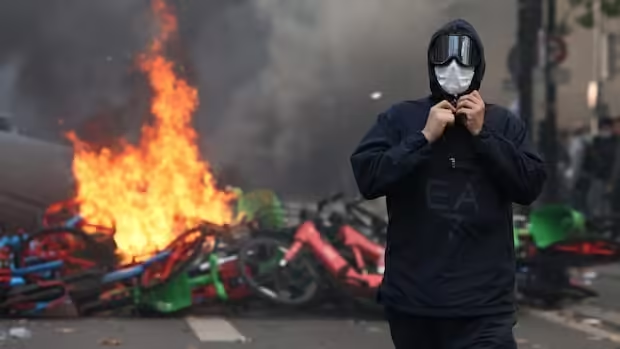

France is about to wake up to an uneasy morning after.
On Saturday, the country saw massive — and unusually violent — cross-generational protests that brought together high schoolers, trade unions and “yellow vest” demonstrators, all choking the streets of Paris, Lille and other French cities.
While many aspects of this day of protests were peaceful, there were also fierce confrontations between brick-throwing protesters dressed in black and police armed with water cannons and tear gas.
The confrontations left parts of Paris looking like a war zone.
One minister estimated 400 people had been arrested, with 110,000 demonstrators in Paris alone. French TV aired video of businesses and retail stores that had been looted and the city’s mayor said entire streets had been vandalized.
While the tear gas and smoke from burning vehicles cleared relatively quickly, the violence will no doubt leave a deep scar on the city.
Saturday’s events also speak to a deeper, more ideological cleavage over values, spending priorities and crucially, whether the French state should protect its economic standing, or its most vulnerable first.
‘Turning point’
What began weeks ago as high schoolers demanding repaired classroom boilers has transformed into an existential battle over the very definition of the French Republic.
“France is coming to a major turning point,” Bally Bagayoko, the left-wing mayor of the working-class Paris suburb of Saint-Denis, told CBC News.
“Today, unfortunately, this France is in sadness. It is unable to provide concrete answers to the legitimate demands of high schoolers … and the only concrete answer it can provide is a heavy handed police response.”
Over the last three weeks of the teenagers’ protest, supporters have harshly criticized police tactics. One young person lost part of an arm during an especially violent confrontation and there were reports Saturday in Paris of other people enduring similar injuries.

A view of the momument in La Place de la République after police fired tear gas at protesters to try to disperse the crowd. (Chris Brown/CBC News)
The involvement of the yellow vest movement amplifies the stakes for France’s government. Initially formed by disillusioned working class voters nearly a decade ago to battle high fuel prices, the movement petered out during COVID lockdown. Its reconstitution now could help potentially transform the students’ school-focused protests into a cause with much longer staying power.
In the aftermath of Saturday’s violence, France’s key political leaders were unanimous in their condemnation of the violence on the streets, and attempted to separate the instigators from those who were there peacefully.
“We will all stand united against the sowers of chaos, who seek only to bring down our institutions and prevent those who peacefully express their demands from doing so,” posted French President Emmanuel Macron.
The country’s centrist Prime Minister Sébastien Lecornu took a similar approach.
“Today, ultra-left groups have orchestrated violence in several French cities; delinquents have joined in to pillage and destroy,” he wrote.
France’s far-right party, the Rassemblement National (RN), rejected the protesters and their message, and instead praised the conduct of the security forces.

Mayor Bally Bagayoko represents the Paris subburb of Saint-Denis. He put himself between protesters and police at a student demonstration earlier this month. (Adrian Di Virgilio/CBC News)
Toxic convergence
On the surface, the current crisis looks like a familiar French budget dispute.
But on the ground, the view from inside the student movement reveals a toxic convergence of fiscal collapse, class warfare, systemic racism and a worrying escalation of state force.
In the days leading up to this weekend’s mass protests, CBC News went inside the student movement in the northern city of Lille to better understand the issues driving it.
Many of the organizers are very young — some just 14 years old. CBC News required their parents’ permission to speak to them.
At the fences of Lycée Faidherbe, amidst the thick black smoke of smouldering plastic bins that some students had set ablaze, the teenagers’ demands sounded immediate and concrete.
“We hope the school will be closed,” Lille organizer Soan Rauch, 16, told CBC News, standing near the barricades.

Soan Rauch, 16, has taken a lead role organizing high schoolers in the city of Lille, France. (Jason Ho/CBC News)
When asked why shutting down their own education is a victory, his fellow classmate, 15-year-old James Caron, didn’t hesitate.
“It helps put pressure on the government,” Caron said. “Because if everything is burning, the government can’t ignore us.”
While conservative critics have attempted to dismiss the movement as the political manipulation of minors by populist left-wing politicians, independent analysts say the teenagers’ grievances are grounded in real, physical decline.
“Actually, they do understand what they’re doing, and they’re not manipulated,” Blanche Leridon, a political analyst with the Paris-based think-tank Institut Montaigne, told CBC News.
“There is a huge topic about the deterioration of the condition of education, and deterioration of their buildings. [Teachers] are missing and it’s really hard for them to learn in good conditions.”
Rauch took CBC News to Lycée Fénelon, his shuttered school, pointing out student-painted banners demanding “respect” written in multiple languages.
Beyond the political slogans, he said that the daily reality inside French public classrooms has become untenable.
“We ask for classrooms that are much less crowded — we are 35 students per class,” said Rauch. “More particularly, we have problems with hallways and thermal boilers. It means that it’s very hot in summer and very, very cold in winter.”

French riot police stand in position amid clashes with protesters during a demonstration at La Place de la République in Paris. (Abdul Saboor/Reuters)
As the student disruptions have rippled across the nation, the Macron government attempted to quell the anger by offering a temporary package consisting of thousands of new substitute teachers. The student unions swiftly dismissed the proposal, calling it an empty gesture.
The race factor
Mayor Bagayoko argues that this structural neglect is concentrated heavily in diverse, working-class communities plagued by high unemployment, like Saint-Denis, which sits at a staggering 35 per cent jobless rate.
“When you grow up in the working-class neighbourhoods, you are treated less well than in the beautiful Parisian neighbourhoods,” said Bagayoko.
“All the children of France must be treated equally.”
The Macron administration continues to claim its hands are tied, pointing to a crushing sovereign debt crisis and severe warnings from global credit rating agencies.
But inside the student strategy meetings that CBC News sat in on, that economic narrative is rejected as a corporate myth.
“I don’t think the government should reduce its social spending, but they should rather try to increase [it],” argued 14-year-old Lille student Bastien Duprez. “And probably decrease budgets to, for example, budgets to the army and, for instance, subsidies to big corporations.”
“We know that a lot of money from the government goes to rich people,” added Alice Note, 17. “So we also think that the money that the rich people have will go to us, to education.”
Leridon, the French political analyst, sees France as a country stuck in an economic vise.
“We are really aware of the specific difficulties we have regarding our debt or deficits … but [people] are not prepared to make any sacrifices. They don’t want higher taxes, they don’t want to work longer,” she said.

Masked protesters walk past burning barricades amid clashes in Paris. (Jack Taylor/Reuters)
Clashing priorities
This clash of priorities has translated into an exceptionally aggressive law-and-order response.
Prior to the weekend, more than 8,000 high school students had been arrested nationwide, the vast majority of them minors. Mayor Bagayoko claims hospital rooms continue to fill up with teenagers suffering from broken jaws, fractured limbs, and severe chemical gas inhalation.
The protest line violence became so intense that on Oct. 6 in Paris, he physically placed his own body between charging riot police and fleeing high schoolers during a protest at Place de la Nation.
“I made the choice to intervene by trying as much as possible to protect the high schoolers first, because I remember that they were minors,” Bagayoko said.
The video of his intervention flashed around the country, transforming him into a central figure in the ongoing crisis.
France is less than six months away from a pivotal presidential election.
With the centrist government entirely paralyzed and unable to pass a budget through a deeply fractured Parliament, the political void is rapidly being filled by the far right.
Marine Le Pen, who will be the Rassemblement National’s candidate in the upcoming presidential election this spring, appears to be in a commanding position. She has called for strengthened anti-riot legislation and largely ignored the issues at the centre of the student’s complaints, instead focusing on the need to restore order on the streets.
For the teenagers holding the barricades, a right-wing takeover isn’t just a political shift, it’s a direct threat to their safety.
“We’re afraid. We have a lot of fear,” Rauch admitted. “We don’t know what’s going to happen tomorrow.
Source: www.cbc.ca