




UNIVERSITY PARK, Pa — Historically, wildfire research has focused on the western United States. However, changing climate conditions, increasing drought severity and dense development patterns are rapidly altering wildfire risk across the Eastern United States. Penn State hosted the Eastern Wildfire Forum in September to address the growing challenge of wildfire in the commonwealth and across the Eastern United States.
“Changing climate conditions and dense development patterns are rapidly altering wildfire risk across the Eastern U.S.” said Erica Smithwickdistinguished professor of geography and ecology, who helped organized the forum. “However, even relatively small fires can have disproportionate impacts due to the close integration of forests, infrastructure and population centers, as well as the growing reach of wildfire smoke.”
The forum was hosted as a collaboration between the Eastern Fire Network (EFNet)a Penn State-led multi-institution research and training network focused on advancing wildfire science in the Eastern United States; the Goddard Foruman annual science-policy dialogue series hosted by Christopher Scott, the Maurice K. Goddard Chair in Forestry and Environmental Resource Conservation at Penn State and the Pennsylvania Department of Conservation and Natural Resources (DNCR).
The forum comprised a daylong workshop of scientists and managers, a second day in the field at a site in the Michaux State Forest that burned in 2025 and on the third day, a wildfire risk policy forum. Connecting academics, fire managers and policymakers, the forum identified opportunities to address the unique and growing challenges of eastern fire.
“We’re looking at Penn State and where to build strength in energy and the environment,” said Bruce Logandirector of the Institute for Energy and the Environment. “We want to find disciplinary people who can be multidisciplinary and transdisciplinary.”
The goal of EFNet is to design solutions to real-world wildland fire science challenges, linking research to implementation and decision making.
“EFNet is different from other groups that think about fire because it is researched focused, transdisciplinary and has the scale of the entire east rather than a smaller region,” said Smithwick, who also directs both the Earth and Environmental Systems Institute and Climate Consortium at Penn State. “The goal of this forum was to catalyze a research agenda and facilitate filling research gaps to support other networks.”
On the first day of the forum, participants identified what is different about the eastern firescape— the factors that contribute to the fire risk — compared to that of the western environment.
Some of the differences they identified, Smithwick said, were that the east has greater diversity in climate and fire ecology, including hurricanes and ice storms, which can impact fuel sources and management strategies. Landownership in the east is much more fragmented with small pockets of state and private land rather than the big swaths of federal land in the west, making it challenging to distribute fire management across regions. Less federal land and higher population density means that there are more wildland-urban interfaces which pose greater fire risk to humans. Historically, there have been fewer fires in the east, creating different social perceptions of fire, which influences policy around fire management.
The other breakout session of the workshop focused on research needs. Understanding that fire in the Eastern U.S. has unique challenges, the groups brainstormed the best areas for academics to focus on.
Participants discussed the need for new mapping and models. Knowing about vegetation, wind and weather, fuels and the impacts of invasive species like the spongy moth and emerald ash borer — and how all of these are impacted by changing climate — is critical for both fire managers and policymakers, Smithwick said.
Also highlighted was the need to bridge the coordination gap of patchwork landownership and the need to make reporting and research consistent across different regions in the east and across the federal-local lines. Other participants noted the need to understand risks of fire, especially smoke impacts, and how to influence the social perception of fire management to incentivize prescribed burns.
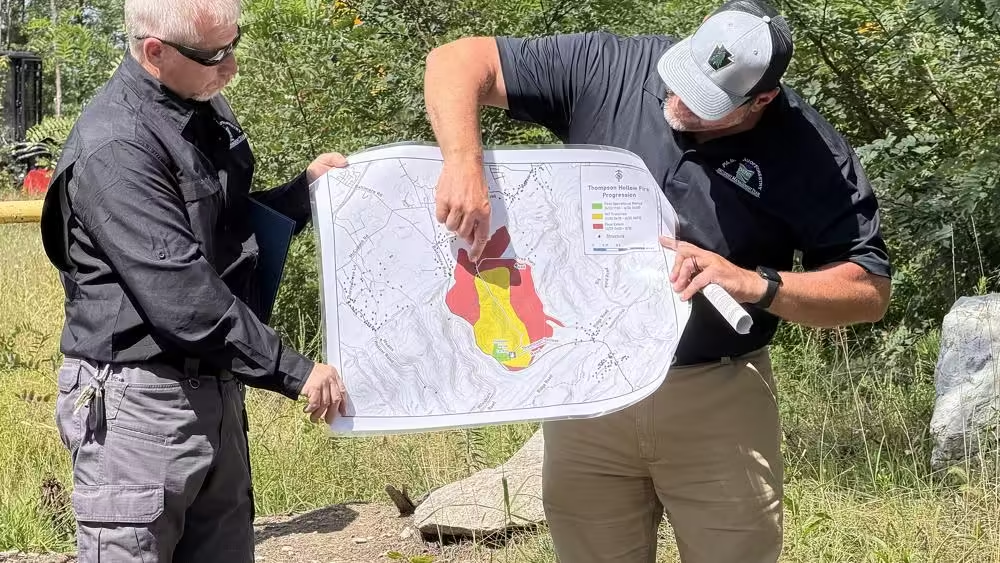
On the second day of the forum, participants traveled to Michaux State Forest and toured the site of the Thompson Hollow wildfire — a fire that impacted 2,400 acres of the state forest in April 2025.
“The field trip to Michaux State Forest was incredible,” said Manzhu Yu, associate professor of geography at Penn State and co-principal investigator of the EFNet project. “State forest managers walked us through the Thompson Hollow Fire and provided lots of detail: the preconditions beforehand, the general practices for managing the forest, the firefighting efforts and the communication around both the fire and smoke concerns. They were remarkably open to new questions, treating themselves as students of the forest rather than authorities, which was genuinely inspiring.”
Other participants said they also appreciated touring the Thompson Hollow Fire site.
“As a Pennsylvania public forest manager whose perspective on wildland fire as either a land management tool or a trigger for emergency response is pretty provincial — it was really eye opening to learn from everyone,” said Roy Brubaker, a district forester DCNR Bureau of Forestry. “It was great to hear from others doing similar work to me but in different eastern region contexts; and content experts in fields I wasn’t even aware were interested in wildland fire here in the east.”
Source: www.psu.edu