






Personal use of company vehicles ticked up in Automotive Fleet’s 2026 survey, while more respondents also reported charging employees for the privilege.
Seventy-nine percent of respondents allow personal use, up from 72% in 2024. Among respondents who answered the charge question, 54% assess a personal-use fee, up from 48% in 2024.
The increase in personal-use privileges interrupts a longer-term decline in the survey results. In 2013, 87% of responding fleets allowed personal use before the share gradually fell to 72% in 2024.
The 2026 survey included 71 respondents, compared with 94 in 2024, and survey populations vary from year to year. The results are best viewed as a snapshot of current practices, with year-to-year comparisons providing directional context rather than evidence of a longer-term reversal.
After declining from 87% in 2013 to 72% in 2024, the share of surveyed fleets allowing personal use rose to 79% in 2026.
Personal Use Remains Widely Available
Among the 67 respondents answering the question about conditions for personal use, 64% said employees may use their company vehicles personally “at all times, whenever necessary,” compared with 53% in 2024. Another 9% limit personal use to travel to and from work, while 24% selected “Other.”
“Other” responses included policies based on mileage or geographic limits, management approval, department-specific rules, minimal personal use, and respondents that do not permit personal use.
Driving privileges for others changed less. In 2026, 42% of respondents permit an employee’s spouse to drive the company vehicle, compared with 38% in 2024. Nine percent allow licensed children to drive, compared with 6% in 2024.
Nearly half of 2026 respondents, 48%, said no one other than the employee is permitted to drive the company vehicle, compared with 60% in 2024. Another 17% selected “Other,” which included domestic partners, significant others, and other household members.
Respondents could select more than one authorized-driver category.
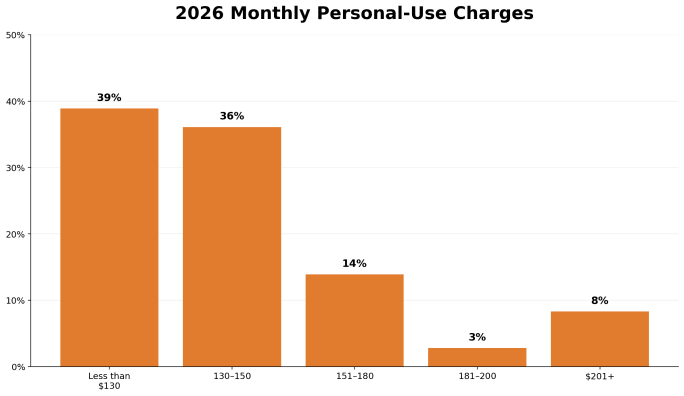
Among respondents who charge for personal use, 61% assess $130 or more per month, while 39% charge less than $130.
More Than Half Report a Personal-Use Charge
Among respondents answering the personal-use charge question in 2026, 54% reported assessing a charge, compared with 48% of respondents in 2024.
Among the 36 respondents reporting a monthly charge in 2026, 39% charge less than $130 per month. Another 36% charge between $130 and $150, while 14% charge between $151 and $180. Three percent charge between $181 and $200, and 8% charge $201 or more.
Overall, 61% of respondents assessing a fee reported monthly charges of $130 or more, compared with 49% in 2024.
Because only 36 respondents reported a monthly charge in 2026, the difference should be viewed as directional. Still, the results show fewer charging respondents below the $130 threshold than in the previous survey.
The 2026 survey also asked about recent increases. Eleven respondents said their companies increased personal-use charges during 2025, and five reported another increase since the beginning of 2026. All five fleets reporting a 2026 increase had also raised their charges in 2025.
The small number of respondents prevents drawing a broader industry conclusion, but the responses show that some fleets have revisited their personal-use charges in consecutive years.
Nearly half of respondents allow no one besides the employee to drive the company vehicle, while 42% permit an employee’s spouse. Respondents could select more than one answer.
Managing Who Can Drive
Among 2026 respondents for whom the question was applicable, 87% require a motor vehicle record (MVR) check for authorized drivers other than the employee, compared with 77% in 2024.
The number of respondents is relatively small, so the difference is directional. MVR checks nevertheless remain a common practice among responding fleets that extend driving privileges beyond the employee.
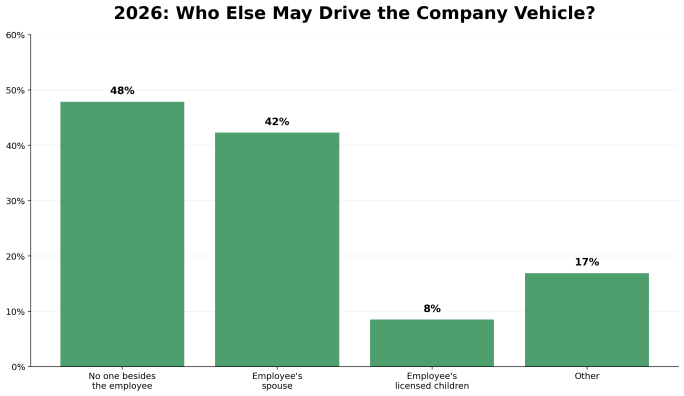
Nearly half of respondents allow no one besides the employee to drive the company vehicle, while 42% permit an employee’s spouse. Respondents could select more than one answer.
Job Function Still Drives Vehicle Eligibility
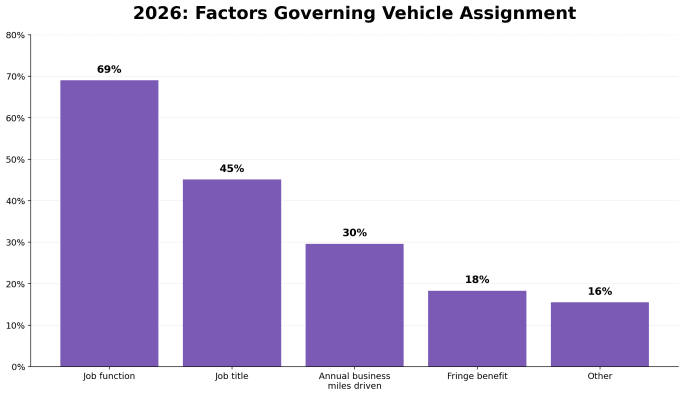
Job function remains the leading factor in determining who receives a company vehicle, cited by 69% of 2026 respondents, compared with 73% in 2024.
Job title was cited by 45%, essentially unchanged from 2024. Annual business mileage was cited by 30%, down from 36% in 2024, while fringe-benefit considerations were cited by 18%, down from 29% in 2024. Another 16% selected “Other.”
Respondents could select more than one vehicle-assignment factor, so the percentages do not total 100%.
The results continue a longstanding pattern. Job function has ranked as the leading vehicle-assignment factor in every Automotive Fleet personal-use survey since 2008.
Source: Automotive Fleet 2026 Personal Use Survey; 71 respondents. Response totals vary by question. That handles the denominator issue cleanly without cluttering the individual graphics.
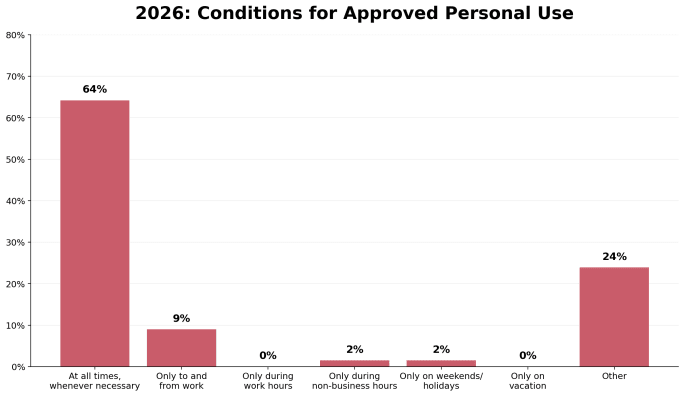
Nearly two-thirds of respondents allow personal use at all times, while 24% selected “Other,” including policies with mileage, geographic, or approval restrictions.
Source: www.automotive-fleet.com