
By MARTY LEVINE
In School of Business Professor Michael Carriger’s class on “Organizational Behavior” in Mervis Hall, the students have been split into 12 teams or “firms” to develop, test and maybe even sell new products for teaching organizational behavior to business students.
Carriger has turned the entire class into a hands-on experience in which the students must figure out better ways to do exactly what the professor himself is doing. Sure, Carriger still employs lectures himself, but he determined a while ago that his students needed more. He tried simply creating a hands-on final project for the course, but that wasn’t enough.
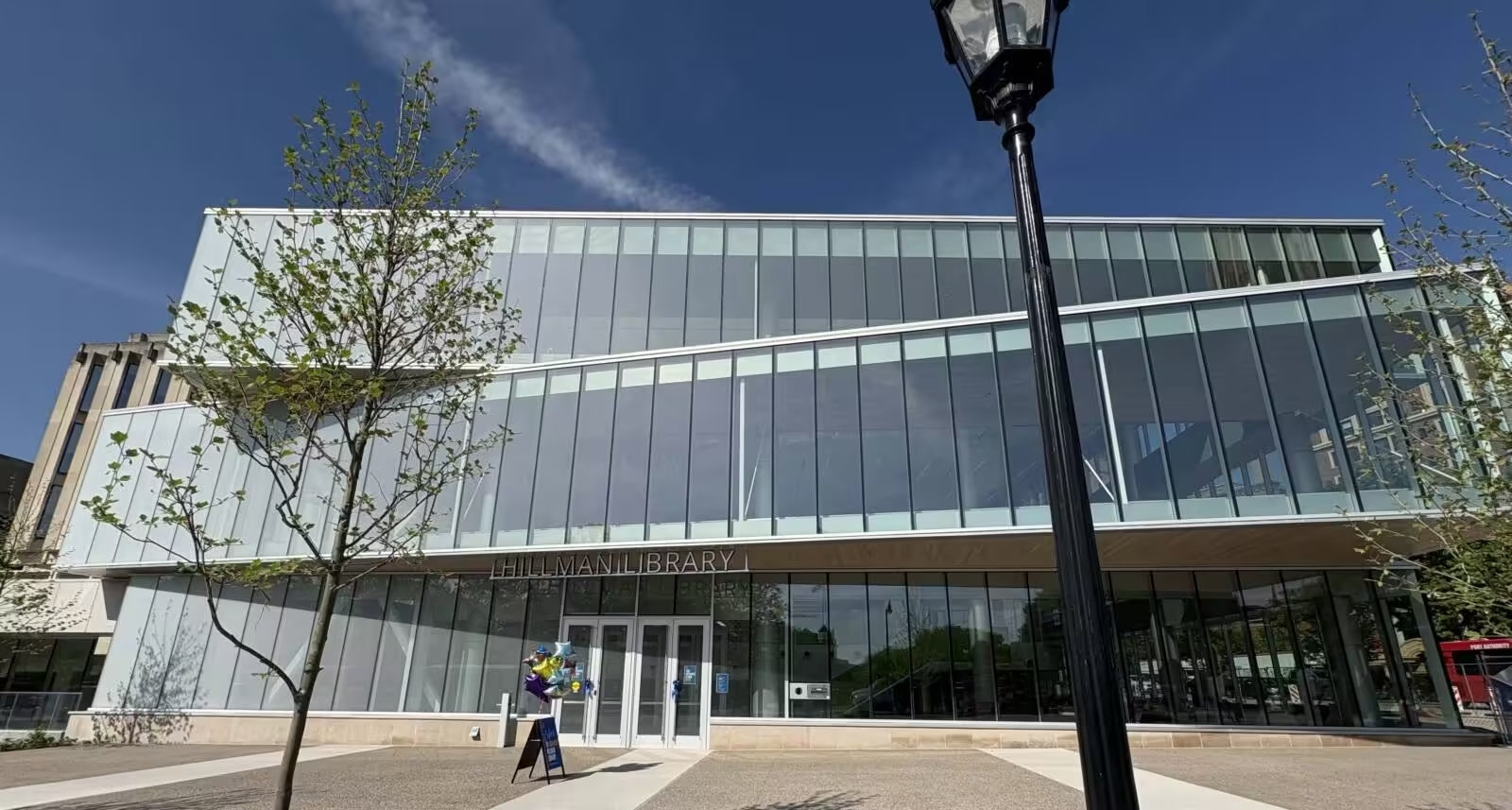
Now all 12 classroom “firms” are using the Open Lab – a hub at Hillman Library with high-tech machinery for sophisticated model building, not to mention good old low-tech craft making – to create business cards and firm-advertising stickers for their laptops, then to storyboard their firm’s best idea for educational improvement, build a prototype of the resulting product for testing among their fellow students, and finally present these products to a panel of students, professors and others, as if they were pitching the product at a business expo. In the Open Lab, they will use its vinyl cutter, laser cutter, 3D printer and scanner, virtual reality headsets and more.
Carrriger hopes, if there are any really promising products, to connect a few of the 12 firms to the Center for Innovation.
With this redesigned class, students “will learn these abstract concepts better because they have now added a physical component to their learning,” he says. And, of course, working in these “firms” will allow organizational behavior concepts, from motivation to teamwork, to come alive for them.
The chance to redesign Carriger’s course came from a grant in the second year of Pitt’s Faculty Experiential Learning & Technology (FELT) grant program, cosponsored by the University Library System and the Center for Teaching and Learning. FELT awarded two course redesign grants of $6,000 each – one earned by Carriger – and three $1,000 grants for partial course modifications.
In today’s class, Carriger’s students are still at the idea-formulation stage. “It’s challenging for them because it is a different way of thinking,” he says. And they’re not being graded on each step, but rather hearing direct feedback from Carriger along the way.
Carriger walks from team to team as they try to come up with more new methods for teaching organizational behavior. He hears them explain a few very tentative ideas for learning enhancement: A deck of cards for a business role-playing game in class. A variant on the classroom software Top Hat that periodically queries students on whether they feel they are understanding each lesson. An entirely new classroom set up – swivel chairs, standing desks, even walking paths, to keep students energized. A team of student “investors” who would force budgets on each “firm” to test their adaptability. A virtual reality experience. Incorporating music, a la Guitar Hero – but in lessons about organizational behavior.
Carriger responded to each team in turn, making sure they stayed focused on the original problem they were asked to solve, and on the learners they’d need to help: “You are fixated on the ideas you originally came up with,” he told one. “I am concerned that anchoring might be going on.” “Try brainstorming,” he told another; “Generate a bunch of ideas, then go away and evaluate them.” “Availability could be playing a role,” he told a third group: the notion that the first idea is simply the easiest to continue developing, but not necessarily the best. “Remember what the problem is, too,” he said. “How do you teach these organizational behavior concepts that are abstract, that you can’t touch, you can’t feel, and make them more real for students?”
Explains Carriger later: “They’re going to learn more about organizational behavior by looking at how their team is working than by us talking about it. I want them to experience their being a real company, a real experience.”
Molly Ritter, curriculum coordinator at the Open Lab, administers the FELT grant program. “Today, everyone is talking about it,” Ritter says of experiential learning, “but there’s not a ton of assignments around it” in courses. On a tour of the Open Lab’s offerings, she admits that “many people are intimidated – ‘I’m not an engineering professor,’ or ‘I’m not an arts professor, so it’s not for me.’ They don’t feel like they have the tools they need” to develop an assignment in a makerspace such as the Open Lab. Experiential learning assignments can take longer to develop and may feel too “messy” or “nebulous,” she adds. And if professors aren’t clear on their learning objectives, it may be difficult for them to redesign their own classes to include experiential learning.
Hence the FELT program, to incentivize faculty to use this makerspace to design experiential learning experiences.
Alongside Carriger’s grant, the other FELT course redesign project is “First Year Chinese 2,” by East Asian Languages and Literature faculty member Fan Fan. It is a course redesign to develop students’ Chinese language skills employing vinyl cutting, laser cutting, 3D printing and virtual reality. Students will manufacture a physical character, a la Flat Stanley, and involve it in shopping, dining, navigating the world and dating, among other activities, to allow them to converse about these real-world situations.
The trio of grants for the redesign of a single course component, using the above technologies and more, are:
“Introduction to New Media,” by English Film and Media Studies/Digital Narrative and Interactive Design faculty member Nathan Koob, described as “an immersive, puzzle-based experience that asks students to engage with emerging media technologies rather than simply study them,” allowing students to “create media artifacts of their own and reflect on the ways technologies can be used, interpreted, and negotiated in society.”
“Teaching and Learning in Secondary Science and Mathematics,” by School of Education faculty member Mahati Kopparla, “in which pre-service teachers develop physical or digital tools to help secondary students understand challenging or abstract math and science concepts,”; and
“Taboo Desires from a Global Lens: Exploring Sex, Love, and Unconventional Romance in Film and Literature,” by Slavic Languages and Literature faculty member Olga Klimova, designed to help students to “compare representations of intimacy, power, identity and social difference across a region of the Slavic and Eurasian world and a region of Europe or North America, then translate their analysis into a physical, visual or immersive artifact.”
Ritter says all the grant winners will gather data on what they were hoping to impart through the experiential learning additions and changes to each course, and determine how they found those changes affecting student comprehension.
Ritter also hopes the experiences of these faculty will be influential on their fellow instructors, since “faculty learn from other faculty,” she pointed out. “It would be encouraging if we could have more instructional designers who are trained in experiential learning,” Ritter added. “They can walk alongside faculty and bring their visions to life,” as well as making sure their course objectives are met.
“I really want FELT to be something that is campus wide,” she said, using not only the Open Lab but also the Media Lab, Digital Scholarship and Publishing Program, University Archives and other resources.
“I am very excited about what these professors have done and the work the students have done already” with their grants, Ritter said. “Students will often report on the OMETS” – evaluations at term’s end” – that it was a highlight of the semester.”
She also points to the work of non-FELT winners as examples of successful experiential learning that faculty might emulate, such as the physics and astronomy department course by Sandhya Rao, “From Stonehenge to Hubble.” Rao added a cultural studies aspect to better show students some of humanity’s older contributions to astronomy. She has developed a dozen asynchronous projects for students, and the Open Lab created project sets for each. Students create models of Stonehenge or Babylonian tablets out of clay; use Open Lab’s 3D printer to make an armillary sphere (rings forming a kind of globe around the Earth or Sun in pre-Copernican views of the universe) and clepsydras (water clocks); and use the laser cutter to make an astrolabe, sextant or quadrant. Ritter is particularly fond of the course’s models of Pawnee star maps, the Allegheny observatory and the Mawangdui Tomb comet wheel from China’s Western Han Dynasty that are also possible.
Explained Rao: “Students gain hands-on insight into astronomical structures and artifacts that were built or used over the past many centuries and even millennia. By building and learning how to use these models, they directly experience how ancient people worked with their surroundings and the sky to make astronomical observations and measurements.
“This experience has been far more valuable to the students than learning from notes and lectures alone,” she continues. “Student feedback has also been overwhelmingly positive, and word of mouth has made it an attractive Gen Ed course for students to consider taking. Open Lab has been instrumental in the success of my class.
Adds Ritter: “It is an enormous amount of work” to prepare such lessons. “I understand why the faculty would feel intimidated by that. But the results speak for themselves.”
Marty Levine is a staff writer for the University Times. Reach him at [email protected] or 412-758-4859.
Source: www.utimes.pitt.edu