



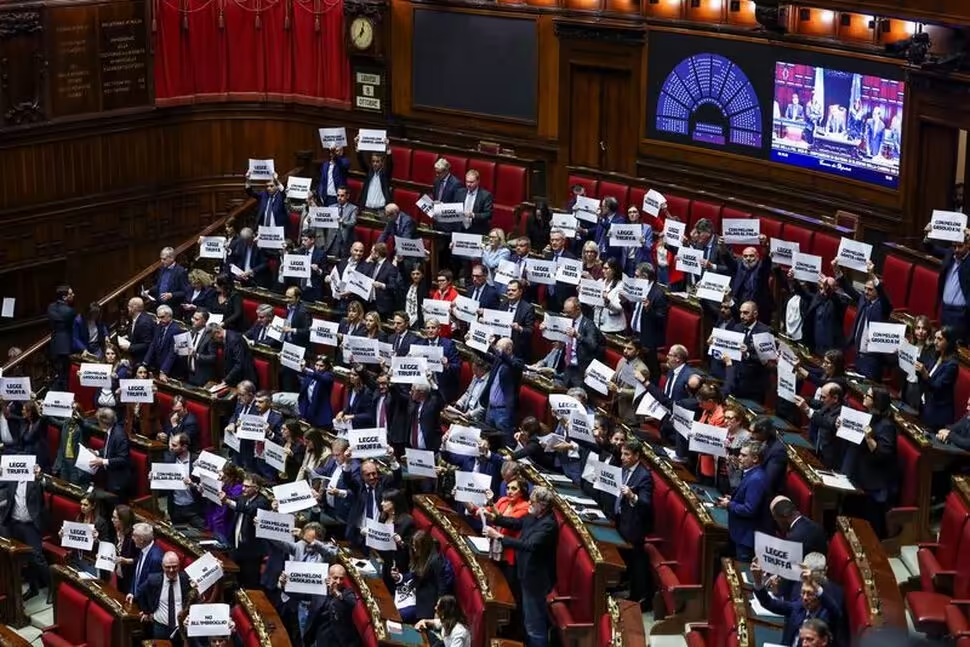

ROME, Oct 8 (Reuters) – Italy’s lower house of parliament on Thursday gave final approval to new voting rules ahead of a general election due next year, completing a reform championed by Prime Minister Giorgia Meloni.
Meloni, whose government last month became the longest-serving since World War Two, says the new rules are intended to increase the prospect of stable government. The opposition says the goal is to favour her ruling coalition at the election.
Below are the main features of the new system.
The reform introduces a purely proportional system (PR), replacing the previous hybrid one by which around two thirds of seats were elected by PR and one third in first-past-the-post races.
To boost stability, a working majority will be guaranteed to any coalition that wins more than 42% of the vote. Italy’s two main camps are Meloni’s conservative alliance and the centre-left bloc, which includes the Democratic Party and the 5-Star Movement.
A coalition surpassing the 42% threshold will receive a “majority bonus” of 70 seats in the 400-member Chamber of Deputies and 35 seats in the 200-member Senate.
However, to avoid excessively large majorities, the bonus is capped to prevent the winner getting more than 220 seats in the Chamber and 113 in the Senate.
If more than one coalition passes the 42% threshold, the one with most votes will get the bonus.
Each coalition or party running outside a coalition must indicate their candidate for prime minister. However, under Italy’s constitution the president formally chooses the prime minister, meaning the party designation will not be legally binding.
MINIMUM THRESHOLDS AND SIGNATURES
Coalitions must secure at least 10% of the vote to enter parliament, while individual parties, both inside and outside coalitions, must obtain at least 3%.
The reform raises to 6,000 from 1,500 the number of signatures parties currently outside parliament must gather in each constituency to field candidates.
Critics say this makes it harder for small or new parties to compete in the elections.
(Reporting by Angelo AmanteEditing by Keith Weir)
Copyright 2026 Thomson Reuters.
The Month in Photos: Sept. 2026
Source: www.usnews.com