



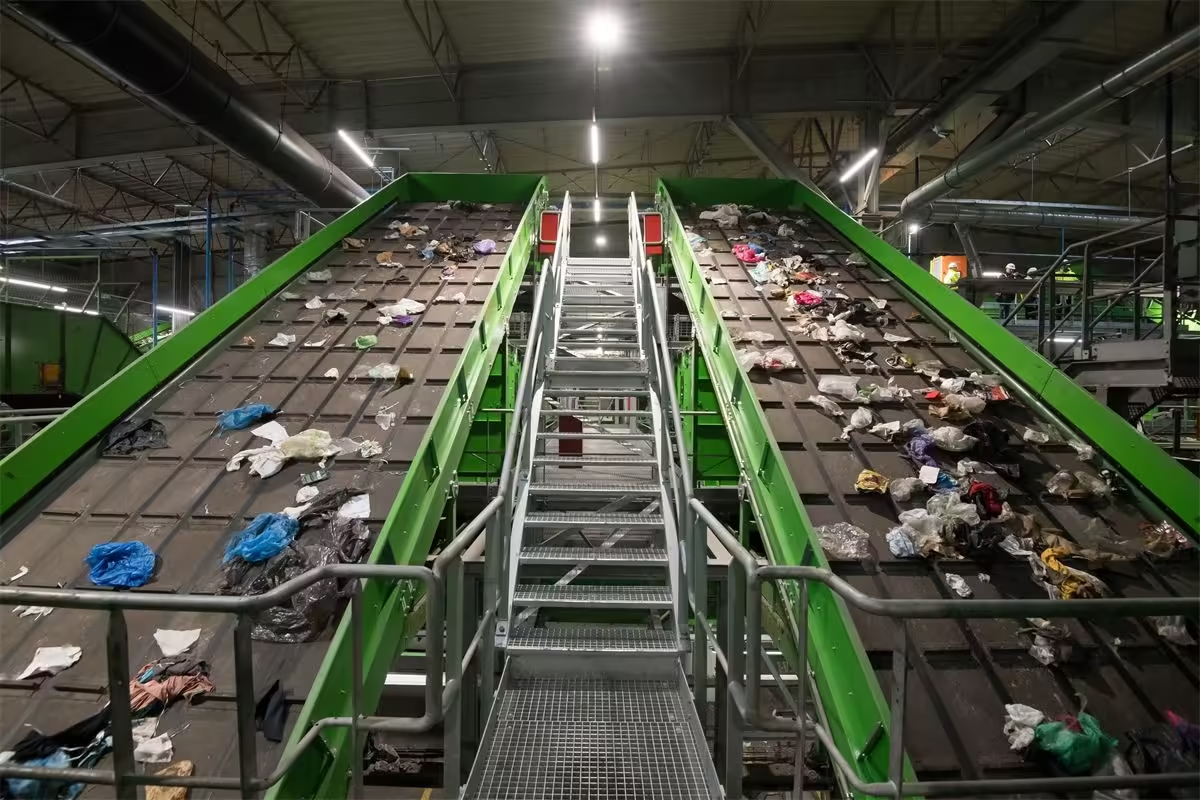

Earlier this year, the European Commission moved ahead with plans for a landmark environmental initiative. The Circular Economy Act, or CEA, aims to build a single market for secondary raw materials and increase the supply of high-quality recycled materials, such as textiles and plastics from waste or end-of-life products.
The goal is to double the European Union’s circular material use rate and tackle the externalities of the linear economy, like harmful emissions and land degradation.
However, as currently framed, the CEA focuses mainly on economic security: reducing industry’s raw material costs and Europe’s reliance on imported critical minerals.
These are undoubtedly important, overdue goals that can strengthen the EU’s industrial strategy, competitiveness and resilience to resource shocks. But when they become the only priorities, environmental and social objectives risk being overlooked.
Producer countries at the table
The CEA has favored what’s inside the EU’s own borders. Yet Europe’s recycling sector is contracting sharply, and many plants have closed since 2025.
Brussels needs to acknowledge the fundamentally international nature of value chains. That means treating circularity as a foreign policy and trade priority, not simply an internal market issue.
The circular economy works best when countries that supply materials and manufacture goods for European markets help shape trade and market access rules from the outset.
Those include recycled-content requirements, digital product passport standards, extended producer responsibility schemes and customs and waste regulations that will govern how primary and secondary materials move in and out of Europe.
The EU must engage these producer countries and draw on their perspectives.
While this is not a straightforward task, projects are already gathering insights on best practice.
One is Switch to Circular Economy Value Chains, or SWITCH2CE, a program co-funded by the EU and the Finnish government and implemented by the United Nations Industrial Development Organization. It links major European companies with producer countries, piloting business models before scaling them up.
The informal sector, which includes waste pickers, collectors and small-scale recyclers operating outside formal waste systems, is central to how circularity functions in producer countries, yet its scale and structure vary enormously among them.
Therefore, Brussels cannot get an accurate picture from a distance. That requires the on-the-ground engagement that programs like SWITCH2CE provide.
For example, in Bangladesh’s ready-made garment industry, recycled-content requirements can be met only by sourcing through the informal sector, a vital lesson for the EU, which has often underestimated how many people are involved.
Data quality is just as decisive. The digital passports at the heart of the CEA and the Ecodesign for Sustainable Products Regulation are designed to travel with a product and record its durability, repair history and material composition.
But they are only as reliable as the data behind them, something which varies from country to country and is shaped by different waste systems and reporting standards.
Getting this right means working with producer countries directly to create harmonized data systems. This is the insight the EU needs to build into its own passport system from the start to make circularity viable on a global scale.
The Brussels effect in reverse
The global circular economy depends on traceable and transparent flows of products, components and materials across borders.
Trade partnerships determine whether circular textile systems can function at all, yet mismatched customs rules, waste bans and tax structures between the EU and producer countries routinely stand in the way.
These barriers sit on both sides, so no reform designed in Brussels alone can resolve them. Instead, they must be negotiated.
SWITCH2CE’s pilots have pinpointed them. Between the EU and Bangladesh, misaligned customs and waste regulations are among the largest remaining obstacles to full circularity.
Producer countries need confidence that EU commitments will last, and Brussels needs to know where investment matters most. Initiatives such as SWITCH2CE have provided important perspectives.
In Egypt, a pilot promoting high-quality refurbishment and repair of digital devices found that environmental motivation alone was not enough to drive engagement: convenience, economic incentives and assurance that EU brands would keep trading mattered just as much.
Europe cannot achieve circularity on its own terms. Only by learning from producer countries and embedding those lessons in an international framework can it make the circular economy truly transformative.
For those looking to continue the conversation around Europe’s climate and sustainability agenda, The Parliament Lounge will bring together policymakers, experts and industry voices during Brussels Climate Week, from 12–15 October. Find out more and register to attend.
Sign up to The Parliament’s weekly newsletter
Every Friday our editorial team goes behind the headlines to offer insight and analysis on the key stories driving the EU agenda. Subscribe for free here.
Source: www.theparliamentmagazine.eu

