
Support CleanTechnica’s work through a Substack subscription, on Patreon, or on Stripe. Help us produce all of the high-quality, original content we publish week after week despite the challenges of content-scraping AI, antisocial media, inflation, and other hurdles.
Electric ships attract attention because the vessel is the visible technology. Put a large battery into an inland cargo vessel, replace the diesel propulsion system with electric motors, and the decarbonization story appears straightforward. Inland shipping looks particularly promising because many vessels travel repeatable routes between known terminals, where large batteries can be charged or exchanged more predictably than they could on an ocean-crossing ship.
China is showing why that vessel-level view is incomplete. Its emerging electric-shipping industry increasingly includes ports, battery suppliers, utilities, logistics companies and financiers alongside shipbuilders. The interesting development is not simply that more electric vessels are appearing on Chinese waterways; it is that organizations are beginning to assemble the infrastructure and commercial relationships those vessels need to operate as freight businesses.
I examine that systems transition in China Is Turning Electric Ships Into Freight Infrastructure, the latest TFIE Strategy Briefing. China’s advantage is becoming less about any one electric ship and more about coordinating vessels, batteries, ports, electricity and finance.
The numbers require some care because three widely cited figures describe three different things. The International Council on Clean Transportation identified 42 electric cargo ships in China by the end of 2025, up from four in 2022. CATL separately reported nearly 900 battery-equipped electric vessels at the end of 2025, but that figure includes passenger vessels, ferries, harbour craft and cargo vessels rather than hundreds of Chinese electric freight ships. Hubei province, meanwhile, has a target of 1,000 green and intelligent inland vessels by 2030, a programme goal that extends beyond battery-electric cargo ships.
Forty-two freight vessels is still a small beginning in a country with an enormous inland fleet, but China is working on the surrounding system at the same time. Hubei’s Thousand Sails programme brings together ports, shipbuilders, energy companies and financial institutions while developing demonstration routes and energy infrastructure. On the recently opened Pinglu Canal, CATL has agreed to work on electric vessels, battery leasing, charging and swapping, renewable generation, storage and microgrids rather than merely supplying battery packs to individual shipowners.
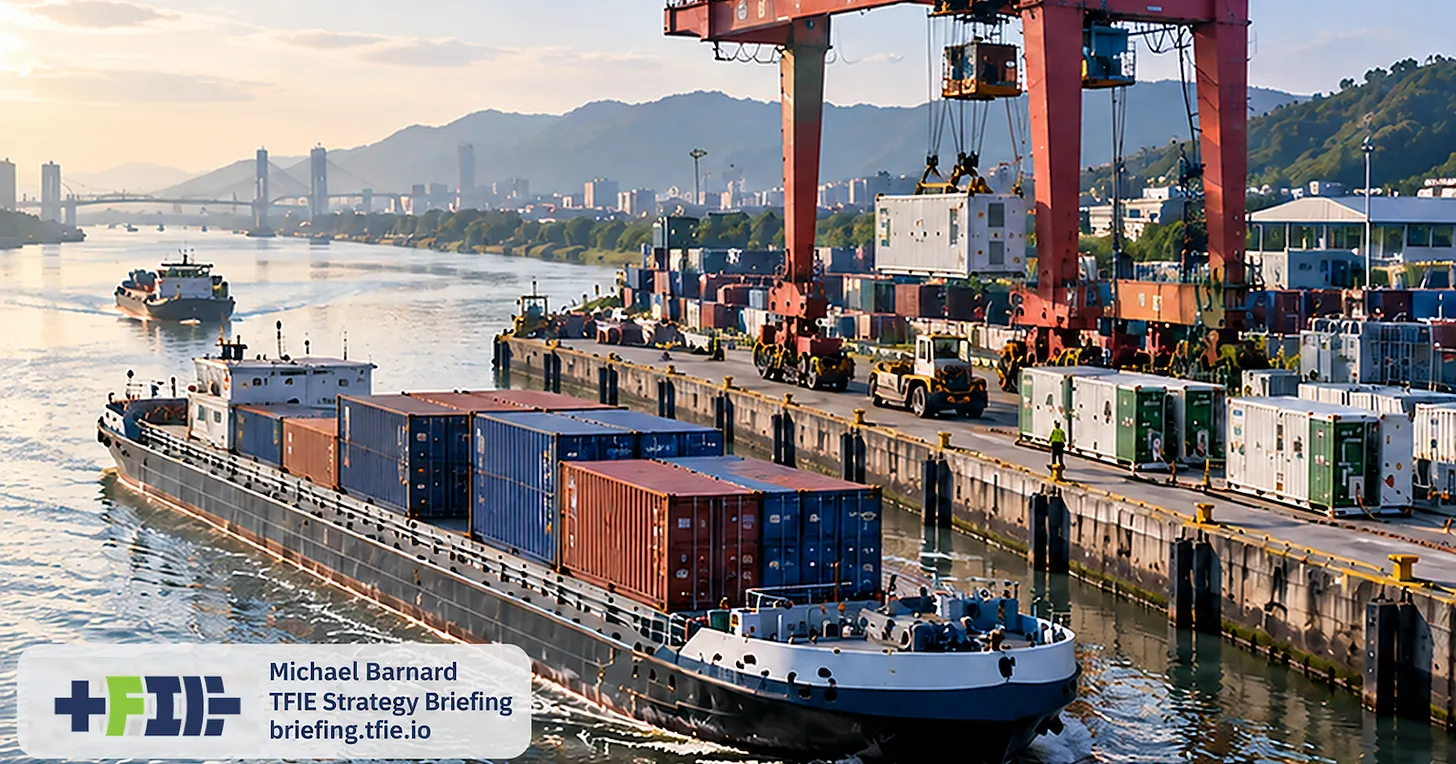
Battery swapping illustrates why that broader coordination matters. An inland vessel can exchange a depleted containerized battery for a charged one instead of waiting for a large onboard battery to recharge, keeping the vessel working while the battery charges ashore at a less demanding rate. That can improve vessel utilization, but only if the terminal has enough charged batteries available, cranes and staging space can handle them without disrupting cargo operations, electricity is available when needed and enough vessels share the infrastructure to use it productively.
Europe already knows how to do much of this. The Netherlands’ Zero Emission Services has operated interchangeable battery containers on inland vessels since 2021, providing real experience with the concept. Its partners have also reported that operating costs remained above conventional shipping, which makes the crucial issue less whether swapping works technically than whether enough vessels use the network often enough to recover its costs.
This is where European electric-shipping policy can easily go wrong. A port can install a charger without creating a viable electric route, and a shipowner can buy an electric vessel without having dependable energy available on its timetable. A technically successful demonstration can still fail commercially if cargo volumes are weak, terminal time is scarce, grid connections are expensive or battery assets spend too much of their lives waiting for customers.
The better starting point is the freight itself. A port authority can identify cargo flows that are likely to remain important through the energy transition, particularly regular movements of construction materials, agricultural products, chemicals, industrial inputs, scrap and containerized goods. Routes with persistent demand and high vessel utilization can then be screened for charging, battery swapping or a combination based on their operating schedules.
That sequence becomes especially important because tomorrow’s freight system will not simply be today’s fleet with batteries installed. Coal, petroleum products and refinery-linked cargoes will decline as the energy system changes, reducing some of the bulk freight that currently fills inland vessels. Ports that electrify every existing route mechanically risk investing in vessels and infrastructure for freight tasks that are shrinking.
Once a promising route is identified, the commercial boundary needs to include the entire service. Cargo customers need to commit enough freight for long enough to support investment, shipowners need vessels with credible remaining lives or replacement cases, terminals need space and operating windows, utilities need a workable grid plan, and somebody has to finance and maintain the batteries. Insurers, classification societies and regulators also have to be comfortable with the safety arrangements.
For investors, that may shift the opportunity away from selling batteries once and toward providing energy as a recurring service. Battery leasing, shared battery pools, charging, maintenance and availability guarantees can move capital costs away from individual shipowners while giving specialized providers recurring revenue. Those models only work when utilization is high enough to support the battery inventory, reserve capacity, terminal handling and replacement obligations the service provider assumes.
China has structural advantages in assembling that system. It combines huge battery manufacturing capacity with shipbuilding, inland-waterway freight, industrial demand and public institutions capable of coordinating investment across several sectors. Europe cannot simply copy those financing and governance assumptions, but it can learn from the way the pieces are being treated as one freight system rather than a collection of demonstration projects.
Europe’s strongest response would be to develop a small number of high-quality electric freight corridors where cargo customers, vessel operators, terminals, utilities and financiers are identified before major capital is committed. Public support can help solve the first-mover coordination problem where several parties need one another to invest simultaneously, but funding should follow credible freight services rather than equipment counts.
That also provides a better benchmark for success. The number of electric vessels commissioned tells us something about technology adoption, while the number of chargers installed tells us something about infrastructure. Neither tells us whether freight is moving reliably at a cost customers will continue to pay once demonstration funding ends.
China’s electric-vessel story is becoming an infrastructure story. The competitive question for Europe is increasingly whether it can turn technology it already understands into repeatable, financeable freight services.
The full TFIE Strategy Briefing analysis examines China’s emerging operating model, Europe’s corridor economics, battery ownership and swapping, port and policy decisions, and the investment tests required before capital is committed. It also previews the forthcoming TFIE Inland Freight Electrification Report and its quantified pathway through 2050.
Sign up for CleanTechnica’s Weekly Substack for Zach and Scott’s in-depth analyses and high level summaries, sign up for our daily newsletter, and follow us on Google News!
Have a tip for CleanTechnica? Want to advertise? Want to suggest a guest for our CleanTech Talk podcast? Contact us here.
Sign up for our daily newsletter for 10–15 new cleantech stories a day. Or sign up for our weekly one on top stories of the week if daily is too frequent.

CleanTechnica uses affiliate links. See our policy here.
CleanTechnica’s Comment Policy
Source: cleantechnica.com