


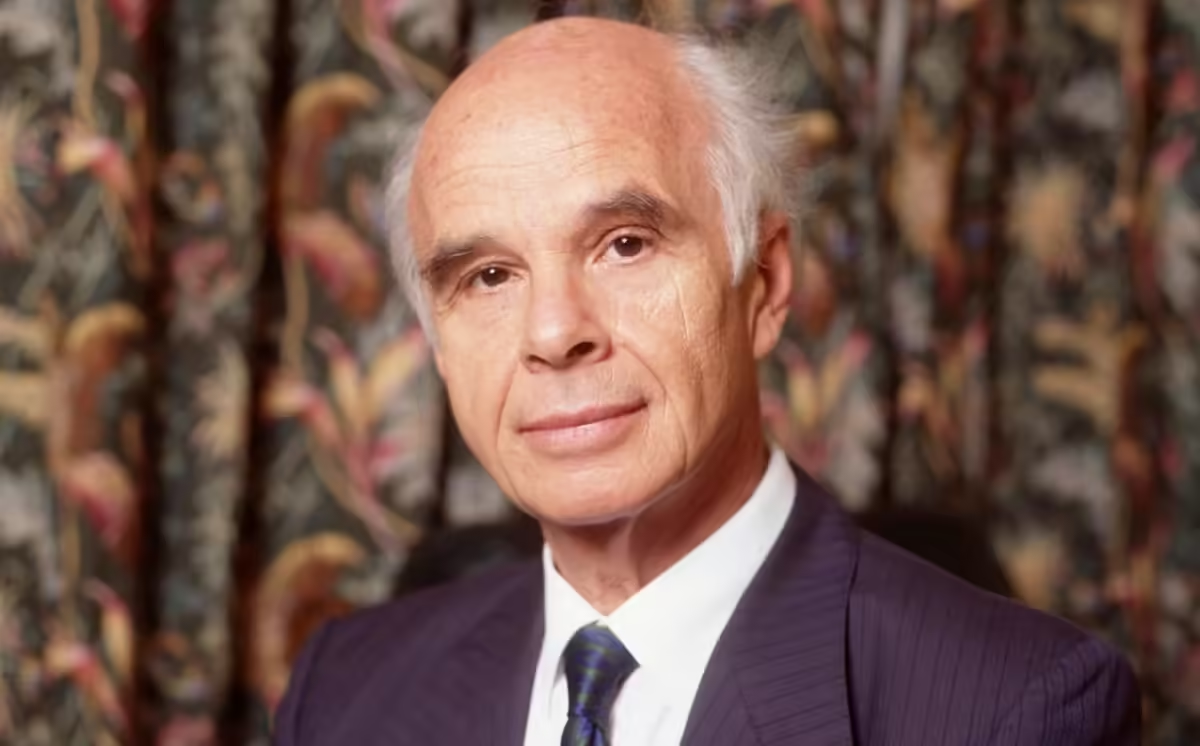

Ervin László, who has died aged 94, excelled in three distinct fields: as a concert pianist, a philosopher of science, and an evolutionary theorist.
Throughout his long and productive life, he was dedicated to raising individual and collective consciousness, inspiring thousands of people through his pioneering work in systems thinking and global ethics. His ability to bridge science, philosophy and spirituality offered a compelling vision of a more peaceful, harmonious and sustainable future. And he had a firm conviction that humanity was capable of making such a breakthrough.
Like the Jesuit philosopher and palaeontologist Teilhard de Chardin, László saw the cosmos as one interdependent and interconnected evolving entity moving towards wholeness, co-operation, partnership and planetary consciousness, with love as an organising principle.
Ervin László was born in Budapest on June 12 1932. His father, István László, was a lawyer turned shoe manufacturer, while his mother, Mária László, was a piano graduate from the Franz Liszt Academy. His uncle, an agnostic philosopher and accomplished violinist, also lived in their household, and stimulated his nephew’s interest in the big questions.
Ervin began playing the piano aged five, memorising pieces by ear rather than through sight-reading. He made his debut with the Budapest Philharmonic aged of nine, performing Mozart’s Piano Concerto in A major.
When he was 11, he played Beethoven’s Waldstein Sonata from memory in front of the celebrated pianist Arnold Székely, who exclaimed “simply genius”, and Ernst von Dohnányi, the pianist director of the Franz Liszt Academy, who enrolled him as a special student. In 1947 he became the youngest person to receive the highest degree of the Academy, and travelled to Geneva, where he was awarded a Grand Prize and invited to perform in Paris and New York. He wrote that playing great music gave him an experience of wholeness and beauty.

The 16-year-old László plays for the conductor and pianist Bruno Walter in 1948 – Jerry Cooke/Getty Images
A turning point came during a concert in Bonn when he was playing the Waldstein Sonata and suddenly realised that he did not know whether he was playing the principal theme of the second movement for the first or second time. Luckily he made the right decision, moving on to the third movement.
A few days before this incident, László had received an invitation from a philosophy professor, John Schrader, to spend a semester at Yale University as a fellow. László had already begun an independent course of study, and was deeply influenced by the philosophy of AN Whitehead, who argued that reality is made up of relations between substances rather than discrete substances themselves. By that time, Martinus Nijhoff had already published his first book in 1963, Essential Society: an Ontological Reconstruction.
At Yale, László met illustrious scientist-philosophers like FSC Northrop and Henry Margenau, and began drafting a treatise on the groundbreaking work of the Viennese biologist Ludwig von Bertalanffy and the Belgian chemist Ilya Prigogine. László received the Sorbonne’s highest degree, the Doctorat ès Lettres et Sciences Humaines, in 1970.
In his shift to the life of a scientist and humanist, László lectured in philosophy at various US universities including Yale and Princeton. In 1984, he founded the General Evolution Research Group of some 40 scientists and philosophers to explore evolutionary laws; they hoped to understand complex global systems and shape equitable futures for humanity, publishing in their journal World Futures.
Following his work at Princeton on modelling the future evolution of world order, he was asked to produce a report for the Club of Rome, of which he was a member. In the late 1970s and early 1980s, László ran global projects at the United Nations Institute for Training and Research at the request of the Secretary-General.
In 1993, László founded the Club of Budapest as an informal international association dedicated to developing a new way of thinking and a new global ethic to help resolve the social, political, economic, and ecological challenges of the 21st century. Its many honorary members included the Dalai Lama, Mikhail Gorbachev, Jane Goodall, Václav Havel, Jean Houston and Riane Eisler. László was convinced that the enormous challenges facing humanity could only be addressed through the development of a cultural and cosmopolitan planetary consciousness and a deep engagement in respectful dialogue.
In 2015, he founded the László Institute for New Paradigm Research to foster open trans-disciplinary inquiry into current science-based conceptions of the human being, in order to develop a coherent and meaningful world view. The aim was to address the existential vacuum of our time and generate a renewed sense of purpose and commitment to the common good.
László was the author, co-author or editor of more than 100 different books in 25 languages, along with several hundred papers and articles. He was a member of numerous scientific bodies, including the International Academy of Science, the World Academy of Arts and Science, the International Academy of Philosophy of Science and the International Medici Academy. He was elected a member of the Hungarian Academy of Science in 2010.
He received honorary PhDs from the US, Canada, Finland, and Hungary. He was the recipient of the Peace Prize of Japan – the Goi Award – in 2001, of the International Mandir of Peace Prize of Assisi in 2005, and of the Luxembourg World Peace Prize in 2017. He was nominated for the Nobel Peace Prize in 2004 and 2005.
Those who knew László personally recognised him not only as one of the great visionaries of our time, but also as a man of deep kindness, generosity, humility, and grace. He maintained an unwavering belief in humanity’s highest potential, as reflected in the titles of some of his later works such as Reconnecting with the Source, The Wisdom Source and The Great Upshift.
Ervin László married the Finnish-born Carita Jägerhorn af Spurila, of royal Swedish lineage, in 1956. They lived in Tuscany, where they had their own vineyard, and had two sons, Christopher and Alexander, both scholars and partners in his work.
Ervin László, born June 12 1932, died June 29 2026
Source: www.yahoo.com