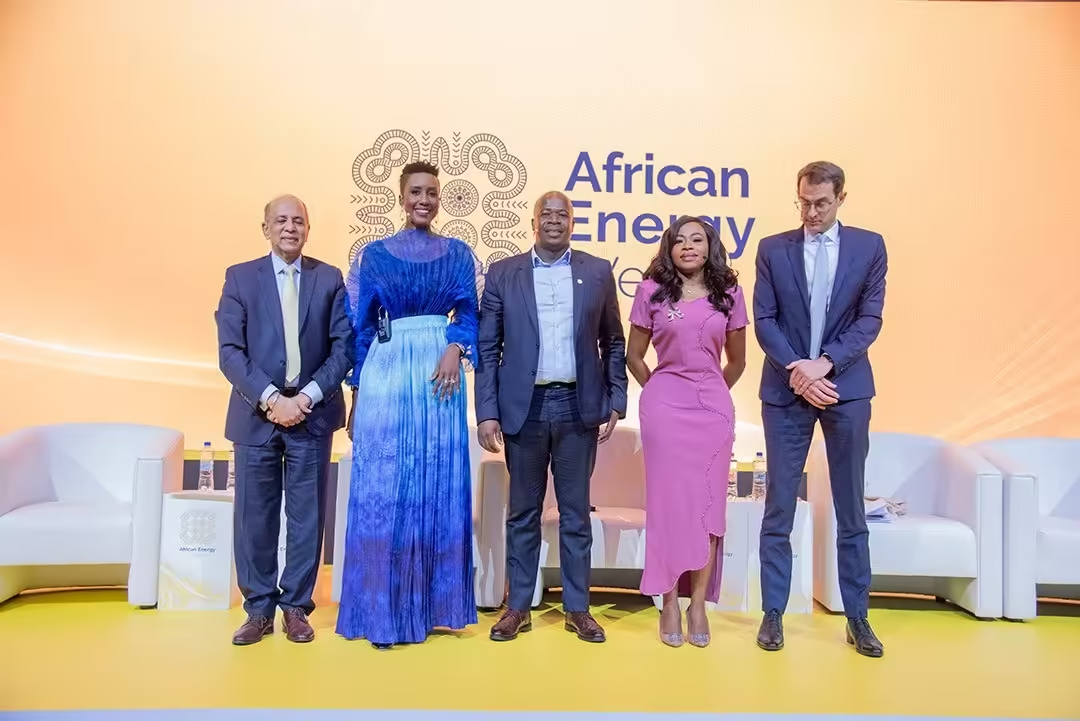

From multibillion-dollar energy investments and local content development to women’s leadership and Africa’s right to determine its energy future, Marieme Sav Sow delivered a compelling message as senior executives from TotalEnergies, Eskom, Afreximbank and SLB outlined the opportunities and challenges shaping the continent’s energy industry.
By Ajong Mbapndah L
At African Energy Week (AEW) 2026 in Cape Town, Marieme Sav Sow, Vice President of Engagement and Advocacy at TotalEnergies, delivered a spirited defense of Africa’s right to develop its energy resources, calling for greater energy sovereignty, stronger local participation and investments that leave lasting economic benefits for African communities. Her interventions brought a distinctly human dimension to discussions often dominated by production figures, investment commitments and technological advances.
Speaking during the Energy Additions Forum’s Energy Leaders Dialogue, Sow argued that Africa should not be forced to choose between economic development and environmental responsibility. Instead, she advocated an approach that recognizes the continent’s enormous energy needs while supporting responsible resource development, emissions reduction, industrialization and job creation.
The high-level discussion, moderated by Atul Arya, Senior Vice President and Chief Energy Strategist at S&P Global Energy, also featured Rivoningo Mnisi, Group Executive for Renewables at Eskom; Helen Brume, Director of Project and Asset Based Finance at Afreximbank; and Jean-Marc Kloss, Group Managing Director for West Africa at SLB. Together, the panelists examined energy security, financing, exploration, infrastructure, technological innovation and the growing determination to ensure Africa captures greater value from its natural resources.
For Sow, whose company maintains an extensive portfolio of oil, gas and renewable energy investments across the continent, the central question was not simply how much energy Africa could produce, but how effectively those resources could transform economies and improve lives.
Africa Must Develop Its Resources on Its Own Terms
“Africa has always been one of our core regions,” Sow declared, emphasizing that TotalEnergies’ commitment to the continent long preceded the latest disruptions in international energy markets.
She pointed to the company’s investments in Mozambique, Angola, Uganda and Tanzania as evidence of a long-term strategy anchored in Africa’s growing importance to global energy supply. Among the projects highlighted was Mozambique LNG, which she said had restarted in January 2026, representing an investment exceeding $20 billion and an estimated $35 billion in government revenues over its lifetime.
Sow also referenced additional investment commitments in Angola, alongside the Tilenga oil development and East African Crude Oil Pipeline (EACOP) projects in Uganda and Tanzania. These investments, she explained, reflected a broader recognition that African countries must strengthen control over their energy supplies and reduce vulnerability to disruptions originating elsewhere.
The ongoing instability affecting international energy markets, including developments in the Middle East, had reinforced the importance of diversified supply chains and energy-producing regions capable of serving multiple markets. TotalEnergies’ integrated operations across oil, gas, electricity and renewables, she argued, provided the flexibility to withstand disruptions without abandoning its long-term investment priorities.
For African governments, the lesson was equally important. Energy security could no longer be treated simply as a question of imports and exports, but as an essential component of national sovereignty, economic resilience and strategic independence.
Sow summarized the principle as ensuring African countries could develop their resources on their own terms.
Beyond First Oil: What Remains for African Communities?
One of Sow’s most striking contributions came when the discussion turned to local content, skills development and the distribution of benefits from major energy investments.
Rather than measuring project success exclusively through production milestones or financial returns, she challenged the industry to examine what happens to communities long after construction and initial production have been completed.
“How I measure success, the success of a project, is not first oil, is not how many thousands of barrels, but it’s really what is the buy-in of the communities, and what is it that we leave ten years later,” she said.
That philosophy, she explained, informs TotalEnergies’ engagement with national oil companies, local suppliers, workers and host communities. Partnerships with institutions such as Uganda National Oil Company, Mozambique’s ENH and Nigeria’s NNPC were essential not only for revenue sharing, but also for strengthening local participation in decision-making and transferring technical expertise.
Sow offered substantial figures to illustrate the company’s local content commitments in East Africa. According to her presentation, the Tilenga and EACOP developments had generated approximately $2 billion in local content expenditure, exceeding an initial target of $1.3 billion. She also cited four million training hours and 34,000 jobs associated with the projects.
Beyond the figures, Sow emphasized the importance of developing African businesses capable of competing independently in the international energy industry. She said a meaningful measure of success would be seeing suppliers trained through TotalEnergies projects subsequently winning contracts with competing operators or expanding into neighboring countries.
Such outcomes, she suggested, would demonstrate that investments had helped build sustainable African enterprises rather than merely creating temporary opportunities tied to individual projects.
Her reflections on Mozambique’s Cabo Delgado province offered another illustration. Having visited the area, Sow recalled meeting women involved in cashew processing, fishermen and entrepreneurs operating soap factories and other small businesses supported by economic activity around the project.
She said initiatives associated with the development had helped create nearly 10,000 jobs, underscoring the connection between investment, community empowerment and regional stability. Economic development, she argued, was among the strongest foundations for lasting security.

More Energy, Less Emissions: Rejecting a False Choice
Addressing the debate over climate change and hydrocarbon development, Sow acknowledged the genuine tensions confronting energy companies and policymakers. She nevertheless rejected the suggestion that Africa must sacrifice economic growth to meet global emissions objectives.
With hundreds of millions of Africans still lacking reliable access to modern energy, she argued, the continent required solutions that could expand supply while reducing the environmental impact of production.
“We do not want to be pigeonholed in a false choice. We want to make sure that we do those two, and at TotalEnergies, our strategy is more energy, less emissions,” she said.
Sow cited Angola’s Kaminho project, which includes an all-electric floating production, storage and offloading vessel, as an example of efforts to reduce operational emissions. She also pointed to emissions-reduction targets associated with Tilenga and EACOP, emphasizing that cleaner production technologies should accompany continued resource development.
For TotalEnergies, she explained, investment discipline rests on three priorities: delivering projects within budget, completing them on schedule and reducing emissions.
“Delivery at cost. Delivery on time. And delivery with less emissions,” she said, outlining the principles guiding the company’s investment decisions.
Her intervention reflected a wider argument running through AEW 2026: that Africa’s energy transition must account for its development realities, industrial ambitions and sovereign priorities rather than follow a uniform pathway designed around the circumstances of more developed economies.
A Timely Reminder on Women’s Leadership
Sow also used the platform to raise an issue that resonated beyond the immediate discussion of energy investments: the representation of women in leadership and decision-making.
Recalling remarks by African Energy Chamber Executive Chairman NJ Ayuk during the opening ceremony, she welcomed his recognition of women’s importance to Africa’s energy future but observed that no women had addressed the audience during that opening session.
With characteristic humor, she described her intervention as a brief moment of activism before returning to the investment discussion. She expressed appreciation for the opportunity to participate alongside Afreximbank’s Helen Brume, stressing that women must have a visible and meaningful role in shaping the industry’s future.
“It’s important that we are here and take part in the story,” Sow said.
Her remarks brought an important dimension to the conference’s broader ambitions. As Africa seeks to expand investment, develop indigenous expertise and strengthen local participation, the inclusion of women in executive leadership, technical professions and strategic decision-making remains an essential part of that transformation.
Afreximbank: African Energy Bank Moves Toward Operations
While Sow focused on energy sovereignty and the long-term benefits of investment, Afreximbank’s Helen Brume offered an encouraging update on efforts to establish financing institutions capable of supporting Africa’s energy ambitions.
Brume disclosed that the proposed African Energy Bank, a partnership between Afreximbank and the African Petroleum Producers’ Organization, had moved beyond the conceptual stage and was progressing toward operational readiness.
According to Brume, initial capital commitments had exceeded the original $500 million target. Nigeria had committed $200 million, Afreximbank $222 million, with additional contributions from countries including Egypt, Ghana and Côte d’Ivoire.
Nigeria had been selected to host the institution, with office space secured in Abuja. Work was continuing on governance structures, recruitment of senior leadership and the development of operational and credit frameworks.
Brume explained that the bank would finance activities across the energy value chain, including upstream and downstream oil and gas, electricity, renewable energy and regional infrastructure.
She expressed confidence that the institution could begin supporting projects within the following year, potentially providing African governments and investors with an additional financing mechanism at a time when access to international capital remains a major challenge.
Brume also highlighted Afreximbank’s project preparation facilities, which can provide loans of approximately $3 million to help early-stage projects complete feasibility studies and other requirements necessary to attract financing.
She emphasized the importance of combining project finance, trade finance, guarantees and advisory services to overcome the complexities of cross-border infrastructure development.
Using EACOP as an example, Brume argued that equity participation by host governments could help align national interests and strengthen the prospects for successful implementation.
Eskom’s Recovery Opens New Opportunities for South Africa
Eskom’s Rivoningo Mnisi brought a South African perspective, outlining progress in stabilizing electricity generation and positioning the utility for a more diversified energy future.
Mnisi reported improvements in Eskom’s energy availability factor, with unplanned outages declining from approximately 16,000 MW to 9,000 MW. He said the utility’s improved operational performance had contributed to reduced load shedding and created a stronger foundation for economic growth.
With approximately 3,000 MW of surplus energy, Mnisi argued that South Africa was better positioned to support industrial expansion while accelerating investments in renewable energy, gas and transmission infrastructure.
He outlined plans for additional solar, wind, battery storage and gas capacity, alongside initiatives designed to encourage private-sector participation and strengthen domestic manufacturing.
Mnisi said Eskom had recently released approximately 6 GW of renewable energy and battery storage opportunities, as well as 1.5 GW of pumped storage opportunities.
He stressed that South Africa should not simply become a consumer of imported clean energy technologies. Instead, the country should develop local manufacturing capacity, expand industrial value chains and ensure communities benefit directly from new investments.
Acknowledging shortcomings in the handling of previous power station closures, Mnisi said lessons from those experiences were informing efforts to make the energy transition more inclusive and economically sustainable.
His contribution reinforced a theme raised by Sow: energy development must ultimately be judged by its contribution to jobs, local industries and the welfare of communities.
SLB Sees Rising Exploration Investment and Technological Opportunities
SLB’s Jean-Marc Kloss offered an optimistic assessment of Africa’s upstream investment outlook, pointing to renewed exploration activity and growing interest in the continent’s oil and gas resources.
According to Kloss, exploration investment in Africa had doubled over the previous five years and was expected to reach approximately $6.8 billion in 2026 and $8 billion in 2027.
He also projected that development investment could increase from approximately $32 billion in 2026 to $50 billion by 2029, reflecting improving investor confidence and the need to replace declining reserves.
Nigeria, he noted, was attracting renewed attention following years of limited deepwater investment, with the potential for substantial new capital commitments in the coming years.
Kloss emphasized that technology would play an increasingly important role in making African projects commercially viable. Artificial intelligence, digital reservoir modeling, advanced drilling systems, modular LNG solutions and subsea technologies were helping operators reduce costs, improve performance and unlock previously stranded resources.
He cited the Tilenga development as an example, reporting that automation and digital drilling technologies had helped reduce drilling times from approximately 27 days to 6.9 days.
For Kloss, the combination of Africa’s resource potential and rapidly advancing technology offered considerable opportunities to improve project economics and strengthen the continent’s position in international energy markets.
From Energy Potential to African Prosperity
Despite approaching Africa’s energy challenges from different institutional perspectives, the panelists shared a central conviction: the continent’s vast energy potential must translate into measurable economic progress.
For Afreximbank, that means mobilizing African capital and developing financing structures that can bring major projects to fruition. For Eskom, it means converting improvements in electricity supply into industrial growth, manufacturing and employment. For SLB, it means deploying technologies that make resources more accessible and investments more competitive.
For TotalEnergies’ Marieme Sav Sow, however, the ultimate test extends beyond production targets, investment announcements and corporate balance sheets. It lies in whether African countries exercise greater control over their resources, whether local businesses become more competitive and whether communities experience lasting improvements in their livelihoods.
Her contributions combined the perspective of a senior international energy executive with a passionate appeal for African ownership, women’s participation and a more equitable distribution of the benefits of resource development.
As the discussion drew toward its conclusion, Sow returned to a message delivered earlier in the day by TotalEnergies leadership. With a playful reference to Shakira’s famous football anthem, she offered her own enthusiastic rendition of a phrase that captured the mood of the conference.
“It’s time for Africa!”
It was a fitting conclusion to an intervention that challenged the energy industry to look beyond what it extracts from Africa and pay closer attention to what it leaves behind.
Source: panafricanvisions.com