
- DOW has outlined three focus areas for defense science
- Efforts span an NSF partnership, STEM scholarships and patent licensing
- The 2027 Defense R&D Summit will explore quantum, trusted AI and more
The Department of War has launched a set of initiatives to carry out the White House’s strategy for a new golden age of American sciencewith a focus on research modernization, scientific workforce development and stronger partnerships across academia, industry and government.
As DOW works to modernize its research enterprise and build its scientific workforce, defense officials and industry executives will convene at the Potomac Officers Club’s 2027 Defense R&D Summit on Feb. 4 to discuss unmanned systems, 5G, trusted AI and autonomy, quantum computing, advanced space technologies and more. Book your spot now to hear where defense R&D investments are headed.
DOW said Thursday the initiatives build on recommendations from Science: A New Golden Age, a July report from Michael Kratsiosdirector of the White House Office of Science and Technology Policy. The Office of the Assistant Secretary of War for Science and Technology oversees the department’s implementation work.
What Are DOW’s Lines of Effort Under the White House Science Strategy?
DOW’s implementation is organized around three lines of effort covering the defense research enterprise, scientific talent and the protection of defense innovation.
Modernizing the Defense Research Enterprise
- National Science Foundation partnership: DOW and NSF have signed a memorandum of understanding to coordinate science and technology activities. Initial focus areas include X-Labs, the Programmable Cloud Laboratories Network and the $40 million AI Forge. DOW is also committing $200 million to Programmable Cloud Labs in fiscal year 2028.
- Research performance framework: The department is creating mission-specific metrics to assess its in-house laboratories, federally funded research and development centers and university-affiliated research centers. A limited pilot will test the framework before a wider rollout.
- Center for Defense Academic Research: The new center connects university research teams with industry, nonprofits and service laboratories through two initiatives. The research those teams produce supports combatant command mission priorities.
Investing in Scientific Talent
- SMART Scholarship for Service Program: The Science, Mathematics and Research for Transformation, or SMART, program funds STEM students who commit to civilian service with DOW. It welcomed more than 750 scholars this year and has awarded over 6,500 scholarships since 2006.
- NDSEG Fellowship: The National Defense Science and Engineering Graduate, or NDSEG, program has awarded nearly 4,900 doctoral fellowships since 1989. Together, SMART and NDSEG have produced over 5,000 Ph.D. graduates.
- DOE talent exchange: DOW will explore linking SMART and NDSEG with the Department of Energy’s Genesis Mission Fellowship. Scholars from both departments would be able to intern at each other’s laboratories.
- SMART SEED Innovation Award: The award provides up to $155,000 a year for up to three years to SMART scholars starting DOW careers after their doctorates. It has funded 140 projects worth $41 million since fiscal year 2020.
Click here to see the list of fiscal year 2026 SMART SEED Innovation Award principal investigators.
Accelerating and Protecting Defense Innovation
- Research security: DOW has strengthened its program protection frameworks to support national security presidential memorandum 33. The changes include risk-based research reviews, foreign-risk entity screening and foreign ownership due diligence.
- Defense Patent Holiday Initiative: The initiative grants royalty-free licensing windows for federally developed patents. These windows help private-sector companies commercialize department-funded technologies faster.
- Domestic manufacturing: The ManTech Program, now in its 70th year, helps move prototypes into programs of record. DOW’s nine defense-led Manufacturing Innovation Institutes now include FutureTEX in Belmont, North Carolina.
What Did DOW Leaders Say About the Science Initiatives?
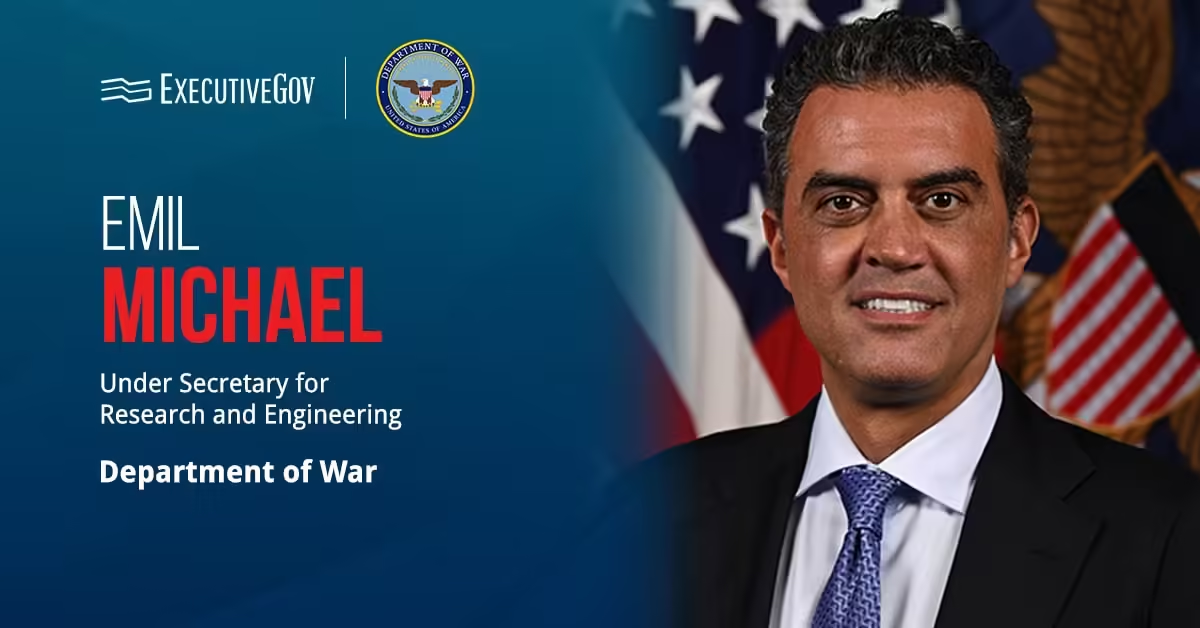
Emil Michaelunder secretary of war for research and engineering and a 2026 Wash100 awardee, said DOW is acting on the president’s call for faster technology development, stronger research security and domestic production.
“We are answering that call by dismantling barriers to commercialization, modernizing our labs, and ruthlessly securing taxpayer-funded research from foreign exploitation,” Michael said.
Joseph Jewellassistant secretary of war for science and technology, said sustaining the U.S. technological edge requires DOW to pair rapid innovation with program protection.
“As we accelerate how we move concepts from the lab to the field, we are equally committed to safeguarding federally funded research and ensuring domestic investments deliver tangible capabilities,” Jewell said.
What Other Science Initiatives Has DOW Announced?
The DOW initiatives are part of a broader package of over $6 billion in science initiatives that the White House unveiled at the Science: A New Golden Age Summit in Washington. The commitments come from federal agencies, companies, universities and philanthropic organizations.
The Office of the Under Secretary of War for Research and Engineering announced approximately $350 million in quantum computing initiatives to support national security. DOW’s Office of Strategic Capital extended an approximately $150 million conditional loan commitment to PsiQuantum to support the company’s domestic manufacturing and prototyping work.
The Defense Advanced Research Projects Agency moved Atom Computing, Diraq, IBM and IonQ to Stage C of its Quantum Benchmarking Initiative. In this final stage, DARPA will test whether each company’s proposed utility-scale quantum system can be built and work as designed.
Source: www.executivegov.com