




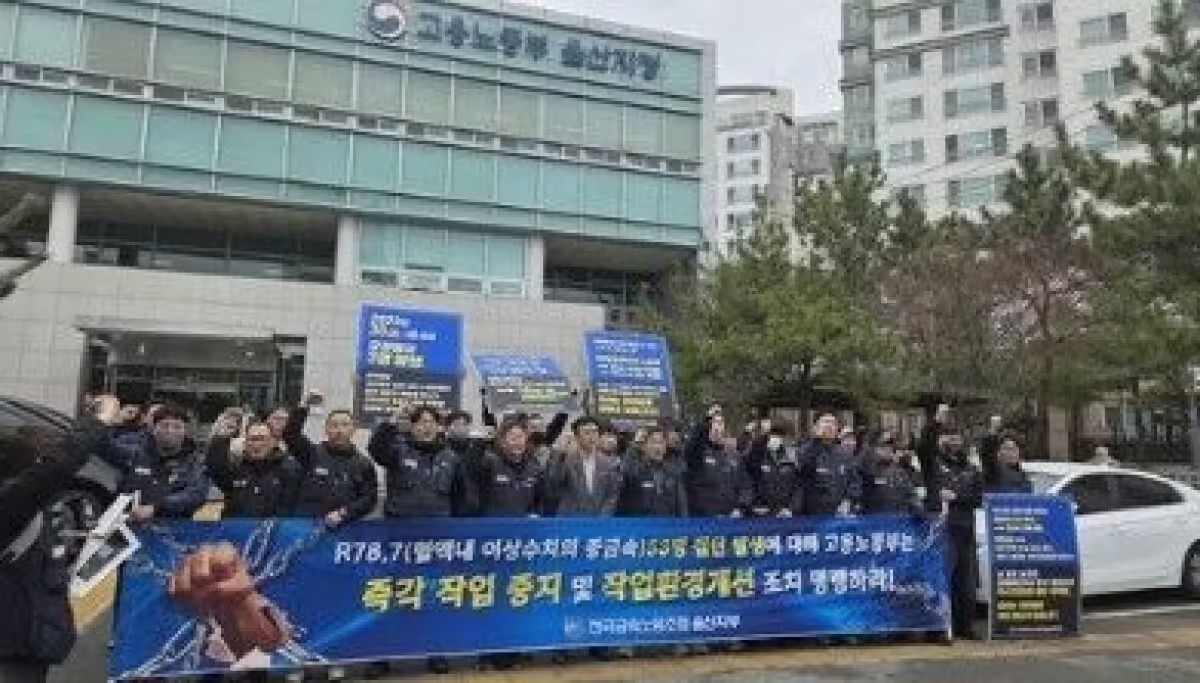

DN Automotive is under police investigation over allegations it disguised lead-removal injections as vitamin shots before workers’ health screenings.
Automotive battery maker DN Automotive is facing a police investigation over allegations that it administered lead-removal injections to workers under the guise of vitamin shots, the Ministry of Employment and Labor said Monday.
Separately, the ministry found 88 violations of the Occupational Safety and Health Act. It referred 68 of them for indictment and imposed 46.2 million won ($34,700) in administrative fines for the remaining 20.
The allegations centered on claims that DN Automotive regularly gave workers at its Ulsan plant chelation injections, which help flush heavy metals from the blood through urine, but falsely described them as vitamin shots ahead of mandatory occupational health screenings. Chelation therapy works by introducing drugs that bind to heavy metals and help the body flush them out.
The ministry’s investigation began after receiving a tip about suspected misconduct at DN Automotive’s Ulsan facility in late January.The allegations hinge on whether the company used chelation injections to suppress workers’ lead readings ahead of occupational health examinations.
The Labor Ministry referred DN Automotive to police on suspicion of obstruction of business after determining that the chelation injections administered just before workers’ health screenings may have interfered with government efforts to protect their health.
The Ulsan Metropolitan Police Agency is now handling the investigation.
Separately, the ministry ordered a suspension of lead-exposure operations from April 21 through May 7.
The ministry has broadened its inquiry to determine whether similar issues exist elsewhere in the battery industry. It is now inspecting 14 other battery plants.
The ministry also formed a nine-member expert panel on Thursday to investigate lead exposure at DN Automotive and recommend workplace improvements. The experts, nominated by labor, management and the government, will work in three groups that focus on health environment surveys, workplace inspections and epidemiological studies.
The state-run Korea Occupational Safety and Health Agency also approved an epidemiological study of DN Automotive’s entire current and former work force to determine how lead exposure may have affected their health.
President Lee Jae Myung called the alleged injections “a serious human rights violation” and ordered a thorough investigation and stern action, according to senior presidential spokesperson Kang Yu-jung on Monday.
Lee rebuked the company over allegations that it tried to pass workplace safety assessments in ways that endangered workers’ health, even after lead levels in its production process were found to exceed the permissible limit by more than five times. He noted that a company entrusted with workers’ safety must not be allowed to give them injections without fully explaining the risk of side effects and then seek to cover up their exposure to toxic substances.
Lee also ordered a thorough investigation into the extent of workers’ exposure to hazardous substances, why they were given the injections and whether the company had attempted to conceal their health screening results. The president also called for tough penalties if investigators find any wrongdoing.
The president also emphasized that the investigation must look beyond a single workplace and ordered officials to look closely at other workplaces for signs of similar attempts to circumvent safety rules or distort workers’ medical test results.
BY JEONG JAE-HONG [[email protected]]
This article was originally written in Korean and translated by a bilingual reporter with the help of generative AI tools. It was then edited by a native English-speaking editor. All AI-assisted translations are reviewed and refined by our newsroom.
Source: www.koreajoongangdaily.com

